The Ultimate Checklist: How to Vet a Paint Protection Film Installer in Calgary
To vet a PPF installer in Calgary, judge the installer over the film brand and confirm these essentials: wrapped edges (not patterns that stop 1/8" short), badges removed and reinstalled rather than cut around, a climate-controlled (68-75°F) dust-free bay, and modified plotter patterns so no knife ever touches your paint. Ask whether they offer both a 10-year manufacturer warranty and a shop workmanship warranty covering lifted edges. Treat a price that's far below competitors as a red flag for cheap film, skipped prep, or exposed-edge kits.
Investing in Paint Protection Film (PPF) is one of the smartest decisions you can make for your vehicle. However, the film itself is only half the equation. The skill, precision, and integrity of the installer are what truly determine the longevity and appearance of your investment. A mediocre film installed by a master will outlast and outshine a top-tier film installed poorly. This guide provides a comprehensive checklist to help you compare vetted Calgary PPF installers and find the perfect partner for your vehicle.
Why the Installer Matters More Than the Brand
Many car owners get caught up in brand names—SunTek, 3M, Stek. While high-quality film is essential, it is merely a raw material. Think of it like a suit: the finest Italian silk will look terrible if tailored by an amateur, while a decent fabric can look impeccable if fitted by a master tailor.
In the world of PPF, the "tailoring" involves complex curves, tension management, precise cutting, and obsessive surface preparation. A poor installation can lead to peeling edges, visible stretch marks, knife cuts in your paint, and dirt trapped under the film. Conversely, a great installation is virtually invisible, protecting your car without altering its appearance.
The Golden Rule
Always choose the installer over the film. A reputable installer will only carry films they trust and know how to work with effectively.
1. The "Wrapped Edge" Standard
One of the easiest ways to spot a high-quality installation is by looking at the edges.
Standard Kits vs. Custom Wraps
Most PPF software comes with "standard" patterns. These patterns are designed for speed and ease of installation, often stopping about 1/8th to 1/16th of an inch away from the edge of the panel.
Why is this a problem?
- Visible Lines: The edge of the film is clearly visible, disrupting the clean look of your car.
- Dirt Accumulation: Over time, dirt, wax, and road grime build up against this exposed edge, creating a dark, unsightly outline.
- Peeling Risk: Exposed edges are more likely to catch on wash mitts or pressure washer spray, leading to lifting.
The Professional Approach:
Top-tier installers customize these patterns, extending the edges so the film can be wrapped around the back of the panel (hood, fenders, doors). This creates a seamless, invisible finish where the film "disappears."
| Feature | Standard Installation | Wrapped Edge Installation |
|---|---|---|
| Edge Visibility | Visible line 1/8" from edge | Invisible (wrapped around back) |
| Dirt Buildup | High (collects wax/dirt) | None (protected edge) |
| Aesthetics | Obvious "clear bra" look | Factory-like finish |
| Protection | Partial coverage | Full edge protection |
2. Badge and Emblem Removal
Another critical differentiator is how the shop handles badges, emblems, and trim pieces.
The "Cut Around" Method
Lazy installers will leave badges on the car and cut the film around them.
- Leaves a visible gap around the emblem.
- Dirt and wax accumulate in the gap.
- High risk of razor marks on paint near the badge.
- Looks like a "sticker" rather than paint protection.
The "Removal" Method
Professional shops safely remove badges, install the film underneath, and then reinstall the badges.
- Seamless, continuous protection.
- No gaps for dirt to hide.
- Factory-fresh appearance.
- Requires more time and skill, but worth it.
3. The Facility: Cleanliness is Godliness
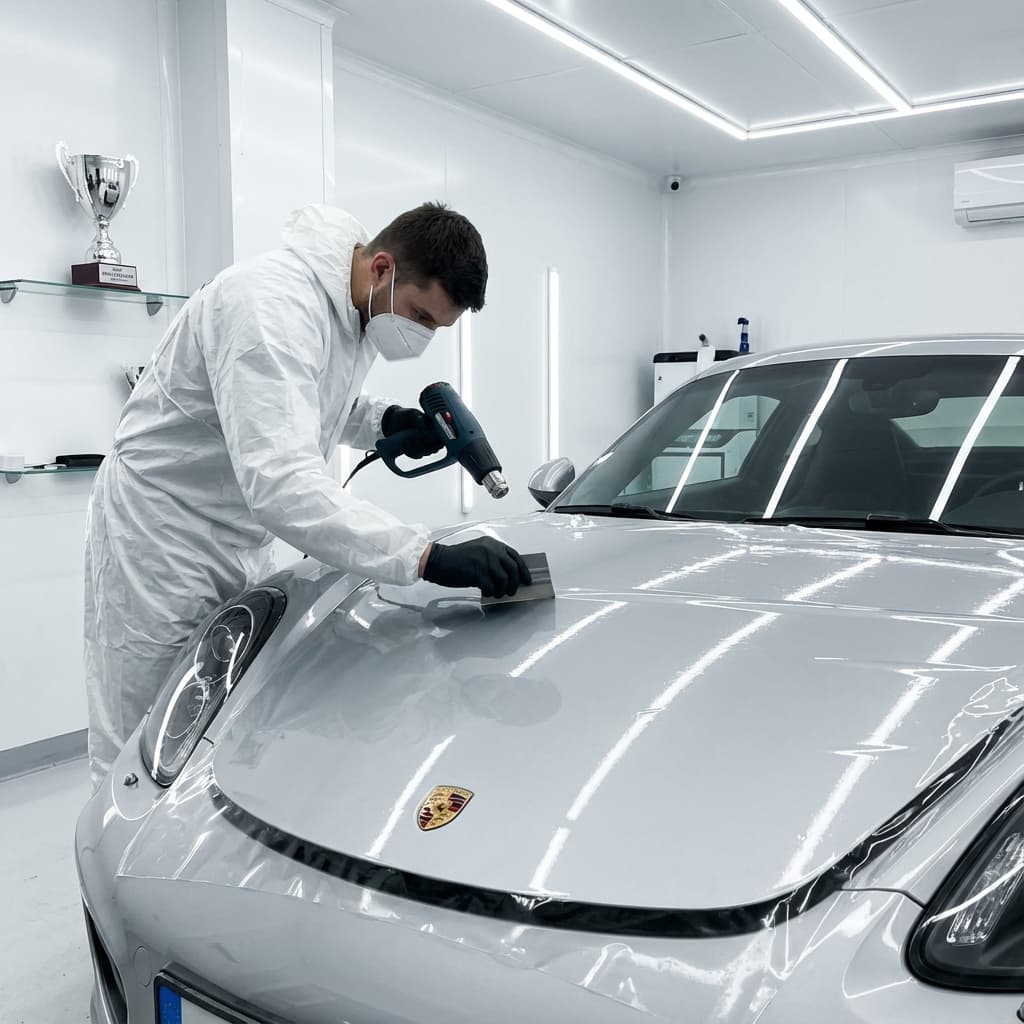
You can tell a lot about an installer by the state of their shop. PPF installation is a surgical procedure for your car; it requires a sterile, controlled environment.
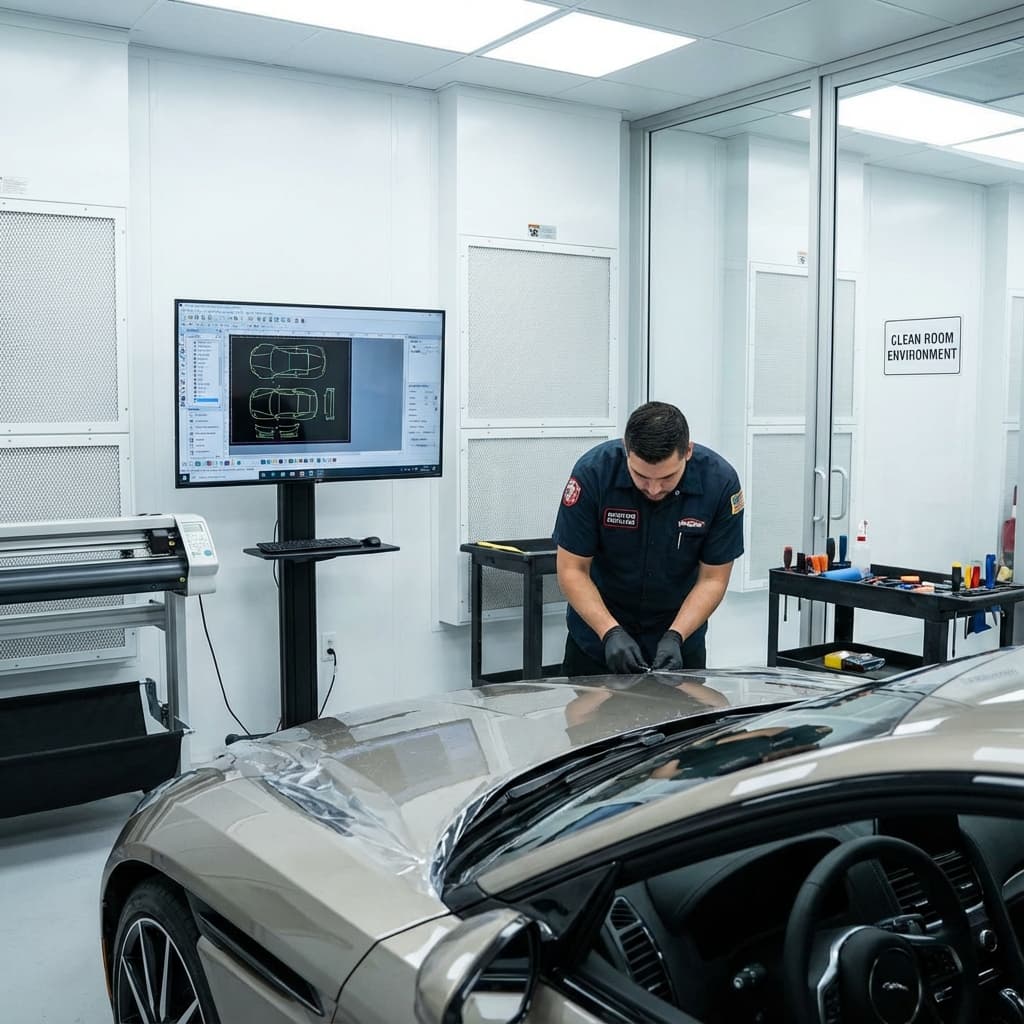
The "Clean Room" Concept
Dust is the enemy of PPF. Even a single speck of dust trapped under the film creates a permanent, unsightly bubble (often called a "silvering" effect).
- Temperature Control:
Films are sensitive to temperature. If it's too cold, the film is brittle and won't stretch properly. If it's too hot, the adhesive can become aggressive. A climate-controlled shop (68°F - 75°F) ensures the film behaves predictably for a perfect install.
- Lighting:
You cannot fix what you cannot see. High-intensity LED lighting from multiple angles is crucial for spotting imperfections, adhesive lines, or trapped debris before the film dries.
- Separation:
The installation bay should be physically separated from the wash bay, detailing area, or any grinding/sanding work. Water mist and dust particles travel easily.
4. Plotter vs. Hand Cutting: The Safety Debate
There are two main ways to cut PPF for a vehicle:
- Bulk/Hand Cutting: A large sheet of film is laid over the panel, stretched, and then cut to shape directly on the car using a razor blade.
- Plotter Cutting: A computer program designs the pattern, and a machine (plotter) pre-cuts the film before it ever touches the car.
Why We Prefer Modified Plotter Patterns
While some "old school" installers swear by hand cutting for better coverage, the risk is undeniable: cutting on the paint. Even the steadiest hand can slip or press too hard, scoring your clear coat. These cuts often aren't visible until years later when the film is removed, revealing rust or paint damage.
The Modern Hybrid Approach: We use advanced software to design the pattern but modify it digitally to extend the edges. This gives us the safety of a pre-cut kit (no knives on paint) with the coverage of a custom bulk install (wrapped edges). It is the best of both worlds.
5. Warranty: Who Stands Behind It?
Warranties can be confusing. There are typically two types you need to care about:
Manufacturer Warranty
Covers defects in the film itself (yellowing, cracking, bubbling, delaminating). Usually 10 years. Valid nationwide if you move.
Workmanship Warranty
Covers the installation (peeling edges, dirt specks, lifting). This is offered by the shop itself.
The Trap: Some shops offer a "Lifetime Warranty" that is filled with loopholes. Or, they may be a "fly-by-night" operation that won't be around in two years to honor it.
The Vetting Question: "If an edge lifts in 6 months, will you fix it for free? What is your policy on installation defects?" reputable shops will stand by their work without hesitation.
6. The "Too Good To Be True" Price
We all love a deal, but in the PPF industry, a significantly lower price usually means something is being sacrificed.
If Shop A quotes $2,000 and Shop B quotes $1,200 for the same coverage, ask yourself:
- Are they using a cheaper, lower-grade film?
- Are they skipping the decontamination prep steps (clay bar, iron removal)?
- Are they using standard kits with exposed edges instead of wrapping?
- Are they rushing the job to turn volume, rather than focusing on quality?
Correcting a bad PPF job is often more expensive than doing it right the first time, as you have to pay for removal, paint correction (to fix adhesive residue or cuts), and then re-installation.
Summary: Your Installer Vetting Checklist
Ideally, Don't Just Take Our Word For It
We encourage all our potential clients to stop by our SE Calgary PPF shop. Meet the installers, see the lights, check the temperature, and inspect a car we are currently working on. We believe transparency is the foundation of trust.
Schedule a Studio TourExperience The Best.
Don't let another commute compromise your vehicle. Get a quote from Calgary's Consumer Choice Award winner today.
Explore Our Services