Calgary's Altitude and UV: Why Your Car's Paint Fades Faster Here

Calgary sits at 1,048m altitude — UV intensity is ~10–12% higher than sea level, and Calgary gets 2,400+ sunshine hours per year. Your car's paint ages measurably faster here than in most Canadian cities. PPF blocks virtually 100% of UV at the paint surface. Quality ceramic coating blocks 95–99%. On dark-colored cars without protection, visible fading can appear as early as year 3–4.
Calgary has a reputation for sunny winters and brilliant summers — and that sunshine, combined with the city's elevation, creates one of the more UV-intense environments for car paint in Canada. Here's the science, and what it means for your vehicle. (For the worst UV stretch of the year — ten days of downtown sun-bake during early July — see our Stampede 2026 car protection guide.)
The Calgary UV Advantage — and What It Costs Your Paint
UV intensity decreases with atmospheric thickness. At sea level, the full column of atmosphere absorbs a meaningful portion of incoming UV radiation. At Calgary's elevation, the atmosphere is thinner — approximately 10–12% less UV is absorbed before it reaches your car's paint surface. That's not a rounding error; it's a real, cumulative difference over the life of a vehicle.
Annual Sunshine Hours — Major Canadian Cities
The Science: How UV Destroys Car Paint
There are two UV wavelength ranges that matter for paint degradation:
UV-A (315–400nm): The Oxidation Driver
UV-A penetrates clear coat and reaches the colour coat underneath. It breaks down the polymer chains in the paint, causing oxidation — this is what produces the chalky, faded appearance in older unprotected paint. UV-A is the dominant UV component at Calgary's altitude and accounts for the majority of long-term colour fade.
UV-B (280–315nm): The Clear Coat Attacker
UV-B is more energetic and damages the clear coat surface itself, causing hazing, micro-cracking, and chalking. It's the reason an unprotected car's clear coat looks "tired" and loses its gloss over time — the clear coat surface is being broken down at a molecular level. UV-B intensity increases more steeply with altitude than UV-A.
Paint Fading Timeline in Calgary by Colour
Darker pigments absorb more UV energy than lighter ones, which is why they fade faster. Here's a realistic timeline for unprotected vehicles in Calgary. It's worth noting that spring compounds this damage further: pollen season (April–June) introduces acidic compounds that etch into UV-weakened clear coat faster than they would on a protected surface. The full picture of how pollen affects car paint in Calgary explains exactly why UV damage and pollen etching accelerate each other when both hit unprotected paint.
Years Before Visible Fading on Unprotected Paint (Calgary UV Conditions)
How PPF and Ceramic Coating Block UV
| Protection | UV-A Blocking | UV-B Blocking | How It Works | Longevity |
|---|---|---|---|---|
| Premium Self-Healing PPF | ~100% | ~100% | UV absorbers embedded in film matrix — film is essentially opaque to UV | 7–10 years |
| 3M Pro Series PPF | ~100% | ~100% | Same UV absorber technology — blocks both UV wavelengths at film surface | 7–10 years |
| Professional Ceramic Coating | 95–99% | 95–99% | SiO2 layer is optically dense at UV wavelengths — blocks most UV before it reaches clear coat | 3–7 years |
| Carnauba Wax | 30–50% | 10–30% | Thin organic layer offers partial UV scatter — degrades within weeks | 6–12 weeks |
| Unprotected Clear Coat | 0% | 0% | No UV blocking — full exposure at Calgary altitude | Degrades continuously |
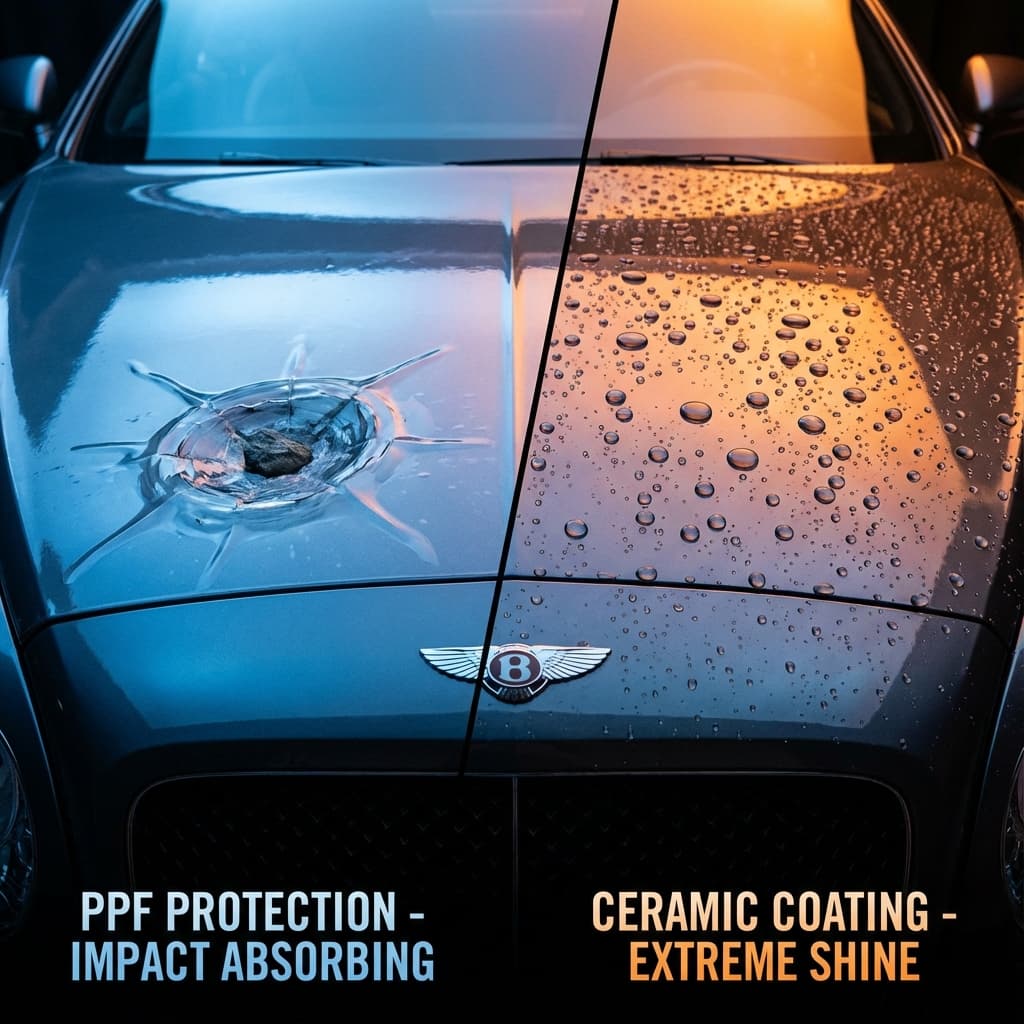
The critical point about PPF is that it doesn't just protect against stone chips — it creates a UV-opaque barrier that the paint surface never ages behind. At year 7, PPF-protected paint looks identical to year 1. The paint has simply not been exposed to UV for the entire period.
Ceramic coating's UV protection is excellent but degrades gradually as the coating thins over 3–7 years. When the coating reaches the end of its life, recoating restores full UV protection. This is why ceramic maintenance matters — a degraded coating left without refresh provides progressively less UV protection. For a realistic picture of what ceramic coating actually protects against and where its limits are, our dedicated guide covers the full range of expectations before you commit to a service.
What This Means for Calgary Car Owners
Timing your protection matters as much as choosing the right product. Fall is the ideal window to install or refresh UV protection before the long Calgary winter strips degraded coatings further — the fall car protection checklist walks through the full sequence of services and the optimal month for each.
Dark Car in Calgary? Protection Is Not Optional
A black or deep blue car without PPF or ceramic coating in Calgary will show visible UV fade by year 3–4. That's a $3,000–8,000 respray to restore — versus $799–1,299 for protection that prevents it entirely.
Garage Parking Helps — But Not Enough
Even garaged vehicles spend hours in Calgary sun on highways, in parking lots, and in driveways. The cumulative UV exposure from non-garage time is still sufficient to cause fading without protection — and the <Link href="/post/wildfire-smoke-ash-car-paint-calgary" className="text-primary-600 dark:text-primary-400 underline hover:no-underline">BC and Alberta wildfire smoke that drifts in every July and August</Link> compounds the damage by depositing alkaline ash on the same UV-weakened clear coat.
PPF Beats Ceramic for Maximum UV Protection
Both work well. PPF is effectively 100% UV blocking for the lifetime of the film. Ceramic coating is 95–99% and requires maintenance recoats every 3–7 years. For dark cars on a long-term ownership plan, PPF is the more complete UV solution.
Related Reading
Fall Car Protection Checklist
The optimal seasonal window to install UV protection before Calgary's winter strips degraded coatings.
Ceramic Coating Expectations
What ceramic coating realistically protects against — UV, contaminants, and the limits of SiO2.
Pollen & Car Paint Damage in Calgary
How spring pollen compounds UV-weakened clear coat and what actually prevents etching.
Block UV Before It Fades Your Paint
PPF from $599. Ceramic coating from $799. Full UV blocking from day one. 5.0-star rated. Free quote — no pressure.
Frequently Asked Questions
Experience The Best.
Don't let another commute compromise your vehicle. Get a quote from Calgary's Consumer Choice Award winner today.
Explore Our Services