Paint Correction Cost in Calgary (2026): Prices by Stage
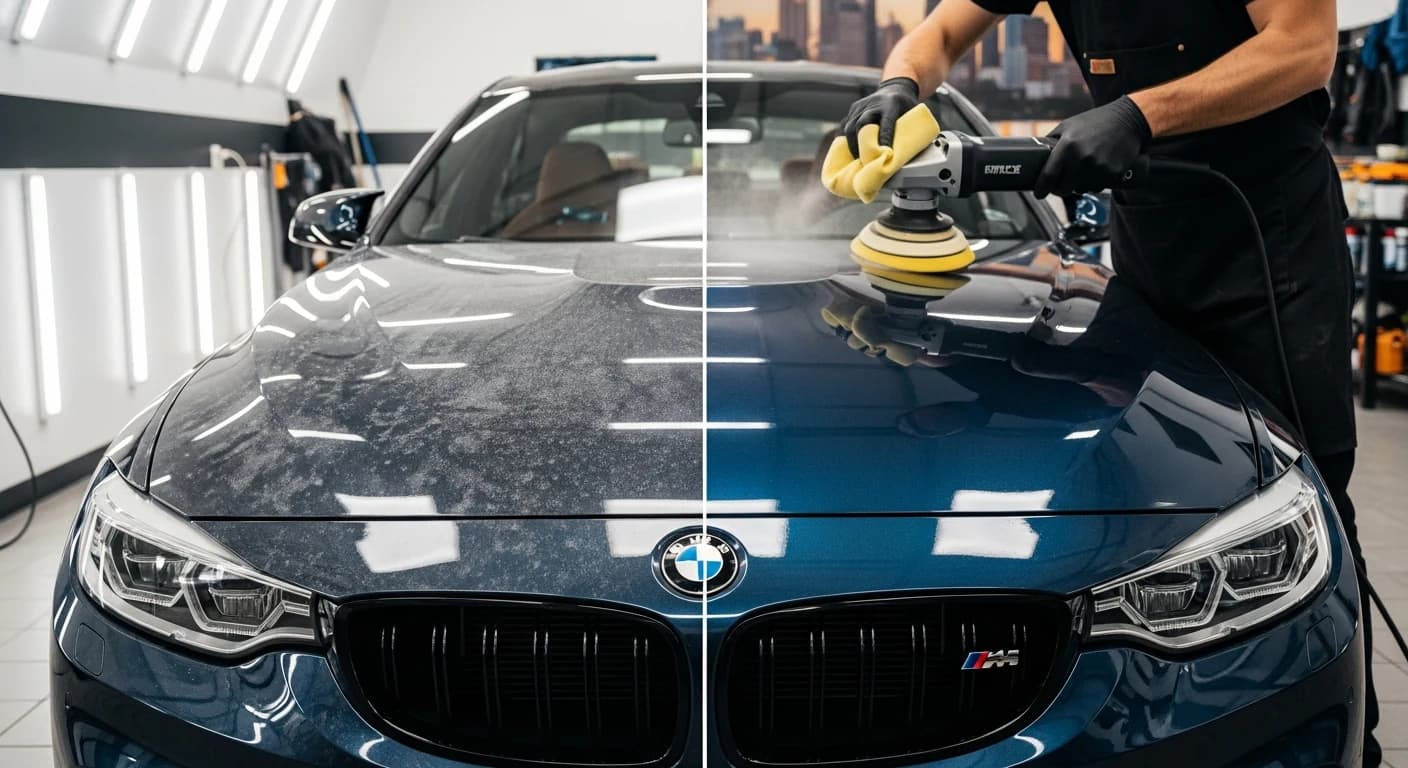
Calgary paint correction in 2026 falls into three tight price bands: single-stage $399–$699 (4–6 hours) for light swirls, two-stage $799–$1,299 (1–2 days) for hard-water etching and wildfire ash marks, three-stage $1,499–$2,499+ (2–4 days) for deep RIDS or auction-prep. A modern factory clearcoat is only 40–60 microns thick — each stage removes 1–6 microns, which is why most vehicles safely handle 2–3 lifetime corrections but not more. Correction is mandatory prep before ceramic coating on any age vehicle and before PPF on anything past 90 days from delivery; bundled up-front, it is included in every reputable Calgary ceramic or PPF quote rather than sold as a surprise line item. It cannot fix rock chips, deep scratches that catch a fingernail, or any damage past the clearcoat — those need touch-up, respray, or PPF, not polishing. Book a paint correction assessment in Calgary if you have visible swirls under sunlight, dulled gloss after hard-water spotting, or are stacking ceramic/PPF on top.
Every Calgary detailer's inbox in August looks the same: a photo of a black sedan under direct sunlight, the paint catching light in a spiderweb of swirls the owner never noticed all winter. Three months of pollen, bug splatter, hard-water sprinkler overspray, and wildfire ash have moved the finish from “a bit dull” to “visibly damaged.” The question is never should I correct it — it is which stage and what does that cost in a Calgary studio in 2026. This guide answers both, plus the six other calls we take every week: is DIY realistic, do I need it before ceramic, how long does it last, will it fix a rock chip, how do I vet a shop, and what should I look for in the quote.
Paint correction is the single most misquoted service in Calgary detailing — a $400 “polish” and a $2,200 “show correction” can appear on the same web page under the same headline, and most owners can't tell what separates them. Our studio quotes correction based on three inputs a paint-depth gauge tells us in five minutes: current clearcoat thickness, deepest defect depth, and the finish standard the owner wants after. That is what unlocks the honest single-vs-two-vs-three stage recommendation below.
Reviewed by Ahmed — Calgary PPF Pros, Consumer Choice Award winner 2026, protecting Calgary vehicles since 2021, 5.0★ rated across 96 Google reviews.
The Three Stages Explained
Paint correction stages are not marketing tiers — they are a physics count. The number refers to how many machine passes with progressively finer polishes are needed to remove defects from the clearcoat. Each pass removes a measurable amount of clearcoat and clears a measurable percentage of defect depth. Choosing the right stage is a trade-off between finish quality and the clearcoat you have left to work with over the vehicle's lifetime — a factory clearcoat that has been fully corrected three times is typically at the end of its correctable life and needs PPF or a respray for any further protection.
Which Paint Correction Stage Does Your Calgary Vehicle Actually Need?
Typical trigger: Type II hard-water etching, wildfire ash acid marks, mag chloride brine staining, holograms from a prior amateur polish, or the moderate marring found on a 2–4 year old daily driver. Defects catch under raking sunlight but not under a fingernail.
On a paint depth gauge, a modern factory clearcoat measures 40–60 microns thick — think of it as the “defect budget” the vehicle was born with. A single-stage removes about 1 µm, a two-stage 2–3 µm, and a three-stage with wet-sanding 4–6 µm. Manufacturers consider the film reliable down to about 25 µm; below that, UV protection to the base coat weakens and clearcoat failure (peeling, cracking, milkiness) becomes probable within a few years. This is the entire reason a good Calgary studio measures before it quotes — knowing you have 55 µm to work with vs 32 µm changes the recommendation. Our winter car protection guide covers what chinook freeze-thaw cycles do to Calgary paint.
When Correction Is Actually Needed — Calgary Triggers
Paint correction is warranted when defects are visible under raking sunlight or LED shop lights and a wash cannot remove them. Below are the seven triggers we see most often in Calgary — the majority of correction jobs in a given month come from just two or three of these, depending on the season.
Hard-water etching from sprinklers
Calgary tap water runs 240–340 ppm — one of the hardest municipal supplies in Canada per the City of Calgary water-hardness data. Two summers of sprinkler overspray on a driveway-parked vehicle moves the paint from Type I (surface deposit) through Type II (light etch) into Type III (bonded mineral inclusion). Type II is a two-stage fix; Type III sometimes needs the three-stage. More in the water-spot section of our ceramic coating maintenance guide.
Wildfire ash acid etching
BC and northern Alberta wildfire ash lands on Calgary paint every August–September, tracked in real time on the Environment Canada AQHI. When dew wets alkaline ash it turns acidic overnight and etches into the clear coat within 48 hours if not rinsed off. Post-wildfire remediation is one of the fastest-growing correction categories in our shop — see our contaminant-removal guide for the safe-wash approach before any correction.
PDR hail recovery colour blending
After paintless dent repair on hail-damaged panels, most panels need a light polish to blend the touched area with the rest of the vehicle. Any respray done alongside PDR needs 30 days to cure before correction and 60 days before ceramic — the sequencing matters and drives most of the April–June correction backlog. See our post-hail 48-hour playbook (and what happens after PDR and body-shop respray) for the full recovery sequence.
Mandatory prep before ceramic or PPF
Ceramic bonds to whatever is beneath it — any uncorrected swirl or water spot gets locked in for the 3–5 year coating life. PPF on 90-plus-day paint telegraphs deep swirls through the film. Every reputable Calgary quote bundles the correction stage into the up-front price; if a quote does not mention it, that shop is planning to lock defects under a $1,500 coating. See the exact correction-before-PPF hand-off for what the film requires from the paint underneath.
Dealer buffer trails on a new vehicle
Dealer prep shops finish every new vehicle with a machine polish that leaves visible holograms under direct sun — a “dealer polish” hides them for a few weeks with silicone-heavy dressings that wash off. A single-stage correction on a new vehicle within the first 90 days is the correct baseline before any ceramic or PPF stack.
Bug and pollen residue baked on hot paint
Calgary spring pollen and summer bug splatter contains acids and enzymes that etch clearcoat within 48–72 hours of hot-sun exposure. Cars parked at work through May–August pick up a hazy dulling that no wash removes — a single-stage polish restores it in a session.
Swirls from automatic car washes or prior amateur polish
Roller-brush touch washes are the fastest way to add swirl marks to a Calgary vehicle. A summer of weekly automatic-wash use adds visible swirls on any vehicle, and a prior DIY polish with a rotary tool often leaves holograms that require professional correction to remove.
The Correction Process — Step by Step
A professional Calgary paint correction is not a “polish” — it is a five-step diagnostic and remediation workflow, and the diagnostic steps matter as much as the machine time. This is the sequence a reputable studio follows on every quoted job, from a $499 single-stage to a $2,499 show-level three-stage.
Inspection + Depth Gauge
Hour 1Vehicle is washed and dried. Paint depth gauge takes 12+ readings per panel to record baseline clearcoat thickness. Defects are mapped under LED lighting to determine which stage the vehicle can safely handle.
Full Decontamination
Hour 2–3Iron remover to dissolve embedded brake dust and industrial fallout. Clay bar or clay mitt with lubricant to lift bonded contaminants. This step is what separates correction from a wash-and-polish.
Compounding Pass
Hours 4–10Machine polish with a cutting compound on a heavy-cut foam pad to remove clearcoat above the deepest defects. Panel-by-panel with IPA wipe between sections to verify progress.
Finishing Polish
Hours 11–14Softer pad with a fine finishing polish to restore optical clarity, remove compound hazing, and bring the panel back to mirror finish. This is where the depth-of-gloss comes from.
Final IPA Wipe + Protection
Hour 15IPA solution strips any polishing oils. Second inspection under LED lighting verifies defect removal. Ceramic coating or PPF applied within 24–48 hours to prevent immediate reintroduction of swirls.
Skipping the depth-gauge step is the single most common shortcut in the Calgary market — it saves the shop 15 minutes and shifts every risk onto the customer. Any quote for a two-stage or three-stage correction without a paint-thickness reading is guesswork. For the sequencing between correction and PPF specifically, our correction-before-PPF prep checklist covers the exact hand-off between the correction bay and the PPF bay.
Calgary 2026 Cost by Stage and Vehicle Class
Pricing bands below reflect what Calgary premium detailing studios actually charge in 2026 for the three most common vehicle classes. Dark-coloured luxury vehicles (especially black BMW, Mercedes, Porsche, and Range Rover) sit at the top of every band because they require slower work under LED lights to avoid holograms; light-coloured smaller vehicles sit at the bottom.
| Stage | Sedan / Coupe | Crossover / Small SUV | Truck / 3-Row SUV / Luxury |
|---|---|---|---|
| Single-Stage | $399 – $549 | $499 – $649 | $599 – $699 |
| Two-Stage | $799 – $999 | $899 – $1,099 | $1,099 – $1,299 |
| Three-Stage / Show | $1,499 – $1,899 | $1,699 – $2,099 | $1,999 – $2,499+ |
| Prep Polish Before PPF (add-on) | $249 – $349 | $299 – $399 | $349 – $449 |
Bundled pricing — correction plus ceramic coating, or correction plus PPF — usually discounts the correction line by 15–30% because the shop is already committed to the vehicle for the coating or film install. That is why a stand-alone $999 two-stage often becomes $749 inside a $2,300 ceramic quote, and why an isolated correction quote for a used vehicle can feel expensive next to bundled pricing on a new-car protection stack. For the full ceramic quote context, our ceramic coating packages (correction included) page lays out the bundled tiers.
Paint Correction — Pros and Cons
The Pros
- Restores the factory finish (or better) — a well-corrected panel is optically clearer than a new vehicle straight off the dealer lot
- Mandatory prep unlocks the full value of ceramic coating and PPF — protection over corrected paint lasts its full advertised life
- Increases resale value materially — a corrected + ceramic-coated used vehicle photographs and shows better than an equivalent uncorrected competitor
- Permanent by definition — the corrected surface cannot un-correct, only the protection on top wears
- Diagnoses paint health early — the depth-gauge step catches thin panels, prior respray work, and clearcoat failure before they become expensive surprises
The Cons
- Removes a measurable amount of clearcoat every time — most vehicles have a lifetime budget of 2–3 corrections before the film gets too thin
- DIY attempts routinely damage clearcoat on edges and curved panels — a single burn-through respray costs more than three professional corrections
- Correction alone without protection re-swirls within 2–3 months of routine washing — the follow-up ceramic or PPF is what makes the spend last
- Cannot fix rock chips, deep scratches that catch a fingernail, or any damage past clearcoat — those require touch-up, respray, or PPF over the panel
- Cheaper Calgary shops quoting two-stage prices for single-stage work is common — the quote language and stage count needs to be pinned down before booking
Bottom Line
Calgary paint correction in 2026 is a physics-and-time trade-off with three honest tiers: $399–$699 single-stage for light swirls and new-vehicle prep, $799–$1,299 two-stage for hard-water etching, wildfire ash, and moderate marring on daily drivers, and $1,499–$2,499+ three-stage for deep RIDS or auction-prep. The decision is best made with a paint-depth gauge in the hand of a technician who quotes stages by micron impact rather than by round-number pricing tiers. Correction is mandatory prep before ceramic on any age vehicle and before PPF on anything past 90 days from delivery — bundle it into the up-front quote and never let a shop lock uncorrected defects under a $1,500 coating.
Considering paint correction ahead of a ceramic or PPF install? Our Calgary studio quotes correction with a paint-depth gauge reading on every vehicle and bundles the stage cost inside every ceramic coating package and paint protection film quote — no surprise line items at delivery. Book a paint correction assessment in Calgary for a stage recommendation matched to your vehicle's current clearcoat thickness, colour, and the protection you plan to stack on top.
Related Reading
How to Maintain Ceramic Coating in Calgary
Washing a coated car, winter care, and how to deal with hard-water spots before they etch.
Paint Correction Before PPF Install
The exact hand-off between the correction bay and the PPF bay — what the film requires from the paint underneath.
Remove Bugs, Tar, Sap & Bird Droppings Safely
How to lift contaminants without scratching the paint, so the correction bay is the last resort, not the first.
Frequently Asked Questions
How much does paint correction cost in Calgary in 2026?
What is the difference between single-stage, two-stage, and three-stage paint correction?
When do I actually need paint correction versus just a wash and wax?
Is paint correction required before ceramic coating or PPF?
How long does paint correction last in Calgary?
Can I do paint correction myself at home in Calgary?
Does paint correction remove rock chips or deep scratches?
How do I choose a paint correction shop in Calgary?
Experience The Best.
Don't let another commute compromise your vehicle. Get a quote from Calgary's Consumer Choice Award winner today.
Explore Our Services