Wildfire Smoke & Ash on Car Paint: Calgary 2026 Guide
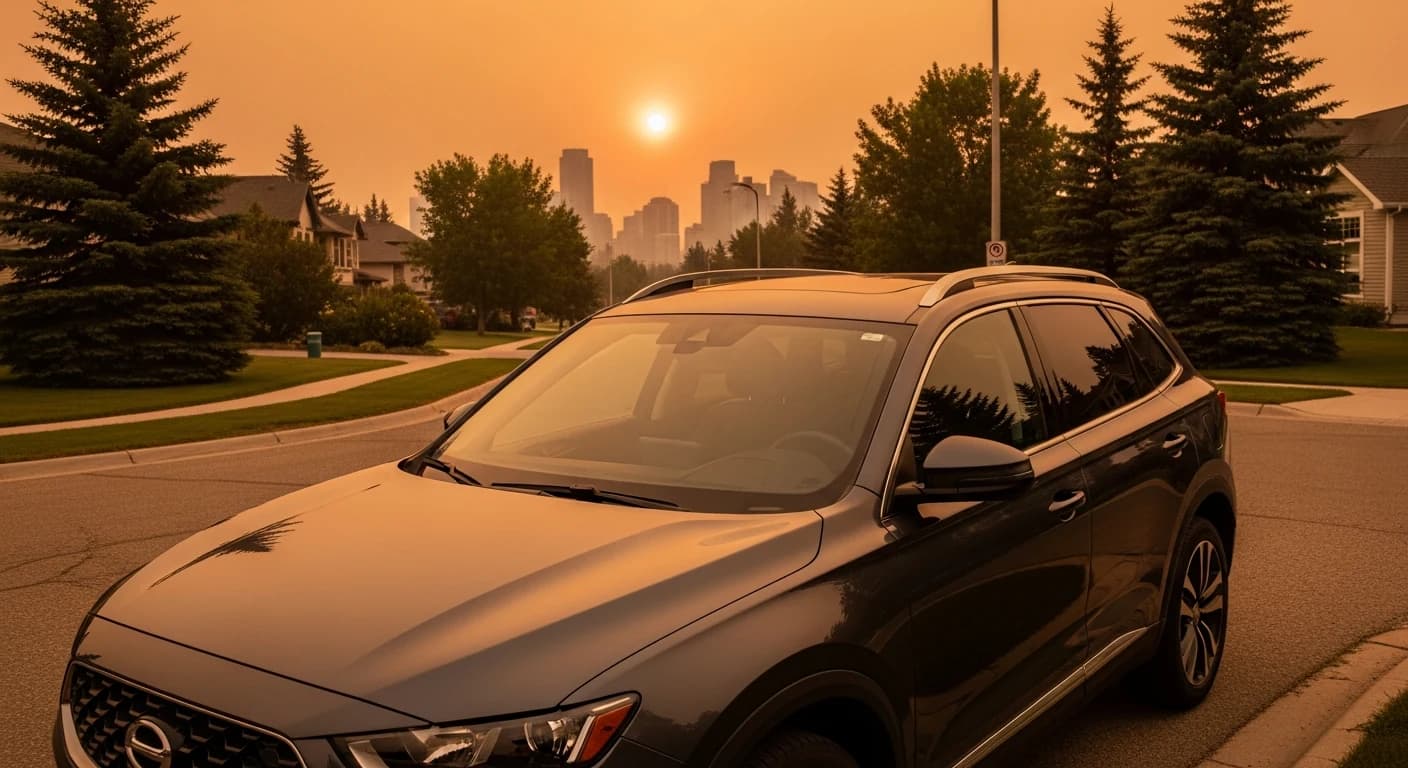
Wildfire ash is alkaline (pH 9–11) and begins chemically etching unprotected Calgary clear coat in 24–48 hours once panel temperature exceeds 40°C — typical for any dark vehicle parked in late July or August. Calgary now averages 15–25 smoke-impacted days per year between June and September from BC and northern Alberta fires. Never wipe ash dry — the silica content acts like sandpaper and will swirl-mark your paint in one pass. Touchless rinse first, pH-neutral wash second, polish only if you see haze afterward. The protection sweet spot: ceramic coating refresh by mid-June ($799–1,499, 2–5 year lifespan) with PPF on the front impact zones for outdoor parkers. Upgrade your cabin air filter to HEPA-grade ($35–80) before the worst smoke arrives.
Every July, the same pattern hits Calgary detail shops. The wind shifts, a BC interior fire dumps its column across the Rockies, and within twelve hours AQHI jumps two bands and the sunset goes orange. By morning, every horizontal surface in the city — sidewalks, patio furniture, the hood of your car — is dusted with fine grey ash. This guide is the field manual we give Calgary drivers when they ask how much damage a smoke week actually does to their paint, and exactly which protection products solve it.
Why Calgary Gets BC Wildfire Smoke (and When)
Calgary's geography makes it a structural recipient of BC wildfire smoke. Prevailing summer winds at the mid-troposphere level (700–500 hPa) flow west to east across the Rockies, and any large fire complex in the BC interior — the Cariboo, Chilcotin, Thompson-Okanagan, Kootenay, or the Boundary regions — sends a smoke column straight over the Continental Divide and onto the Alberta foothills within 12–24 hours. The timing overlaps almost perfectly with the back half of Calgary's cottonwood and tree-sap season, which means a single panel can be carrying acidic sap residue and alkaline ash residue at the same time — opposite ends of the pH scale, attacking the clear coat from both sides. Northern Alberta fires in the Wood Buffalo, Whitecourt, and Slave Lake zones reach Calgary on a different pattern (a northerly draw behind a passing low) but the result is the same: a measurable spike in PM2.5 and a visible ash layer on outdoor surfaces.
Environment and Climate Change Canada's AQHI archive shows Calgary now averages 15–25 wildfire-smoke-impacted days per year between June and September. The 2023 season was a record-breaker that pushed PM2.5 readings into the "very high risk" band (AQHI 10+) for multiple consecutive days. By mid-May 2026, Whitecourt and Woodlands County were already under evacuation order and BC interior fires were burning — meaning ash on Calgary paint is no longer an unusual event but a structural feature of the summer driving environment.
Within Calgary, ash settles unevenly. The downtown bowl and the Bow and Elbow river valleys (Inglewood, Bridgeland, Sunnyside, Mission, Eau Claire) trap smoke longer than the higher-elevation ridges (Edgemont, Hidden Valley, Aspen Woods, Signal Hill) where prairie wind clears it faster. Commuter corridors — Deerfoot, Crowchild, Glenmore, and Stoney Trail — see the heaviest cumulative deposition because vehicles sit in slow traffic with the panel baking. Outdoor-parked vehicles in Beltline street stalls, East Village surface lots, and suburban driveways in Mahogany, Auburn Bay, and Cranston catch the full overnight dew-and-ash cycle that does most of the etching damage — SE owners can see the Mahogany and Auburn Bay protection menu built for those lake-community driveways.
The Real Risk Pattern
A car that catches a single smoke day and gets a touchless rinse within 24 hours: low risk, no permanent damage. A car parked outdoors during a four-day smoke event (AQHI 7+) with no rinse and a couple of dew-and-bake cycles: high risk of permanent clear-coat etching that needs polishing or paint correction to remove. The bonding reaction is exponential with both time and panel temperature, so the difference between a Friday catch and a Monday-evening one is far larger than you would expect.
The Chemistry: Why Alkaline Ash Etches Clear Coat
Most Calgary drivers think of paint damage in terms of acid: bug splatter, pollen, tree sap, bird droppings. Wildfire ash is the opposite. Wood combustion produces a residue dominated by mineral oxides — calcium oxide, potassium oxide, magnesium oxide — that hydrate into hydroxides on contact with atmospheric moisture, pushing the surface pH into the 9–11 range. Modern automotive clear coats are formulated for a roughly 5–9 pH tolerance window; sustained contact with anything above pH 9 begins to break down the polymer crosslinks at the surface, dulling the gloss and creating microscopic etch pits.
What makes wildfire ash particularly destructive is the second ingredient — microscopic silica and aluminosilicate particles from soil, vegetation, and structures pulled into the smoke column. These act as a fine abrasive that does no damage sitting still but tears swirl marks into the clear coat the instant anything (a microfibre cloth, a chamois, even a flannel cover slipping in the wind) drags across the panel. This is the same physical mechanism that the spring pollen damage pattern relies on — but pollen is at the acidic end of the pH scale, while wildfire ash attacks from the alkaline end of the same window. Calgary's altitude compounds the problem indirectly: at 1,048 metres, UV intensity is roughly 10–12% higher than at sea level, which weakens the clear-coat polymer matrix over years and makes the surface more vulnerable to any chemical attack — alkaline ash included. UV doesn't drive the alkaline hydrolysis reaction itself (that's heat and moisture), but a UV-aged clear coat etches faster and deeper than a fresh one. See Calgary's UV intensity at altitude for the underlying numbers.
The 24–48 Hour Etch Window
The single most important fact about wildfire ash and Calgary summer paint is the timeline. Fresh dry ash on a cool panel is mostly inert — left in shade, it can sit for several days without permanent damage if the air stays dry. The chemistry only turns destructive when two things enter the equation: heat (panel temperature above 40°C, typical for any dark vehicle in July sun) and moisture (morning dew, a passing shower, or even high humidity at night). Once a dew cycle dissolves the alkaline minerals into a thin liquid film on the clear coat, the etching reaction accelerates rapidly.
Dry deposition (0–12 hours)
Ash settles onto every horizontal surface. While the ash is fully dry and the panel is cool, no chemical reaction occurs. A high-pressure touchless rinse during this window removes essentially all of the contaminant with zero risk. This is the easy fix window.
Wet activation (12–48 hours)
Overnight dew or morning humidity hydrates the alkaline minerals into a liquid film. As the sun heats the panel above 40°C, the pH-9-to-11 solution begins reacting with the clear coat surface. Removal still works with a touchless rinse plus pH-neutral wash, but any dry wiping at this stage causes swirl marks from the silica content. Most damage happens in this window.
Permanent etching (48+ hours)
Repeated wet-and-bake cycles drive the alkaline reaction deeper into the clear coat, leaving a hazy etch ring in the contact zone. Even after the visible ash is fully washed off, the etching remains. Light etching responds to a one-step machine polish; deeper etching needs a multi-step paint correction. After three or more dew cycles, the damage is usually permanent without polishing.
What Protection Actually Works (and What Doesn't)
The protection landscape for wildfire ash maps cleanly onto the same hierarchy as other Calgary summer contaminants — the underlying physics is hydrophobicity and surface chemistry. How ceramic coating's hydrophobic surface works is the same mechanism that protects against pollen, sap, and bird droppings, and it works on alkaline ash for exactly the same reason: the contaminant cannot make intimate contact with the paint's pore structure. What changes with wildfire smoke specifically is that contact times are longer (smoke events typically run 3–7 days) and the chemistry is more aggressive, which exaggerates the gap between unprotected and protected surfaces.
| Surface | Safe Contact Window | Etch Risk | Removal Difficulty |
|---|---|---|---|
| Bare clear coat | < 24 hours dry, < 6 hours wet | High after 48hr in sun | Touchless rinse + clay-bar + possible polish |
| Carnauba wax (4–8 weeks old) | 24–48 hours | Moderate — wax degrades fast in heat | Touchless rinse + reapply wax after |
| Synthetic sealant (3–6 months old) | 48–72 hours | Moderate | Rinse + pH-neutral wash usually sufficient |
| Ceramic coating (in lifespan) | 5–10 days | Low — sits on top of coating | Standard car wash, single pass |
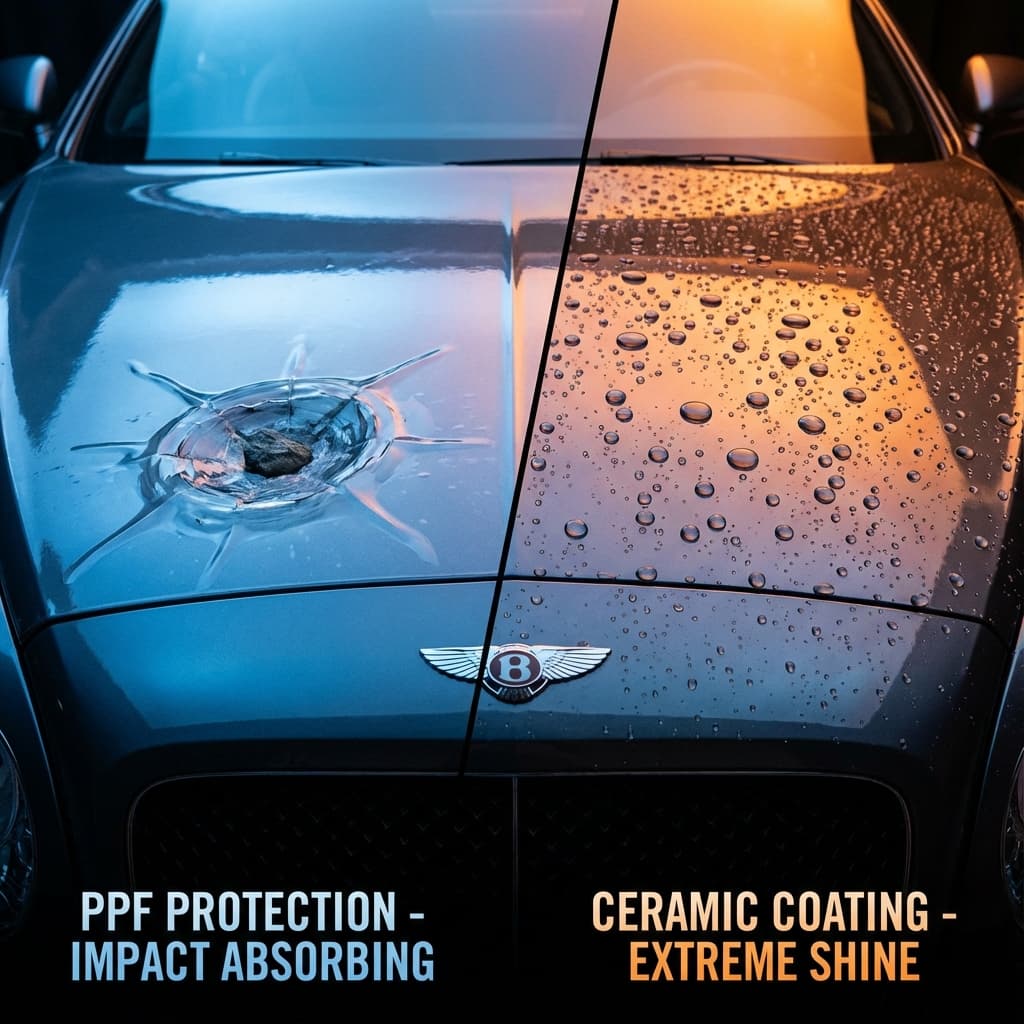
| PPF (our flagship PPF / 3M Pro Series) | Indefinite (paint protected) | Very low — film absorbs the chemistry | Standard wash, no solvent needed |
The Pros
- Pre-smoke-season ceramic coating refresh (book by mid-June) provides 2–5 year passive protection
- Front-end PPF (hood, bumper, fenders) protects the panels most exposed to ash and dew bake-on
- Touchless rinse within 24 hours of any AQHI-7+ smoke day breaks the polymerization cycle
- Garage parking during peak smoke weeks eliminates 90% of the exposure
- HEPA-grade cabin air filter ($35–80) protects passengers and reduces interior ash deposition
The Cons
- Dry-wiping ash with a chamois or microfibre — silica content guarantees swirl marks in one pass
- Brush-style automatic car washes — drag bonded ash and grit across the rest of the panel
- Acidic wheel cleaners on ashy paint — pH crash reactions can flash-etch into the clear coat
- Waiting out a multi-day smoke event without any rinse — every dew cycle deepens the damage
- Running standard summer washer fluid in heavy smoke — it streaks badly and embeds particulate into wiper rubber
The 24-Hour Ash Removal Procedure (Bare Paint)
If you catch ash within 24 hours of deposition on unprotected paint, the safe removal procedure is short. The same procedure works for the lightest tree sap and pollen loads — we covered the underlying logic in the Calgary touchless wash procedure, and it transfers directly here.
- Pre-rinse from a distance. Stand at least 18 inches from the panel and rinse top-down with the highest-pressure setting your coin-op or pressure washer offers. The goal is to lift the dry ash off the surface before any cloth touches it. Two full passes.
- Switch to a pH-neutral foam. A pre-soak with an alkaline-neutralizing pH-7 car shampoo (CarPro Reset, Adam's Car Shampoo, Meguiar's Gold Class) chemically deactivates any remaining alkaline residue before mechanical washing begins. Let the foam dwell 3–5 minutes.
- Two-bucket hand wash. One bucket of clean rinse water, one bucket of fresh soap solution. A grit guard in each. Use a clean microfibre mitt and wash in straight lines — never circles. Rinse the mitt in the clean bucket between every panel.
- Final rinse and dry by air or vacuum. Never towel-dry an ashy car the first time after a smoke event. Either drive it gently around the block to air-dry, or use a leaf-blower / pet dryer to push the water off. Microfibre drying is fine on the second wash a few days later, once you're confident no abrasive residue remains.
- Inspect at a 45° angle in direct sun. Any remaining hazy spot is etched clear coat. Light etching responds to a one-step compound + finishing pad; deeper damage needs a full multi-stage correction (stages, cost, timeline).
- Reapply wax or sealant if removed. The alkaline foam may strip the top layer of wax or older sealant. Spot-reapply your maintenance product after the area dries — or use this as the trigger to book a ceramic coating.
During an Active Multi-Day Smoke Event
If a smoke event is forecast to last 3+ days and you cannot garage the vehicle, a simple 60-second pre-rinse from a garden hose every 24 hours is the single highest-leverage action you can take. You don't need soap, you don't need a wash mitt, you don't need to dry the car — just knock the ash off the horizontal surfaces before the next dew cycle. This single habit eliminates roughly 80% of the smoke-season etch risk for outdoor parkers.
Cabin Air, Filters, and Things Most Drivers Forget
Paint is only half the story. A bad smoke week stresses three systems most Calgary drivers ignore until they cause problems: the cabin air filter, the engine intake filter, and the windshield washer system. All three are cheap to address before the worst of August arrives.
| Component | Smoke-Season Action | Cost | When to Service |
|---|---|---|---|
| Cabin air filter | Upgrade to HEPA or activated-carbon | $35–80 | Replace at start of smoke season, then again after any week with 3+ AQHI-8 days |
| Engine air filter | Inspect for grey ash deposits | $20–60 | After any multi-day heavy smoke event; replace if visibly loaded |
| Washer fluid | Switch to all-season / fine-particulate rated | $8–14 | Top up before smoke season; refill weekly during smoke weeks |
| Wiper blades | Inspect for embedded grit | $30–60 | Replace if you see streaking after a smoke event |
| HVAC recirculation setting | Use RECIRC during smoke days | Free | Reduces PM2.5 cabin infiltration by ~70% |
The Calgary Summer Protection Stack (2026 Pricing)
For drivers who park outdoors and commute daily through July and August, the protection economics favour a stack rather than any single product. Here's what we typically recommend for a Calgary daily-driver heading into wildfire season, in priority order.
| Layer | What It Solves | Cost (2026 Calgary) | Lifespan |
|---|---|---|---|
| Ceramic coating (full vehicle) | Ash, sap, pollen, bird droppings, UV fade, easier washing | $799–1,499 | 2–5 years |
| Front-end PPF (hood, bumper, fenders) | Ash etching on highest-temp panels, gravel chips, bug splatter | $1,299–2,499 | 8–10 years |
| Maintenance ceramic spray top-up | Restores hydrophobics worn by consecutive smoke days | $60–90 per visit | 3–4 months |
| HEPA cabin air filter upgrade | PM2.5 protection for passengers | $35–80 (DIY) | One smoke season |
| Garage parking (where available) | Eliminates 80–90% of exposure entirely | Free–$150/mo | Indefinite |
For the underlying logic on why ceramic outperforms wax across an entire Calgary summer, see our ceramic vs wax comparison. The most popular combination — ceramic on the body, PPF on the front impact zones — is what we call the PPF + ceramic Halo Package. Ask about pre-smoke-season protection bundles →
A Daily Routine for Smoke-Season Calgary
For Calgary drivers who simply cannot park indoors between June and September, a structured short daily routine prevents almost all of the avoidable damage:
- Check AQHI and smoke forecast before you leave the house. The free WeatherCAN app from Environment Canada gives Calgary-specific hourly PM2.5 readings, and the FireSmoke Canada / BlueSky Canada model shows the 24–48 hour forecasted smoke plume so you can see whether a transport event is heading over the Rockies. AQHI 7+ in Calgary means visible ash deposition is likely by evening.
- RECIRC the cabin on smoke days. Switch the climate control to recirculation mode whenever AQHI exceeds 5. Cuts incoming PM2.5 by roughly 70%.
- Pre-rinse every 24–48 hours during active smoke weeks. Sixty seconds with a garden hose, top down, panels first. No soap, no drying. This is the highest-leverage habit.
- Skip brush-style car washes entirely until smoke season ends. The brushes will grind embedded silica into your clear coat. Touchless or hand wash only.
- Weekly pH-neutral hand wash. Saturday morning is fine. Wash before the panel heats — early shade or before 10 AM in midsummer.
- End-of-season ceramic top-up. Book a maintenance ceramic spray application in mid-September after smoke season tapers. Restores anything the summer degraded.
Related Reading
Tree Sap & Cottonwood Damage
The June–August acid-etch threat that overlaps the back half of cottonwood season with the front half of smoke season.
Bird Droppings & the 48-Hour Rule
Why magpie droppings etch Calgary clear coat faster than ash, and the protection window that actually matters.
Calgary Altitude & UV
Why higher-altitude UV accelerates every summer contaminant reaction, including alkaline ash etching.
External references: Environment and Climate Change Canada — Air Quality Health Index and Alberta Wildfire — current status dashboard.
Pre-Smoke-Season Protection, Booked Before Mid-June
Free 15-minute consultation. We'll recommend the right combination of ceramic coating, paint protection film, and pre-summer detail for your vehicle, parking pattern, and commute. Calgary AB. Consumer Choice Award winner. 10-year manufacturer-backed warranty.
Frequently Asked Questions
Experience The Best.
Don't let another commute compromise your vehicle. Get a quote from Calgary's Consumer Choice Award winner today.
Explore Our Services