Yes — paint protection film is tax-deductible in Alberta to the extent your vehicle is used for business. For most Calgary realtors, contractors, fleet operators, and rideshare drivers, a $1,499–$2,499 full-front PPF install is capitalized as an addition to the vehicle's Class 10 (30% declining-balance CCA) cost and depreciated over the vehicle's holding period. Installs of $500 or less can be expensed in-year as a vehicle repair. GST/HST registrants recover the 5% GST as an Input Tax Credit on the business-use portion. On a typical $2,500 install at 70% business use, the combined CCA tail plus GST ITC delivers roughly $620 in cumulative tax benefit — a 25% effective discount on the install. The deduction is highest on Class 10 motor vehicles (pickups configured for hauling), capped on Class 10.1 passenger vehicles above the ~$37K ceiling, and requires a contemporaneous mileage log to survive a CRA review. This is general guidance — confirm your specific situation with your accountant.
One of the most common questions in our intake every spring is “is PPF tax-deductible?” — almost always from a Calgary realtor about to wrap a new Lexus, a residential contractor protecting a fresh F-150 work truck, an Uber driver doing 35,000 km a year on Stoney Trail and Deerfoot, or an incorporated consultant capitalizing a luxury sedan into the business. The honest answer is yes, and the dollar-figure math is meaningful — typically a 20–35% effective discount on the install once the CCA tail and GST Input Tax Credit are run through. This guide is the 2026 Calgary playbook on how the deduction actually works, which CRA class your vehicle and its PPF sit in, and the documentation you need to keep so the deduction holds up in a review.
The business-vehicle conversation in our bay falls into four repeatable patterns. A realtor arrives with a new SUV the week before a brokerage launch and wants the invoice formatted so the accountant can capitalize it cleanly. A residential framing contractor brings in a new F-150 with a tool-laden bed and asks whether his Class 10 motor-vehicle status (more than 50% for hauling) changes the math — it does, in his favour. A rideshare driver with a Toyota Camry hybrid drops off the car after a Friday-night shift and picks it up Monday morning with a full-front PPF and a printed invoice that names every coverage zone for the mileage-log defense. An incorporated consultant in for a luxury sedan asks whether the Class 10.1 cap is going to limit the deduction — sometimes it does, sometimes the vehicle just barely qualifies for Class 10, and the accountant's reading of the spec sheet matters. We do not give tax advice in our bay, but we do format the install invoice the same way every accountant in the city wants to see it.
Reviewed by Mostafa — Calgary PPF Pros, 4× Consumer Choice Award winner, serving Calgary realtors, contractors and fleet operators since 2021. This article is general guidance for Alberta drivers — always confirm with a CPA before filing.
Who Actually Qualifies to Deduct PPF in Alberta
The deduction is available to anyone who uses a vehicle to earn business or commission income, with the dollar amount of the deduction scaled to the business-use percentage. In our 2026 Calgary intake, the four most common qualifying profiles look like this.
Sole proprietors filing a T2125 (self-employed)
Realtors, contractors, consultants, photographers, rideshare and delivery drivers, mobile-trade operators. PPF capitalized as an addition to the vehicle's Class 10 or Class 10.1 cost, depreciated at 30% declining-balance, claimed on Line 9936 (CCA) and Line 9281 (Motor Vehicle Expenses) of the T2125. Mileage log is mandatory.
Incorporated small businesses (CCPCs)
Construction companies, professional corporations, consulting firms, e-commerce operators with delivery vehicles, fleet operators. PPF capitalized into the corporation's vehicle asset pool, depreciated through corporate CCA, fully recovers GST ITC at 5%. Cleanest treatment of the four profiles because the corporation owns the vehicle outright.
Commissioned employees with a signed T2200
Pharmaceutical reps, commission-based sales reps, account managers required by their employer to use a personal vehicle for client work. The employer signs Form T2200 (Declaration of Conditions of Employment) and the employee claims motor vehicle expenses on Form T777, including the prorated PPF as a CCA addition. The T2200 is non-negotiable — without it, no claim.
Rental property owners using a vehicle for property management
Calgary landlords with multiple rental properties (especially those managing them personally rather than through a property manager) can claim the business-use portion of vehicle expenses including PPF on Form T776 (Statement of Real Estate Rentals). Lower business-use percentages typical here (most landlords run 10–25% business use), so the dollar benefit is smaller, but the deduction is legitimate.
Capitalize or Expense? The $500 Decision Point
CRA's general framework on motor-vehicle improvements is to capitalize anything that extends the useful life or increases the value of the vehicle, and to expense anything that is a routine repair or maintenance item. The practical $500 threshold most accountants apply means a small partial-front install at the low end may be expensed in-year, but every Calgary PPF Pros full-front, full-front-plus-rocker, or full-body install is unambiguously a capital addition.
| Install Type | 2026 Calgary Price Range | CRA Treatment | Where It Shows Up |
|---|---|---|---|
| Partial Front Touch-Up (bumper only) | $399–$599 | May be expensed if under $500 | T2125 Line 9281 / T777 motor vehicle expenses |
| Partial Front (bumper + leading hood) | $899–$1,399 | Capitalize as CCA addition | Added to Class 10 or 10.1 vehicle pool |
| Full Front (hood, fenders, bumper, mirrors) | $1,499–$2,499 | Capitalize as CCA addition | Added to Class 10 or 10.1 vehicle pool |
| Full Front + Rockers | $2,200–$3,200 | Capitalize as CCA addition | Added to Class 10 or 10.1 vehicle pool |
| Full-Body PPF (every panel) | $4,500–$9,500 | Capitalize as CCA addition | Added to Class 10 or 10.1 vehicle pool |
For the underlying 2026 Calgary cost ranges and which package most business-vehicle owners land on, our 2026 Calgary PPF pricing baseline walks through the package math by vehicle size. For trucks specifically, the truck and SUV PPF guide for Calgary covers the bed-rail and rocker decisions that affect commercial vehicles.
Class 10 vs Class 10.1 — The Single Biggest Tax Question
The CRA distinction between Class 10 and Class 10.1 is where the biggest dollar swing happens on a business-vehicle PPF deduction. Class 10 has no per-vehicle capital cost cap, which means the entire vehicle plus its PPF is depreciable at actual cost. Class 10.1 caps the capital cost at the prescribed limit (roughly $37,000 plus GST/PST in 2026, with CRA periodically indexing this ceiling — see CRA's T4002 guide on motor vehicle expenses and CCA classes for the current-year prescribed amount), which means anything spent above the cap, including PPF on a vehicle already at the cap, does not generate CCA.
| Vehicle Type | Common Examples | CRA Class | PPF Capitalization |
|---|---|---|---|
| Pickup with seating ≤3, used >50% for hauling | F-150 SuperCab work truck, Silverado regular cab | Class 10 (no cap) | Full actual cost capitalized |
| SUV or van used for business >50% | Transit cargo van, Sprinter, Promaster | Class 10 (no cap) | Full actual cost capitalized |
| Standard passenger car or SUV | Toyota Camry, Honda CR-V, RAV4 | Class 10 (no cap, if under ceiling) | Full actual cost capitalized |
| Luxury passenger vehicle above ceiling | BMW X5, Lexus RX, Tesla Model S, Porsche Cayenne | Class 10.1 (capped) | Capped at the prescribed cost limit |
| Pickup with crew cab seating 4–6, recreational use | F-150 Crew Cab Lariat, Silverado Crew LTZ | Often Class 10.1 if not >50% hauling | May be capped |
The crew-cab pickup edge case is where we see the most Calgary confusion. A contractor running an F-150 Crew Cab Platinum at $85K who uses it 60% for hauling tools and equipment to job sites can argue Class 10 (motor vehicle, not passenger vehicle) and capitalize the full vehicle plus PPF. The same truck owned by an executive using it 80% for commuting and 20% for client visits is a Class 10.1 passenger vehicle and the cap applies. The classification turns on actual use, not on what the vehicle is theoretically capable of. Get this conversation right with your accountant before the install — and document the hauling use in your mileage log so the classification holds up in a review.
A Worked Calgary Example — $2,500 PPF, 70% Business Use
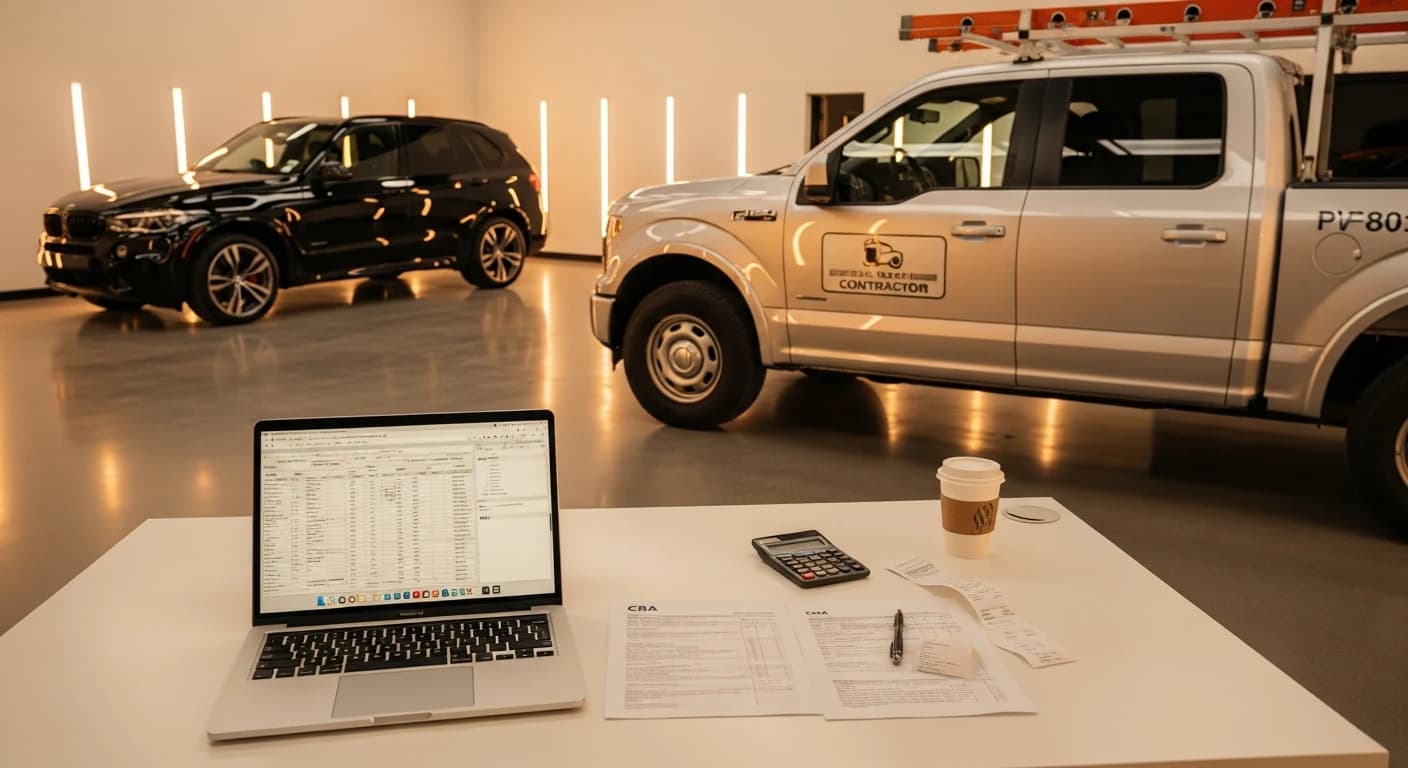
Concrete numbers help. Here is the math for a typical Calgary realtor scenario: a $2,500 full-front PPF install (our flagship self-healing PPF, 7.5 mil, hood + fenders + bumper + mirrors + A-pillars) on a 2025 Toyota Highlander used 70% for business (showing properties, client meetings, market scouting) and 30% personal. Filed as a sole-proprietor T2125, Alberta, 2026 tax year.
| Calculation Step | Amount | Notes |
|---|---|---|
| PPF install cost (including GST) | $2,625 | $2,500 + 5% GST |
| Business-use percentage | 70% | From mileage log: 17,500 business km / 25,000 total |
| Business-use portion capitalized | $1,750 | $2,500 × 70%, GST recovered separately |
| GST Input Tax Credit (year 1) | $87.50 | $125 GST × 70% business use |
| Year 1 CCA (half-year rule, 15%) | $263 | $1,750 × 30% × 50% first-year rule |
| Year 1 tax savings @ 30.5% marginal rate | ~$80 | $263 × Alberta combined marginal rate |
| Years 2–8 cumulative CCA tail | ~$1,486 | Declining-balance over typical 8-year holding |
| Years 2–8 cumulative tax savings | ~$453 | $1,486 × 30.5% marginal rate |
| Total tax benefit over holding period | ~$620 | GST ITC + cumulative CCA tax savings |
The effective net cost of the $2,500 install drops to roughly $1,880 — a 25% discount funded by the CRA. The math improves at higher business-use percentages, higher marginal tax brackets, on Class 10 motor vehicles versus Class 10.1 capped passenger vehicles, and for GST-registered businesses recovering the full Input Tax Credit. For incorporated businesses earning above the small-business limit, the dollar benefit per dollar of CCA is lower (around 23% combined federal + Alberta general corporate rate), but the corporation typically holds the asset longer and runs more vehicles through the same CCA pool.
The 5-Item Documentation Pack Your Accountant Wants
CRA does not require pre-approval of motor-vehicle expenses, but it does have a 3-to-4-year audit and reassessment window (longer for fraud), and motor-vehicle expenses are one of the most-reviewed line items on a sole proprietor's return. Five documents, retained for six years, are what we see accountants ask for at every year-end.
The Pros
- Original installer invoice with vehicle VIN, coverage zones, price breakdown, and GST line item — we format this at install for every Calgary PPF Pros business-vehicle customer
- Proof of payment — credit card statement, e-Transfer record, or business cheque image showing the transaction
- Contemporaneous mileage log — paper book, MileIQ, TripLog, QuickBooks Self-Employed, or equivalent — covering the full tax year
- Manufacturer warranty certificate (STEK, 3M) supporting the protective-purpose argument and useful-life extension
- For incorporated businesses, the bookkeeping journal entry capitalizing the addition to the specific vehicle in the asset register
The Cons
- Missing mileage log = entire deduction is at risk in a CRA review — this is the single most-common failure point
- Cash payments without a receipt are not deductible — always pay by card, e-Transfer or cheque
- Vague installer invoices without VIN or coverage zones look like personal-use detailing and weaken the claim
- Reconstructing a mileage log after the fact, even with credible estimates, is rejected by CRA — only contemporaneous logs are accepted
- Mixing personal and business kilometres without separation produces a denied claim, not a prorated one
Tell us at booking — we format the invoice for tax filing
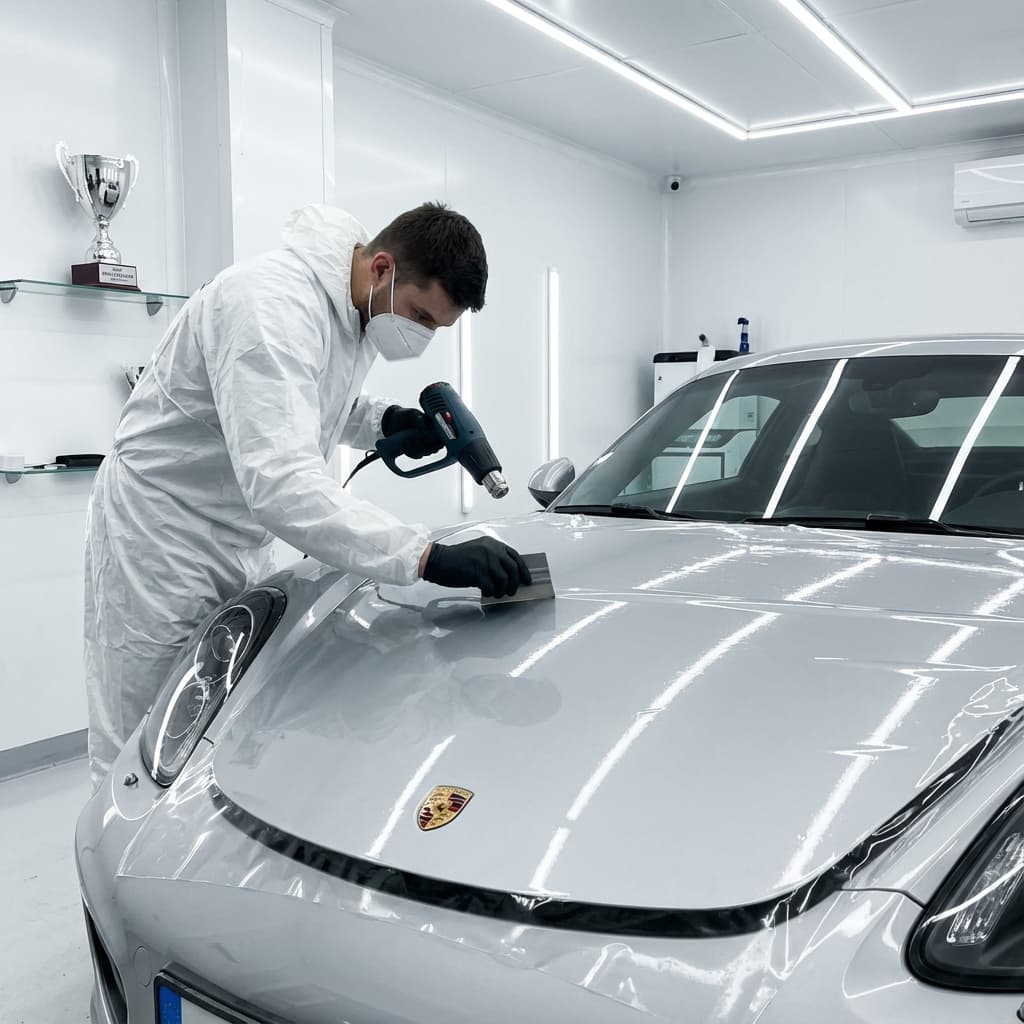
When you book a business-vehicle install, mention it at intake. We add the vehicle VIN, itemize each coverage zone (front bumper, full hood, full fenders, A-pillars, mirrors, rocker panels, etc.), break out the GST as a separate line, and add a one-line description of the protective purpose. The invoice goes directly to your accountant's intake folder without back-and-forth. For the complementary ceramic coating layer that also qualifies, see our Halo Package guide for the PPF + ceramic combo.
Calgary Specifics — Realtors, Contractors, Fleets, Rideshare
Each Calgary business-vehicle profile lands on a slightly different recommended PPF package and a slightly different deduction structure. Here is the practical map across the four profiles we book most often.
| Profile | Typical Vehicle | Recommended Package | Typical Business Use % |
|---|---|---|---|
| Calgary Realtor | Lexus RX, BMW X5, Audi Q5, Tesla Model Y | Full Front + Rockers — $2,200–$3,200 | 60–80% (mileage log required) |
| Residential Contractor | F-150, Silverado 1500, Ram 1500 | Full Front + Bed Rail — $2,500–$3,500 | 85–95% (Class 10 motor vehicle) |
| Incorporated Consultant | Mercedes E-Class, Audi A6, Tesla Model S | Full Front + High-Touch Zones — $1,799–$2,499 | 50–70% (corporate-owned) |
| Rideshare / Delivery Driver | Toyota Camry Hybrid, Hyundai Sonata, Tesla Model 3 | Full Front — $1,499–$1,999 | 80–95% (mileage log critical) |
| Fleet Operator (3+ vehicles) | Mixed fleet, often Class 10 motor vehicles | Bulk per-vehicle pricing — quote-based | 90–100% (corporate-owned) |
The single highest-ROI business-vehicle install we book each year is the residential contractor based in Springbank, Cochrane or Bearspaw running a brand-new F-150 work truck 40,000+ km annually on Stoney Trail, Deerfoot, and gravel job-site approaches into Aspen Woods, Auburn Bay and the new southeast communities. Class 10 motor vehicle (no cap), 90%+ business use, GST ITC at 5% on the full install, and a vehicle that would otherwise be respraying a chip-shot bumper and lower rocker every 18 months. The realtor scenario is close behind — luxury SUV resale value depends heavily on intact front-end paint, and the deduction effectively rebates 25–35% of the install.
For Calgary rideshare drivers specifically, the math is more nuanced because the vehicle is usually personally-owned, claimed via T2125, and the business-use percentage is high but not 100%. The PPF deduction is real and worthwhile, but the documentation discipline (mileage log especially) is what separates a survivable CRA review from a denied claim. The same logic applies to delivery drivers on SkipTheDishes, DoorDash, Uber Eats, and Instacart. If the vehicle is leased rather than owned, our guide to financing PPF over a lease term covers how the deduction stacks with captive-lender lease-return charge avoidance.
Five Mistakes That Get the Deduction Denied
We are not your accountant, and the conversation in our bay is always about the install — not the tax filing. But after five years of Calgary business-vehicle intakes and conversations with the accountants who file for our customers, the same five mistakes appear over and over.
1. No mileage log
Reconstructing kilometres from credit-card receipts and calendar entries after the fact is not acceptable to CRA. Install a tracking app the day you start using a vehicle for business. The cost is $5–$10/month; the deduction it protects is hundreds to thousands per year.
2. Treating a Class 10.1 vehicle as Class 10
Luxury SUVs above the prescribed ceiling are capped. Capitalizing PPF on a capped vehicle does not produce additional CCA. The PPF is still worth doing for the vehicle protection and resale support, but the tax math is different.
3. Expensing the install in-year above the threshold
A $2,500 install expensed in-year as a repair will be reclassified to a capital addition in a CRA review, and the year-1 deduction reversed. Capitalize anything over $500 unless your accountant specifically directs otherwise.
4. Claiming 100% business use on a sole-prop vehicle
CRA assumes any sole-prop vehicle has some personal use. A 100% claim is a high-probability audit flag. Real-world percentages for realtors and rideshare drivers land at 70–90%, and that is what your log should show.
5. Losing the install invoice
No invoice = no deduction. Email yourself the PDF the day of the install, store it in your accounting software, and back it up to cloud storage. CRA can ask for it any time in the next six years.
The Bottom Line for Calgary Business-Vehicle Owners
Paint protection film on a business-use vehicle in Alberta is deductible, the dollar benefit is real, and the documentation discipline is what makes the deduction stick. For most realtors, contractors, fleet operators and rideshare drivers in Calgary, the effective net cost of a full-front install drops 20–35% once the CCA tail and GST Input Tax Credit are run through. The biggest tax-impact decision is whether the vehicle is Class 10 (motor vehicle, no cap) or Class 10.1 (passenger vehicle, capped), and the second-biggest is whether your mileage log holds up — both questions deserve a five-minute conversation with your accountant before the install.
The mistake we see most often is the missing mileage log. Install a tracking app on the day you start using a vehicle for business, format the install invoice with the vehicle VIN and coverage-zone breakdown (we do this for every Calgary PPF Pros business-vehicle customer at booking — just ask), and keep the warranty certificate and proof-of-payment together for six years. For the broader ROI calculation that grounds the protection decision before the tax layer, our honest ROI guide for PPF on every vehicle tier walks through the cost-of-ownership math. For luxury and fleet operators, the full-body PPF guide for Calgary owners covers the capitalization math at the high end. Final reminder: this article is general guidance, not personalized tax advice — confirm your specific situation with a CPA before filing.
Related Reading
2026 Calgary PPF Pricing Baseline
Real 2026 install ranges by package and vehicle size — the cost numbers that feed your deduction math.
PPF for Trucks & SUVs in Calgary
Work-truck and fleet coverage zones — the Class 10 motor vehicle scenario.
PPF + Ceramic Halo Package
The combined invoice that capitalizes as a single addition to your business vehicle.
Book Your Business-Vehicle PPF — Accountant-Ready Invoice Included
Realtor, contractor, fleet operator, or rideshare driver? Tell us at booking — we format the install invoice with the vehicle VIN, itemized coverage zones, separate GST line, and a one-line protective-purpose description so it drops straight into your accountant's intake. Multi-vehicle fleet quotes available. Calgary AB. 4× Consumer Choice Award winner. 5.0★ from 90+ reviews. See our PPF service menu and warranty terms or book the PPF + ceramic Halo Package for the combined-invoice capitalization. This article is general guidance — always confirm with your accountant.
Frequently Asked Questions
Experience The Best.
Don't let another commute compromise your vehicle. Get a quote from Calgary's Consumer Choice Award winner today.
Explore Our Services