EV Charging Port PPF in Calgary: The $300 Fix Every Tesla, Rivian & Cybertruck Owner Misses Before First-Brine Week (2026)
EV charging port PPF in Calgary is a CA$149–$299 precut film install that prevents CA$400–$1,400 of respray damage from three specific winter failure modes: cold-weather cable stiffening drag (cables lose 40–60% of their bending compliance below –20 °C and gouge the port edge on every insert), latch-scuff arcs on the door surround, and misalignment gouging at Supercharger and public DC pedestals. The fix: a self-healing TPU puck (8×8–12×12 cm) around the port opening, or a full charge-door skin for Tesla and Rivian owners who public-charge frequently. Book the install before first-brine week (the first week of October) so the film hits functional cure before Calgary's direct-liquid calcium-chloride season begins. Applies to Tesla Model 3/Y/S/X, Cybertruck, Rivian R1S/R1T, Ford F-150 Lightning, Hyundai Ioniq 5/6, Kia EV6/EV9, GMC Hummer EV, Lucid Air/Gravity and Chevy Silverado EV.
Every October a Calgary EV owner rolls into our bay for a full-front paint protection film quote on a nine-month-old Tesla or Rivian and, halfway through the walkaround, notices a fine 4 mm arc across the trailing edge of the driver-side rear charge door — clear-coat scuff, base coat still intact, dead-line-shaped, and unmistakably caused by the CCS charging cable dragging as it was inserted on a cold morning at the Deerfoot Costco Supercharger. The owner did not put it there deliberately; nobody teaches you that a cold charging cable becomes measurably stiffer and swings at a sharper angle against the port face. The fix, once you know it exists, is a CA$149–$299 precut puck of self-healing PPF that would have been installed in twenty minutes at delivery for less than the cost of one bad Supercharger insert. This post is the exact playbook — the physics of cold-cable drag, the model-by-model damage map, the Calgary timing sequence around first-brine week, and the six owner mistakes we watch happen every winter.
Calgary's public and Supercharger EV registrations have tripled since 2022, and by mid-2026 our shop is filming three or four Tesla, Rivian, or Ioniq charge doors every week during the September–October pre-winter rush. Every one of those installs started as a phone call that opened with the same sentence: "I did not know that was a thing." Charge-port PPF is not a thing yet in Calgary the way full-front and rocker-panel packages are — no local shop owns the query, and Tesla, Rivian and Ford do not put it on any delivery checklist. The gap is entirely why this post exists. What follows is the same conversation we walk every EV owner through — with the same numbers we quote at the counter and the same sequencing we recommend to protect a nine-month-old paint job from a winter of cable drag.
Reviewed by Calgary PPF Pros — 4× Consumer Choice Award winner, protecting Calgary vehicles since 2021, 5.0★ rated across 90 verified reviews.
The Three Damage Mechanisms Bare Paint Cannot Beat
Charge-port scuff is not one failure mode; it is three distinct mechanical events stacking on the same 10 cm of paint over 40–60 charge cycles per winter. Understanding all three is what tells you whether a puck is enough or whether the full charge-door skin is the correct spec for your driving pattern.
- Cold-cable stiffening drag. The EPDM and PVC jacket compounds used on Tesla, CCS, and NACS cables lose 40–60% of their bending compliance between +20 °C and –20 °C — documented on Rivian owner forums, Ford Lightning owner threads, and expected from the base polymer behaviour. A stiff cold cable sags at a sharper downward angle against the port face and drags across the paint edge every time it is inserted, retracted, or bumped by a passing coat sleeve. The damage signature is a 3–8 mm arc across the trailing edge of the port surround, always in the same downward direction.
- Latch-release scuff arc. The port latch mechanism on Tesla, Rivian, and most CCS EVs releases with a small mechanical push-back that swings the cable head across the port surround at a downward angle. When the port surround is bare paint, that swing puts a curved scuff arc across the leading edge on every disconnect. Compounded across 40+ winter cycles, the arc reads like a fingerprint smudge on dark paint and needs a two-step machine polish to remove.
- Misalignment gouging at DC pedestals. Supercharger and public DC fast-charging pedestals with stiff or misaligned cable-management retractors present the cable at a 5–15° off-axis angle. Insert on the wrong axis and the port lip gouges the cable jacket on the way in, or the cable jacket gouges the port lip on the way out. Either way the paint takes the damage; the cable is designed to survive. Cybertruck stainless is not exempt — the CNC-milled charge-port bezel is the exact zone that catches the misalignment.
| Failure Mode | Where It Shows | Repair Cost (CA$) | PPF Prevention |
|---|---|---|---|
| Cable-drag arc | Trailing edge, 3–8 mm downward | $400–$700 (respray + blend) | Puck absorbs 100% |
| Latch-release scuff | Leading edge, curved arc | $180–$260 (2-step polish) | Puck absorbs 100% |
| Misalignment gouge | Port lip, 2–5 mm scratch | $600–$1,400 (paint + blend) | Charge-door skin required |
| Combined 2–3 modes | Full port surround | Full quarter repaint | Skin + halo, always |
Model-by-Model Charge-Port Map — What Your EV Actually Needs
Every current EV has a slightly different port geometry, a slightly different door hinge line, and a slightly different Calgary-owner damage pattern in our records. The table below is the shortlist by model — puck if the port is recessed and only the surround is exposed, full charge-door skin if the door itself catches cable weight on public-charge inserts.
| Vehicle | Port Location | Priority | Recommended Spec | Installed (CA$) |
|---|---|---|---|---|
| Tesla Model 3 (incl. Highland) | Driver-side rear quarter | High — soft clear coat | Charge-door skin | $249–$299 |
| Tesla Model Y (incl. Juniper) | Driver-side rear quarter | High — soft clear coat | Charge-door skin | $249–$299 |
| Tesla Model S / X | Driver-side rear quarter | High — luxury paint code | Charge-door skin | $279–$329 |
| Tesla Cybertruck | Driver-side rear quarter (bezel) | Medium — bezel + gasket | Puck + gasket edge | $199–$249 |
| Rivian R1S / R1T | Driver-side rear quarter | High — softer aluminum clear | Charge-door skin | $269–$319 |
| Ford F-150 Lightning | Driver-side front fender | High — heavy cable weight | Charge-door skin | $249–$299 |
| Hyundai Ioniq 5 / 6 | Passenger-side rear quarter | Medium — softer Korean paint | Puck (or skin if DC-heavy) | $179–$249 |
| Kia EV6 / EV9 | Passenger-side rear quarter | Medium | Puck (or skin if DC-heavy) | $179–$249 |
| GMC Hummer EV | Driver-side rear quarter | Low — recessed pocket | Puck | $149–$199 |
| Chevy Silverado EV | Driver-side front fender | Low — recessed pocket | Puck | $149–$199 |
| Lucid Air / Gravity | Driver-side rear quarter | Medium — luxury paint | Charge-door skin | $249–$299 |
For the broader coverage-map conversation across EVs — full-front, rockers, hood, frunk — the parent guide to Calgary EV PPF for Cybertruck, Rivian, Lightning and Lucid walks through the full-vehicle coverage decision alongside charge-port protection. Tesla-specific owners running a full protection package should also cross-reference our Tesla PPF packages for Model 3, Y, S and X to see how charge-door protection stacks on top of a front-clip install.
The September Booking Sequence — Beat First-Brine Day by 14 Days
The single-biggest scheduling mistake we see in October is a Calgary EV owner who books charge-port PPF for the last week of October, drives through the first two weeks of direct-liquid calcium-chloride brine on Deerfoot in the meantime, and hands us a port face that is already coated in a hygroscopic salt film that has to be fully decontaminated before the film goes on. The City of Calgary road-maintenance team begins direct-liquid brine on Deerfoot, Stoney, Glenmore, and 16 Ave N in the first week of October — that is your hard deadline. The sequence below is what we book for every Calgary EV owner who calls us the second week of September.
Sep 14–20 — Book the install
Week 1Confirm vehicle model, port location, and public-vs-home charging pattern on the phone; get a firm CA$ quote and a bay slot before Sep 30. Send a phone photo of the port face for a paint-condition read.
Sep 22–27 — Pre-install decon
Week 2Wash the vehicle thoroughly the day before drop-off (touchless preferred). Do not wax, sealant, or coat the charge-port zone in the 30 days prior — the PPF adhesive needs bare clear coat to bond fully.
Sep 24–28 — Install day (60–90 min)
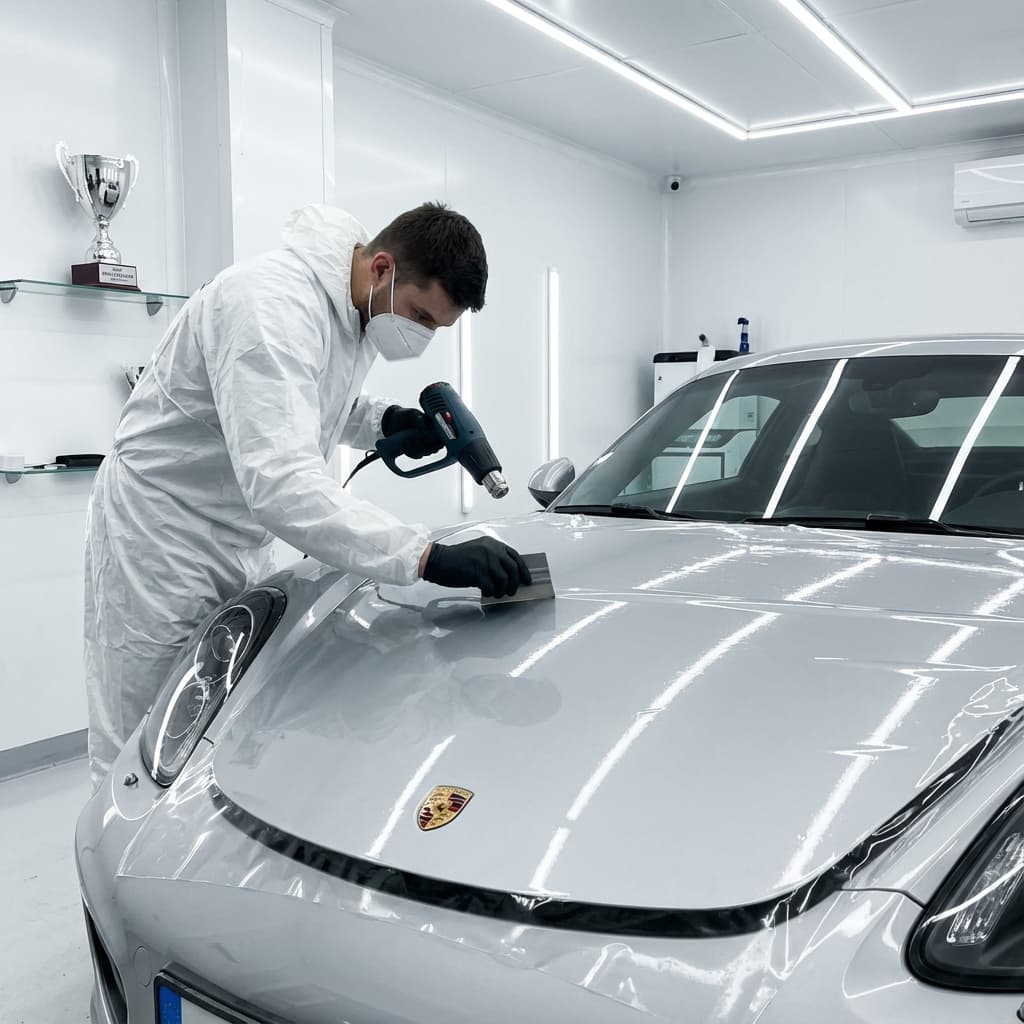
InstallInstall includes IPA prep, plotter-cut PPF application with edge tension, heat-set on the door hinge line, and a light polish of any pre-existing scuff before the film seats. Drive the vehicle away the same day; avoid a car wash for 48 hours.
Sep 25–Oct 4 — Functional cure
CureFilm reaches functional cure at day 7 on aluminum panels (Rivian, Lightning, Cybertruck bezel), day 14 on painted steel (Ioniq, EV6, Model S/X). Charge normally throughout; the film survives cable-drag on day 1.
Oct 1–7 — First-brine week
DeadlineCity of Calgary begins direct-liquid calcium-chloride on Deerfoot, Stoney, Glenmore and 16 Ave N. Filmed charge port is now protected; unfilmed vehicles are on the clock for the first winter of damage.
If your window has already slipped past September, we install year-round in a heated indoor bay — but the September slot is measurably cheaper (no brine-decon add-on) and gives the film a full clean-substrate cure before winter salt spray. The same physics we cover in our companion post on how Calgary road salt and pickle-mix brine chew unprotected paint applies fully here — a charge port that has been sitting in a salt film for a month is not a substrate any PPF adhesive is designed to bond to without a full decon pass.
Six Owner Mistakes We See Every Calgary October
Each of these is a conversation we have had this year — every one is preventable in ten minutes at the phone-booking stage.
The "wait until spring" mistake
Booking charge-port PPF for April because "the damage happens in winter anyway." Correct — which is why the film has to be on before the winter, not after. A skin installed in April is protecting damaged paint through the next summer's bug and pollen season. Fix: book September, install September, done.
The "just the puck, no door skin" mistake on a Tesla or Rivian
Buying the CA$149 puck for a Model Y that gets three public-charge sessions a week. The puck protects the surround but not the door face itself, and the cable head lands on the door face at every Supercharger. Fix: default to the charge-door skin on any Tesla, Rivian, or Lightning driven above 500 km/week.
The "Amazon DIY kit" mistake
A DIY PVC kit installed over dust in an unheated garage in October. Non-self-healing film scratches on the first cable-drag event, the edges lift in the first chinook, and the residue has to be commercial-solvent removed before a proper install can go on. Fix: skip the kit; the CA$100–$150 professional delta buys the actual protection.
The "coating the port zone first" mistake
Applying a ceramic coating to the entire vehicle including the charge port zone, then asking us to install PPF on top three weeks later. Ceramic on the substrate blocks the PPF acrylic adhesive from bonding — the film lifts within 60 days. Fix: PPF first, ceramic second, always. Or if the coating is already on, we chemical-strip the port zone before the film goes on (adds CA$40–$60).
The "wait for the delivery inspection" mistake
Assuming the Tesla, Rivian, or Ford delivery team will flag or install charge-port protection. They will not; it is not on any delivery checklist across any manufacturer. Fix: book the PPF appointment for the Monday after your delivery date the moment your VIN is assigned.
The "public charging in a heated garage" mistake
Reasoning: "My home charger is in a heated garage so the cable is never cold." True — but the Supercharger cable at Deerfoot Costco at 07:30 on a Tuesday in January is very cold, and that is the drag event that scuffs the paint. Fix: even garage-charged EVs get charge-port PPF if they ever DC-fast-charge in Calgary winter.
What Separates a Clean Charge-Port PPF Install From a Bad One
The install itself is 60–90 minutes; the difference between a shop that does it every week and a shop that does it occasionally shows up at year two, not day one. Six install signals to look for at pickup.
The Pros
- Plotter-cut PPF (vehicle-specific precut, not hand-trimmed) — edges land exactly on the door seam without lifting
- Self-healing TPU film — XPEL Ultimate Plus, STEK DYNOshield, or 3M Pro Series (never PVC)
- Edge tension set with heat gun on the hinge line — proves the installer relieved the compound curve properly
- Port pilot-light window is crystal clear (no slurry residue) — proves clean IPA prep
- Zero visible film seam from three-metre viewing distance — matches the door hinge line
- Written warranty on the film (10-year manufacturer, minimum 2-year install) — proves shop stands behind the work
The Cons
- Hand-trimmed film with visible knife marks around the port opening
- PVC or entry-level TPU film that will not self-heal on the first cable-drag event
- Silicone edge sealer applied on top of the film (masks bad edge tension; peels in 90 days)
- Cloudy pilot-light window — slurry trapped under the film that never fully dried
- Visible film seam on the door face (three-metre visibility) — indicates poor pattern selection
- Verbal warranty only — no written coverage on either film or install labour
How Charge-Port PPF Fits Into a Full Calgary Protection Plan
The single-panel puck or skin is a targeted fix — the highest-ROI single line item in the PPF catalogue on any EV, but not a substitute for a broader front-end package if the vehicle is a daily driver on Deerfoot, Stoney, Glenmore, or the Trans-Canada. The math we walk every Calgary EV owner through is: charge-port skin first (CA$249–$299 — the fix for the highest per-cycle damage event), full-front PPF second (CA$1,499–$1,999 — the fix for gravel and rock chips), rocker-panel PPF third (CA$549–$899 — the fix for winter brine spray off the front tires), ceramic coating fourth on top of it all (CA$799–$1,299 — the fix for salt-film adhesion). For the full-price context, our Calgary PPF cost breakdown by package and vehicle size shows how the individual line items stack into complete protection.
Book Your Calgary EV Charge-Port PPF Before First-Brine Week
Send a phone photo of your charge-port face and a raking-light shot of the door surround — we'll come back with a paint-condition read, a spec (puck vs charge-door skin) matched to your vehicle and charging pattern, and a firm installed price. Same-day and next-day appointments available through September. Calgary AB. Consumer Choice Award winner. 5.0★ from 90+ verified reviews. Independent specialist studio.
Frequently Asked Questions
Experience The Best.
Don't let another commute compromise your vehicle. Get a quote from Calgary's Consumer Choice Award winner today.
Explore Our Services