EV PPF Calgary 2026: Cybertruck, Rivian, Lightning, Lucid
Non-Tesla EVs — Cybertruck, Rivian R1T/R1S, Ford F-150 Lightning, Lucid Air and Mach-E — need a different paint protection film playbook than ICE vehicles because the body materials, paint chemistry and direct-to-customer delivery model are all different. The Cybertruck needs satin-finish PPF on bare stainless at $2,400–$3,200 full-front-plus-rockers; Rivian needs STEK DYNOshield or GSWF Defender Platinum self-healing PPF in 8-mil over its notoriously soft water-based clear coat at $2,200–$3,100; the F-150 Lightning needs full-front plus a charge-port puck and frunk-edge coverage at $1,799–$2,499. Add a 5-year ceramic stack on top of the PPF for the public DC fast-charger brine-dwell problem unique to Calgary winters. Decline any dealer-style add-on at delivery (most EV brands skip this anyway), and book the install for the week after pickup before the first highway run. For Tesla Model 3, Y, S, X owners, our Tesla-specific paint protection guide for Model 3, Y, S, X and Cybertruck is the deeper read for that vehicle family.
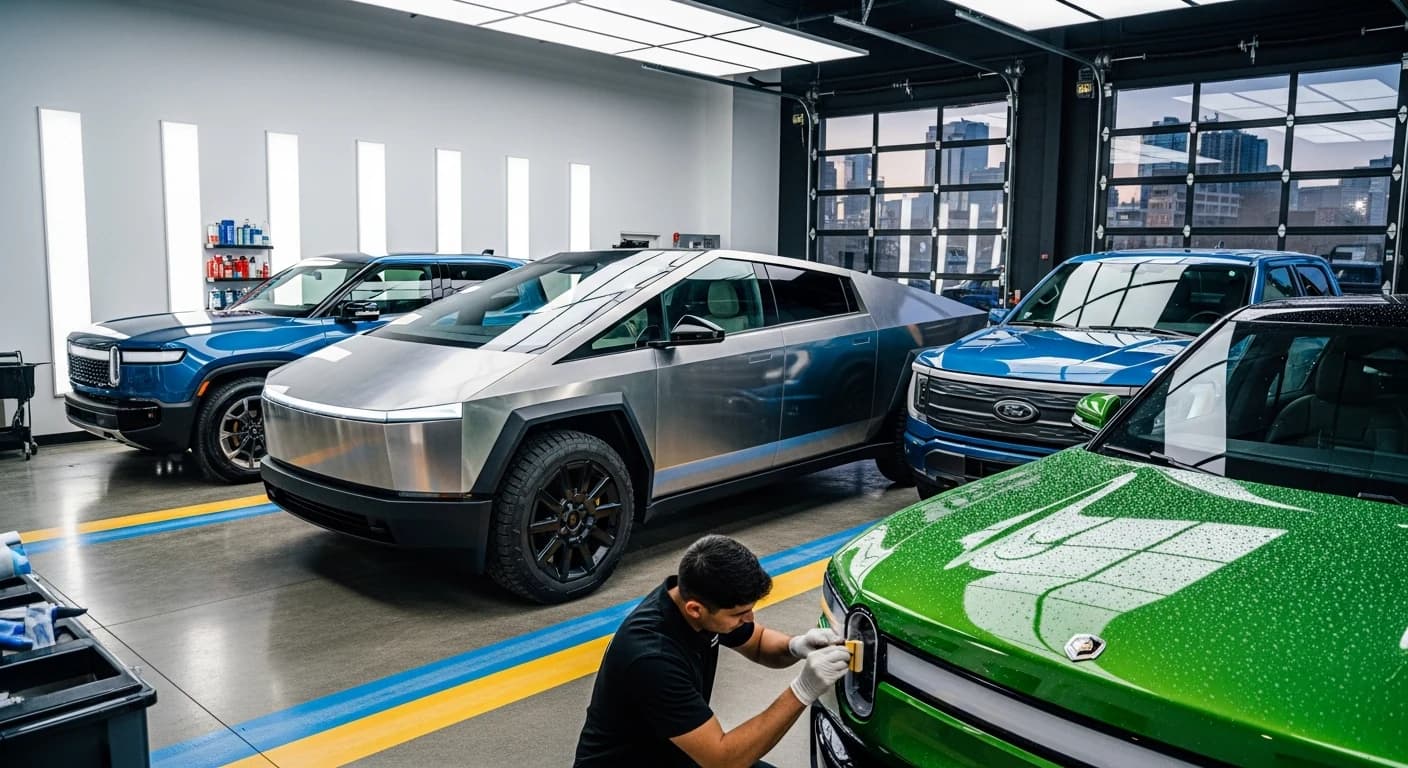
Calgary EV registrations crossed a tipping point in 2025 and 2026. Five years ago, every “EV PPF” conversation in our bay was a Tesla — Model 3, Model Y, the occasional Model S. Today we are installing on Cybertrucks every other week, Rivian R1S launch-green deliveries from the new Edmonton service centre, F-150 Lightnings out of the Ford-Lincoln dealer cluster on Macleod Trail and 16 Avenue, Lucid Air deliveries from the Calgary Lucid Studio, and Mach-E GTs in for full-front before the first Kananaskis run. This guide is the 2026 Calgary protection playbook for the non-Tesla EV — what to install on each body type, why the Cybertruck's bare stainless is its own special case, and the protection stack that wins on cost, longevity and resale across the whole segment.
The most common pattern in our EV intakes is the same conversation in three different sequences. A Cybertruck owner arrives the day after delivery, photos already taken, asking whether stainless “really needs film”; we walk them through what Calgary magnesium-chloride brine does to a 304-series stainless panel left untreated through three winter freeze-thaw cycles. A Rivian R1S owner books at 8,000 km, photos showing a half-dozen leading-fender chip clusters that appeared within the first month of normal Stoney Trail commuting; we walk them through what the soft water-based clear coat does without film, and what paint correction can and cannot rescue. An F-150 Lightning owner arrives a week before pickup, asking us to schedule the bay for the morning after delivery; that is the cleanest install we book — factory paint, no dealer sealant, no brine exposure yet. The Lightning install is also the only one where the customer asks if the film affects fast-charging at the L2 charger at home — it does not.
Reviewed by Mostafa — Calgary PPF Pros, Consumer Choice Award winner 2026, protecting Calgary EVs since 2021.
Why Non-Tesla EVs Need a Different PPF Playbook
Three structural differences make the EV install in our bay distinct from an equivalent gasoline vehicle. Understanding all three is what separates a film install that lasts a decade from one that lifts an edge after the first Chinook freeze-thaw.
The body materials are different — and they each behave differently under film
Cybertruck is bare 304-series cold-rolled stainless steel — no paint at all. Rivian, Lucid and Lightning are aluminum-heavy mixed-material body construction. Mach-E is steel-and-aluminum mixed. Each material has a different surface energy, a different thermal expansion rate (which matters across Calgary's 70°C annual swing) and a different acceptable adhesive class. A film and adhesive that bonds beautifully to a painted steel sedan can lift along an aluminum hood edge under Chinook freeze-thaw stress. Installers without specific EV experience often miss this and the result is documented on the Cybertruck Owners Club forum and Rivian Owners Forum every spring.
The clear coats are softer — water-based formulations chip earlier
Rivian, Lucid and Mach-E all use water-based clear coats engineered for lower VOC emissions in the paint shop, and these clear coats are measurably softer than the legacy solvent-based clear coats on a 2018 F-150 or a 2020 Range Rover. Softer clear coat means earlier chip onset, deeper chip penetration at the same impact energy, and faster spread of brine etching from any chip edge. Owners report consistent first-chip-clusters at 5,000–12,000 km on unprotected Rivians, Lucids and Mach-Es — far earlier than the equivalent ICE vehicle.
The delivery model is direct-to-customer — no dealer sealant problem, but no dealer prep either
Rivian, Tesla and Lucid deliver direct from a brand-owned showroom or service centre rather than a traditional dealership. That removes the finance-desk sealant problem (great — no contaminated bonding surface for the PPF installer to decon) but also removes the dealer-prep buffer that ICE buyers get; the vehicle arrives with factory paint and immediately gets driven home through whatever weather is happening. For winter or shoulder-season deliveries, that means brine, sand and gravel on the leading hood before the first PPF appointment. Booking the install for the Monday after pickup is the standard practice.
For the broader picture of where Calgary chips come from and what stops them, see our rock-chip protection guide.
Cybertruck — Stainless Steel Is Not Maintenance-Free
The most common Cybertruck question we get is the most important one: does bare stainless need film at all? The honest answer from our Calgary bay is yes — for reasons that have nothing to do with rock chips and everything to do with what magnesium-chloride brine does to chloride-sensitive 304-series stainless over multiple freeze-thaw winters. Tesla's own owner's manual flags this: road salt and brine should be removed within 48 hours, or pitting and tea-staining can develop on the panel surface. In a Calgary winter — five months of pre-wet brine on every arterial road from late October through April — that 48-hour rule is unrealistic for a daily-driver Cybertruck owner.
The standard Cybertruck install in our bay is a satin-finish PPF on the high-impact zones — bumper, hood, fenders, rocker panels, A-pillars and mirrors — which preserves the matte stainless look while adding self-healing scratch resistance, fingerprint shedding and brine dwell-time protection. Gloss film is the wrong call on Cybertruck because it changes the panel's appearance and most owners reject the test panel after seeing it. For long-term-hold Cybertruck owners, full-body satin-finish coverage is the only path that protects every panel against the multi-year chloride exposure that Calgary delivers. Our dedicated Cybertruck PPF page covers the stainless-specific coverage zones and current Calgary pricing in more depth.
| Cybertruck Package | What's Covered | Best For | Calgary 2026 Price |
|---|---|---|---|
| Partial Front (Satin) | Bumper, mirrors, leading 24 in. of hood and fenders | Short-hold or city-only Cybertruck | $1,400–$1,899 |
| Full Front + Rockers | Above plus full hood, full fenders, rocker panels, A-pillars | Most Calgary Cybertruck owners — the standard pick | $2,400–$3,200 |
| Full-Body Satin | Every panel including bed sides, tailgate, roof | Long-hold (10+ year) Cybertruck, full chloride defense | $7,500–$9,500 |
Rivian R1T & R1S — Soft Clear Coat, Hard Lifestyle
Rivian's water-based clear coat is the central paint-protection story for the R1T pickup and R1S three-row SUV. Owner-documented chip clusters appear on the leading fender and lower bumper within the first 5,000–12,000 km on unprotected vehicles — far earlier than the equivalent painted Range Rover, F-150 or Tahoe. The Rivian Owners Forum has multi-year photo threads of factory-paint owners pulling into service centres at 10,000 km with eight to fifteen identifiable chips on the front clip. Rivian's own paint warranty covers cosmetic issues for 12 months / 20,000 km only, which is half the coverage of legacy Detroit Three trucks.
The fix is structural: STEK DYNOshield or GSWF Defender Platinum self-healing PPF in 7.5–8 mil on the bumper, full hood, full fenders, A-pillars and mirrors, with rocker-panel extensions on the R1T (the wider wheelbase throws gravel onto the rocker in a measurably different pattern than the R1S). Launch-green and limestone — the two most popular Rivian colours in Calgary — both show chip-edge silvering more readily than a darker el-cap or compass-yellow. The R1S also picks up roof-rail and tailgate-edge damage from kayak straps, ski boxes and dog crates, which we cover at install if the owner uses the vehicle for adventure gear-hauling. Our PPF-by-vehicle page has current Calgary pricing by vehicle class.
| Rivian Package | What's Covered | Best For | Calgary 2026 Price |
|---|---|---|---|
| Partial Front R1T/R1S | Bumper, mirrors, leading 24 in. of hood and fenders | Short-hold or city-only Rivian | $1,499–$1,999 |
| Full Front R1T | Full hood, full fenders, full bumper, A-pillars, mirrors | Most R1T owners — the standard pick | $2,200–$2,900 |
| Full Front R1S + Rockers | Above plus rocker panels, roof-rail strips | R1S adventure-use, Kananaskis weekenders | $2,600–$3,400 |
| Full Body Rivian | Every painted panel on the vehicle | Launch-edition R1T/R1S, indefinite hold | $6,500–$8,200 |
Ford F-150 Lightning — Aluminum Body, Charge-Port Edge Cases
The Lightning's painted aluminum-heavy body is not a problem for PPF — the 7.5–8 mil premium-film adhesive class bonds to aluminum as well as it bonds to painted steel, and there is no galvanic issue. The interesting Lightning edge cases are the front charge port on the driver-side fender (which takes weekly physical abuse from CCS and J1772 charging cables) and the frunk lid edge (where owners load tools, dog gear and groceries every day, scuffing the paint along the lift point).
Our standard Lightning install is full-front PPF plus a small precut puck around the charge port and an extended pattern along the frunk lid edge — the kind of detail an installer without Lightning-specific experience often skips. Atlas Blue, Rapid Red and Iconic Silver are the three most common colours in our Calgary bay and all three show chip-edge silvering at the same rate; lighter Star White Tri-Coat owners get a more forgiving chip pattern but the leading hood is still the first panel to show damage at 8,000–10,000 km of normal Stoney Trail commuting. The standalone version of that charge-port fix — for owners not ready for full-front film — lives in our $150–$300 EV charge-port PPF playbook, which walks through cable-drag, latch scuff and misalignment failure modes across every current EV.
| F-150 Lightning Package | What's Covered | Best For | Calgary 2026 Price |
|---|---|---|---|
| Partial Front | Bumper, mirrors, leading 24 in. of hood and fenders, charge-port puck | Short-hold or city-only Lightning | $1,199–$1,599 |
| Full Front + Charge Port | Full hood, full fenders, full bumper, A-pillars, mirrors, charge-port puck, frunk edge | Most Calgary Lightning owners — the standard pick | $1,799–$2,499 |
| Full Front + Bed + Rockers | Above plus bed rail, tailgate edge, rocker panels | Work-truck use, gear-hauling, gravel exposure | $2,500–$3,300 |
| Full Body Lightning | Every painted panel | Lightning Platinum or Lariat ER, indefinite hold | $5,800–$7,400 |
For the broader Ford F-150 truck-protection map across both Lightning and gas variants, our truck PPF page covers the coverage zones for full-size trucks, including the F-150.
Lucid Air & Ford Mach-E — Reflective Paint, Long-Hold Math
Lucid Air owners arrive in our Calgary bay with two specific concerns and both are paint-related: the Stellar White, Cosmos Silver and Infinite Black finishes are the most reflective in the segment (more glossy than even AMG and Porsche flagship colours) and the show-car gloss makes any swirl mark, water spot or chip-edge silvering instantly visible. The fix is two-stage paint correction before any film, full-front PPF in 7.5 mil to keep the optical clarity at its highest, and a 5-year ceramic on top of the PPF for hydrophobic water-spot resistance. Full-body PPF is the standard recommendation on Air Grand Touring and Air Sapphire because the trim values ($120K–$250K) make panel-by-panel respray math obvious.
Ford Mach-E owners — particularly Mach-E GT and Premium trim buyers — are the most cost-sensitive in this segment and typically land on full-front plus high-touch zones (door cups, door edges, leading hood) at $1,499–$2,099 in 2026 Calgary pricing. The Mach-E's lower hood line means a higher percentage of gravel hits the bumper rather than the hood, which makes partial-front more viable on this vehicle than on the Lightning or R1T. Cyber Orange and Grabber Blue both show chip-edge silvering more readily than dark colours; Space White and Iconic Silver are more forgiving.
The Calgary EV Protection Stack at a Glance
Pulled together, here is the recommended stack for each non-Tesla EV in 2026 Calgary pricing — film tier, ceramic add-on, and the package total most owners land on after inspection.
| EV | Recommended PPF | Ceramic Add-On | Total 2026 Calgary Price |
|---|---|---|---|
| Tesla Cybertruck | Full Front + Rockers (Satin-Finish) | 5 yr ceramic on stainless | $3,400–$4,500 |
| Rivian R1T | Full Front + Rocker | 5 yr ceramic over PPF + body | $3,000–$3,900 |
| Rivian R1S | Full Front + Rocker + Roof-Rail | 5 yr ceramic stack | $3,400–$4,400 |
| F-150 Lightning | Full Front + Charge Port + Frunk Edge | 3 yr ceramic over PPF + body | $2,500–$3,400 |
| Lucid Air GT / Sapphire | Full Body PPF (Air Sapphire) | 5 yr ceramic over PPF | $8,000–$10,500 |
| Ford Mach-E GT | Full Front + High-Touch Zones | 3 yr ceramic over PPF + body | $2,100–$2,900 |
For the deeper ROI calculation on full-body coverage and why the math closes faster on a $90K+ EV than on an equivalent ICE vehicle, our full-body PPF ROI math for $75K+ EVs works through the 7-year ownership scenario. For the cross-vehicle pricing baseline that grounds these numbers, see our Calgary PPF cost ranges by package and vehicle size.
The Direct-Sales Delivery Conversation — Mostly Good News
Unlike the dealer-package landscape for an ICE Subaru or Hyundai, the direct-to-customer EV brands largely sidestep the finance-desk sealant problem. Rivian, Tesla and Lucid deliver from brand-owned showrooms or service centres and do not push aftermarket sealants at delivery. Ford and the Mach-E are the exception — Ford-Lincoln dealers in Calgary will sometimes offer a sealant or wax package on Lightning and Mach-E deliveries through their standard finance flow.
The Pros
- EV brands (Tesla, Rivian, Lucid) deliver factory-paint vehicles with no finance-desk sealant contaminating the PPF bonding surface
- Manufacturer warranties on all five EVs explicitly allow professional PPF installation
- No dealer prep step means the PPF installer gets first-shot bonding with no decon needed
- Direct-sale brands maintain transparent paint condition photos in delivery documentation
The Cons
- No dealer prep also means no dealer-applied protection during the gap between delivery and PPF appointment
- Most non-Tesla EV owners take delivery and drive home through whatever Calgary weather is happening that day
- Ford Lightning and Mach-E (dealer-sold) may still get a finance-desk sealant offer — decline this
- EV owners who wait 2+ weeks for PPF often arrive with measurable first-chip-clusters already present
Direct-to-customer delivery — the cleanest path
For Tesla, Rivian and Lucid deliveries: take delivery, drive home only, do not pressure-wash or hand-wax, book the install for the following week. For Ford Lightning and Mach-E from a Calgary dealer: decline any sealant or wax package at signing, ask the dealer not to apply a delivery sealant, and bring the vehicle in for inspection within 7–14 days. More on protecting a new vehicle is on our PPF for new cars page. For the broader dealer-vs-independent decision, our dealer PPF vs professional installer comparison walks through what dealer packages include.
Calgary Winter, Brine and the Public DC Fast-Charger Problem
Every Calgary EV owner faces a winter pattern that ICE drivers do not: 20–45 minutes per DC fast-charging session at a public charger — Petro-Canada Electric Highway, ChargePoint, Flo, Tesla Supercharger — sitting on a slush-coated charging pad in magnesium-chloride brine. That is more chemical dwell time on the rocker panels and lower body than an ICE driver gets at a gas pump (a 5-minute fill versus a 25-minute charge). On a Cybertruck's bare stainless, that brine dwell is exactly the tea-staining and pitting risk Tesla's owner's manual warns about. On a Rivian, Lightning, Lucid or Mach-E, that brine dwell is the chemistry that wicks into any chip edge and accelerates corrosion at the under-paint metal.
The protection stack that handles this winter pattern is PPF on the impact zones plus a 5-year ceramic on top of the PPF and on the rest of the painted body. The ceramic makes the post-charging wipe-down realistic — a microfibre and a spray detailer removes the brine in 90 seconds. Without ceramic, the brine sheets up and dries into hard-water-style mineral deposits that require chemical decontamination at the next wash. For the deeper Calgary winter-protection picture and what brine actually does to unprotected paint, our Calgary winter road salt and PPF protection guide walks through the chemistry and the practical EV-relevant takeaways.
EV Delivery Timing — Book the Bay Before the Truck Lands
EV deliveries are scheduled with longer lead times than dealer purchases — a Rivian R1S order shows a delivery window 4–8 weeks out, a Cybertruck order 6–16 weeks, a Lucid Air 6–12 weeks. That is enough runway to hold a PPF install bay for the Monday or Tuesday after delivery. The pattern we encourage: confirm the delivery window with the manufacturer, call our bay and reserve the install date the day the window confirms, take delivery, drive home only, bring the vehicle in on the booked day. For owners with an unconfirmed delivery window, book a soft hold on the install day and let the bay flex by a few days if delivery slips.
For the broader timing logic across all vehicle classes and the seasonal demand curve, our guide to getting PPF before or after winter covers what changes between summer and winter installs.
The Bottom Line for Calgary EV Owners
Non-Tesla EVs in Calgary need PPF earlier, in different patterns, and almost always with a ceramic top layer. The Cybertruck's bare stainless makes satin-finish PPF the only correct call — gloss film visibly changes the panel and most owners reject it after a test panel. The Rivian R1T and R1S need full-front-plus-rocker because the soft water-based clear coat chips earlier than any legacy paint we install over. The Ford F-150 Lightning needs the standard truck pattern plus a charge-port puck and a frunk-edge extension. The Lucid Air and high-end Mach-E land on full-body PPF more often than not because trim values and reflective paint chemistry make the math obvious. Add a 5-year ceramic stack over the PPF and across the rest of the body for the unique brine-dwell-at-the-DC-charger problem that defines Calgary EV winters.
The mistake we see most often: waiting for the first chip to call. Rivian, Lightning, Lucid and Mach-E owners who wait the first month consistently arrive with measurable chip clusters on the leading fender and bumper — at which point the cleanest install requires touch-up, cure time and we lose the factory-paint window forever. The cleanest path is direct-to-PPF: confirm the delivery date, reserve the bay, take delivery, drive home, drop the vehicle off the next business day. The lifetime workmanship warranty we offer alongside the manufacturer's 10-year film warranty is the assurance that the install holds across the Calgary climate envelope — the same envelope that makes EV ownership here genuinely more demanding on paint than the Vancouver or Toronto markets the brands designed for.
Related Reading
Tesla Protection Guide (Model 3, Y, S, X)
The Tesla-family deep dive — Model 3, Y, S, X and Cybertruck specifics.
Truck PPF Calgary
Truck-specific protection for full-size pickups, including the F-150 Lightning and gas trucks.
PPF + Ceramic Halo Package
Why stacking film and ceramic outperforms either layer alone on a Calgary EV.
Reserve Your EV PPF Bay Before Delivery
New EV order on the way? Send the delivery window and we'll hold a bay for the Monday or Tuesday after pickup — no factory-paint exposure beyond the drive home. Already taken delivery? Send photos of the front clip, hood, charge-port surround and rocker panels and we'll come back with a paint-condition read, a sized PPF package matched to your vehicle, and a transparent total. Calgary AB. Consumer Choice Award winner. 5.0★ from 96 Google reviews. Independent specialist studio. Book your Calgary EV PPF consultation through the Halo Package, or see our full PPF service menu and warranty terms.
Frequently Asked Questions
What's the best paint protection film for non-Tesla EVs in Calgary?
Does the Cybertruck need paint protection film if it's bare stainless steel?
Why does Rivian paint chip so easily — and does PPF actually fix it?
How much does PPF cost for the F-150 Lightning in Calgary, and is the aluminum body a special case?
Do EVs need full-body PPF or is full-front enough?
Will PPF affect EV range, charging speed or sensor calibration?
Should I get ceramic coating on top of EV PPF in Calgary?
When should I book PPF on a new Calgary EV — before or after delivery?
Experience The Best.
Don't let another commute compromise your vehicle. Get a quote from Calgary's Consumer Choice Award winner today.
Explore Our Services