Best Month to Install PPF in Calgary: 2026 Booking Calendar
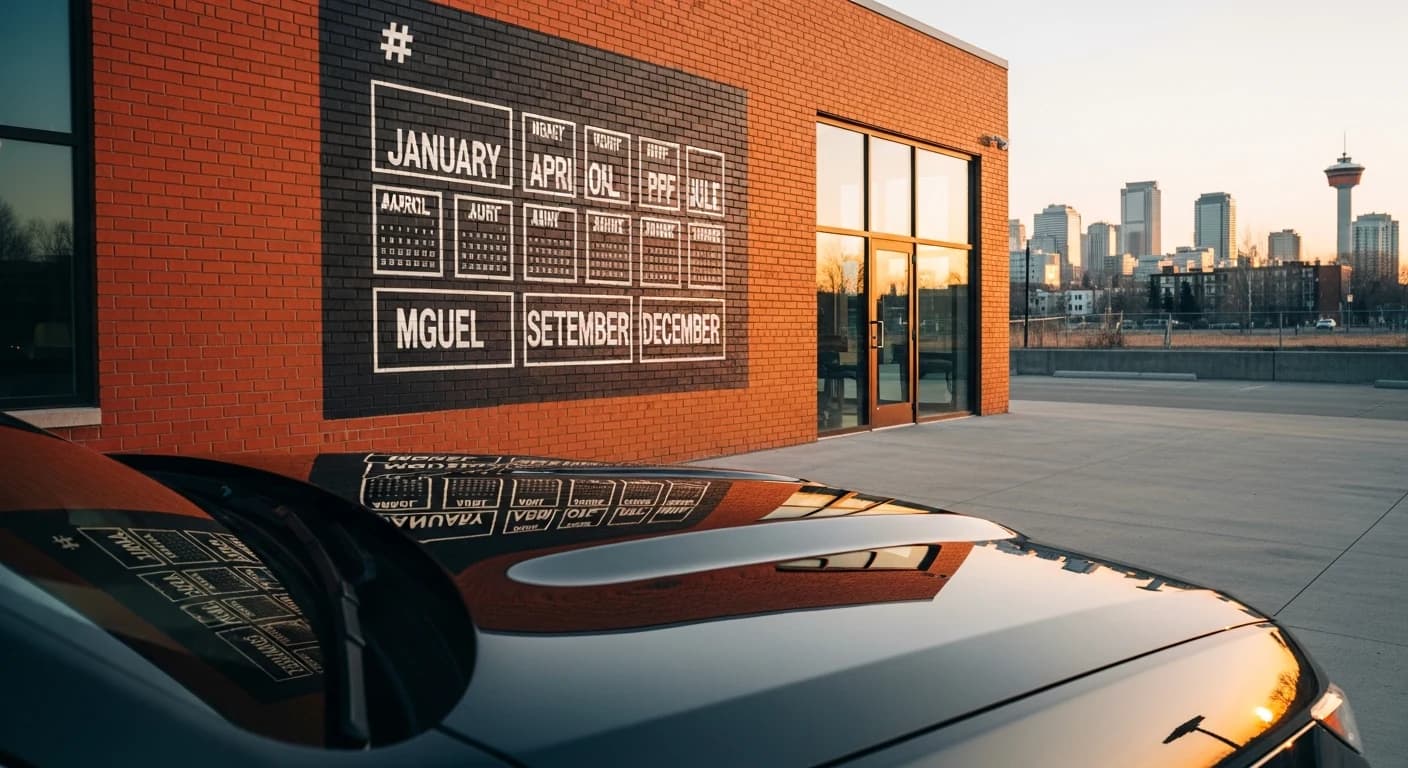
The two best months to install paint protection film in Calgary are late April through late May (post-gravel-sweep, pre-hail) and early September through mid-October (post-construction, pre-salt). Both windows give you stable shop calendars, the lowest lead times outside the deep-winter lull, and protection in place before Calgary's next batch of paint damage hits. Late November through February is the underrated dark horse — shop calendars are wide open, pricing pressure is at its lowest of the year, and our climate-controlled bay holds 18–22°C regardless of what's happening outside. The only objectively bad timing is waiting through the November–March window with unprotected paint while road salt and chip-seal grit do permanent clear-coat damage. Today's date matters: if you're reading this in mid-June 2026, our shop is in peak hail-season booking pressure right now — front-end and moonroof bookings have a 3–4 week lead time, but post-Stampede (late July) and September windows still have wide-open capacity. Climate-controlled means month doesn't dictate quality; it dictates timing of when you stop losing paint.
Every week our shop fields the same call from a Calgary owner: "Is it too late in the year to do PPF, or should I wait until spring?" The honest answer is that the install month matters far less than most generic timing guides admit — our bay runs at the same 18–22°C in January as it does in July — but the calendar around your install matters a lot. Booking lead times, hail-season capacity, pre-delivery scheduling, lease-end math, and the months of paint damage you avoid between now and your appointment all shape what "best month" actually means for your vehicle. This guide is the month-by-month calendar we use internally, written for Calgary drivers and Calgary roads. If you're still hunting for a Calgary PPF shop close to your postal code, start with our neighbourhood picker before locking a date.
We see roughly 60% of our annual install volume in two compressed windows: late April through Stampede week, and early September through Remembrance Day. The rest of the year is meaningfully slower — which most Calgary owners interpret as "the wrong time" when it actually means "the best service experience, shortest lead time, and most attentive scheduling." In a typical February or July-30, we can take a new customer from initial quote to install in under 10 days; in a typical late May or early September, that same install slots in 3–4 weeks out. The customers who get the best outcomes are the ones who treat the booking-pressure curve as a planning input rather than waiting for the "right" season.
Reviewed by Calgary PPF Pros — Consumer Choice Award winner, protecting Calgary vehicles since 2021.
The Two Optimal Windows (And Why)
If you want the single best calendar pick of the year — and you have flexibility on timing — book your install between April 20 and May 30 or between September 5 and October 15. Both windows share three characteristics that make them stand out: stable shop temperature and humidity outside the bay (relevant only to vehicle acclimation, not film application), no acute capacity pressure from hail-damage or post-winter-damage replacement work, and immediate protection from the next batch of seasonal damage. The April–May window catches the start of gravel season on Deerfoot, Stoney Trail, and Highway 2; the September–October window catches the start of road salt and the early-winter chip wave. In both, you get the film on your vehicle right before the damage that would otherwise be hitting it.
Month-by-Month Calgary PPF Calendar
This is the table we use internally to give honest scheduling advice. Climate-controlled installs are quality-equivalent across every month — the differences below are about booking pressure, immediate protection value, post-install conditions, and pricing context.
| Month | Booking Pressure | Lead Time | Immediate Protection Value | Best For |
|---|---|---|---|---|
| January | Low | 3–7 days | High — salt + chip-seal grit attacking unprotected paint daily | Existing-owner pre-spring prep; lease-end vehicles; calendar flexibility |
| February | Low | 3–7 days | High — final 8 weeks of salt season ahead | New-car owners taking January delivery; pre-spring planning |
| March | Building | 1–2 weeks | Very high — gravel sweep starts mid-month | Lock in before April rush; mid-cycle leases |
| April | High (late month) | 2–3 weeks | Peak — fresh chip-seal + Stoney Trail gravel | Pre-Rockies trip prep; post-winter-damage owners |
| May | Very high | 3–4 weeks | Peak — pre-hail urgency | Pre-hail-season front-end + moonroof film; pre-Stampede prep |
| June | Peak (now) | 3–4 weeks | Active hail risk; bug season; lake-day water spots | Urgent pre-summer-trip; pre-hail moonroof; existing-owner top-ups |
| July | High (early), Low (late) | 2–3 weeks → 1–2 weeks | Mid-summer bug + UV exposure | Pre-Calgary-Stampede; post-Stampede catch-up |
| August | Medium | 2 weeks | Tail end of hail; pre-back-to-school | Late-summer delivery; pre-fall scheduling |
| September | High (rebuilding) | 2–3 weeks | Peak fall — pre-salt window | Pre-winter prep; lease-end fall vehicles; fall trip planning |
| October | High (early), tapering | 2 weeks → 1 week | Critical — last clean install window before salt | Pre-winter; combined undercoating + PPF visits |
| November | Tapering | 1–2 weeks | Strong — salt season active | Late-fall deliveries; pre-holiday gift installs |
| December | Low | 5–10 days | Strong — full salt season exposure | Holiday-gift installs; year-end budget closeouts |
June 2026 Reality Check
If you are reading this in mid-June 2026: front-end PPF bookings inside the next two weeks are tight because hail-season replacement work and pre-Stampede installs are filling bays. If you can wait until late July (right after Stampede), you'll get a meaningfully easier scheduling window. If you need protection NOW — particularly pre-hail moonroof film — call to check the cancellation list rather than the front-of-queue lead time, because hail-claim shifts open up bay capacity unpredictably. Read our guide on Alberta hail season and your car's paint for the front-end + moonroof bundle that pre-empts the worst summer damage.
The Three Variables That Actually Matter
Generic timing guides written for the U.S. South cite outdoor air temperature as the dominant install variable. That's a sea-level, mild-climate assumption that doesn't survive contact with Calgary. The three variables that actually shape your install timing here are different.
Variable 1: Calgary Shop Capacity, Not Outdoor Weather
Every Calgary PPF studio worth booking with operates a climate-controlled installation bay year-round — 18–22°C, 40–50% relative humidity, filtered air, controlled lighting. Outdoor temperature is a non-factor once the vehicle is inside and warmed to ambient. What does shift dramatically through the year is shop capacity. May, June, and September are 3–4× busier than January, February, or late July. If you book during a slow month, your installer is genuinely able to spend more discretionary time on edge wrapping, hidden corners, and pre-install paint inspection. If you book during a peak month, the install is still excellent but the surrounding service experience is leaner.
Variable 2: How Many Months of Damage You Avoid
The single biggest cost of waiting is not the install price — it's the paint damage your unprotected vehicle accumulates between now and the appointment. Calgary daily drivers on Deerfoot, Stoney Trail, Highway 2, or Highway 1 typically accumulate $40–120/month of chip-touch-up-equivalent damage during gravel season and $30–80/month of salt-etching and chip-seal damage during salt season. Waiting six months "for better timing" routinely costs $300–700 in pre-install damage that the new film then locks in place — film bonds to the chip rim and prevents future deterioration, but doesn't undo what's already there. The rational choice in most cases is "install in the next available bay slot" rather than "wait for the perfect month." See our deeper analysis of applying PPF over existing rock-chip damage for the cost math.
Variable 3: The 30-Day Post-Install Conditions
Every PPF install has a 30-day cure window during which automated brush washes are off-limits, edge contact (gas pumps, parking-stall hardware, snow scrapers) should be minimized, and pH-neutral wash methods are required. The conditions during that 30 days do matter, but not in the way most owners assume. A January install means the wash window overlaps with peak salt — you need to use touchless or hand-wash methods through February. A July install puts the wash window in clear weather but exposes uncured edges to a higher bug-splatter and tree-sap load (see our bug splatter and mosquito paint damage guide for what we mean). A September or April install lands the wash window in mild, low-grime conditions, which is part of why those are the optimal windows.
Booking Lead Time by Season — What to Actually Expect
Deep Winter Lull (Jan–early Mar)
3–7 daysWide-open bay calendars. 3–7 day lead time. The cheapest pricing pressure of the year. Best for owners who value a relaxed scheduling experience, want a long pre-install consultation, or are stacking PPF with paint correction (we have more bench time for prep work).
Spring Rush Build (Mid-Mar–Apr)
1–3 weeksBooking pressure ramps fast as Calgary owners react to the first rounds of spring chip-seal. Lead time stretches from 1 week in mid-March to 3 weeks by late April. Book by April 1 to land an early-May install slot.
Peak Spring (May)
3–4 weeksThe single busiest month of the year. 3–4 week lead times standard. Pre-hail urgency drives moonroof and front-end bookings; pre-Rockies trip prep drives full-front installs. Book 4+ weeks ahead if you have a specific install date in mind.
Hail-Season Plateau (Jun)
3–4 weeksSustained high pressure. Net-new installs compete with insurance hail-damage replacement work for bay time. 3–4 week lead times persist. Pre-Stampede booking spike in late June.
Post-Stampede Window (Late Jul)
1–2 weeksOne of the year's two underrated low-pressure windows. Tourists leave, locals defer to fall, lead times drop to 1–2 weeks. Best mid-summer booking window outside the deep-winter lull.
Fall Pre-Winter Rush (Sep–early Oct)
2–3 weeksSecond-busiest period of the year. Owners book to beat salt season; lease-end fall vehicles drive a wave of pre-turn-in installs. Lead times: 2–3 weeks. Book by August 25 to lock in a September install.
Late-Fall Tail (Mid-Oct–Nov)
1–2 weeksPressure tapers from peak to medium. Lead times drop to 1–2 weeks. Strong window for owners who missed the September rush or are layering undercoating, ceramic, and PPF on the same visit. See our fall pre-winter strategy in the linked checklist below.
December Wind-Down
5–10 daysCalendar opens up. Lead times drop to 5–10 days outside of statutory-holiday weeks. Year-end budget-closeout customers and holiday-gift installs are the dominant pattern. Strong window if January is your target install month.
Special-Case Timing Decisions
New Vehicle Pre-Delivery
Schedule PPF within the first 1,000 km of ownership, ideally within the first two weeks of delivery. Calgary's first-commute damage rate is high enough that even a single round-trip Airdrie or Okotoks run can leave a measurable chip on a bare hood. If your delivery falls in May–July, treat the PPF booking as a separate logistics step from the delivery itself — book the bay slot before you confirm the delivery date with the dealer. Do not let the dealer apply paint sealant, ceramic, or any "protection package" in the 72 hours before your install — those products contaminate the bond surface and we have to charge a full decontamination pass to remove them. For the full drive-home-to-install-day sequence — transport film, dealer wax, drive-vs-flatbed, and the exact pre-PPF decon protocol — see our delivery-day playbook for the first 48 hours after pickup.
Lease-End Strategy
Most leased vehicles in Calgary accumulate $800–2,400 in chargeable paint damage over the final 12 months. A Standard PPF Full Front package at $1,299–1,799 routinely pays back inside one lease-end inspection. Best timing within a remaining-lease window: if your lease ends May–August, install in the prior October–November. If your lease ends October–December, install in April–May. If you have fewer than four months remaining, install immediately in the next available slot — partial protection still reduces inspection charges, and any damage already on the vehicle is locked in regardless.
Pre-Mountain-Trip and Pre-Stampede
For pre-Rockies trips (Icefields Parkway, Highway 1A, unpaved Kananaskis routes), book at least 30 days before departure so the wash-restriction window closes before you start cleaning mountain road grime. Mid-April through mid-May is the optimal window for July–August Rockies trips. Pre-Stampede installs need to be booked by mid-May at the latest to land an install before the late-June bay-pressure peak — front-end and rocker coverage is the most-requested package for Stampede-week parade-route and parkade exposure. For visiting-relative parking and out-of-town tourist crowds, see our Calgary Stampede 2026 car protection guide for the parkade strategy and timing checklist.
Post-Damage Paint Correction Cycles
If your vehicle has accumulated visible chips, swirl marks, or salt-etching haze, the right sequence is paint correction first, then PPF — not the other way around. The optimal calendar for that combined visit is February–March for paint correction followed by an April–May PPF install, which gives the corrected paint a clean 4–6 week curing window before the film locks it in. Compressing both into a single visit is possible but adds 1–2 days to the appointment block.
Winter PPF in Calgary — The Underrated Window
The most persistent myth in Calgary PPF timing is that winter installs are lower quality, riskier, or weather-dependent. None of it is true for installs done in a properly climate-controlled bay. Our installation environment is held at 18–22°C and 40–50% relative humidity year-round — identical to a July afternoon. The vehicle takes 4–6 hours to acclimate from -25°C parking-lot ambient to bay temperature, which we build into the scheduling block rather than charge for. Once acclimated, the film application, edge wrapping, and cure are identical to any other month.
The Pros
- Shop calendar is wide open — 3–7 day booking lead times typical
- Pricing pressure is at its annual low; promotional windows are common
- Stops salt and chip-seal damage that same day rather than letting it accumulate through spring
- Installer has more bench time for paint inspection, edge wrapping, and pre-install prep
- Lease-end vehicles get a full clean-winter exposure under film before turn-in inspection
The Cons
- First 30-day wash window overlaps with peak salt — touchless or hand-wash only
- Vehicle needs 4–6 hours to warm to bay temperature before install begins
- Pre-install decontamination wash is more involved when winter road grime is frozen on
- Visible curing edges are harder to inspect outdoors in low-light winter conditions
For a deeper look at the winter-install logistics — including how we handle the warm-up window, the salt-season wash protocol, and the customers who get the most value out of a January or February install — see our standalone guide on whether PPF can be installed in Calgary winter.
Three Timing Myths Calgary Owners Believe (And Shouldn't)
Myth 1: "Spring is the only good time." Spring is one of two good times, but it's also the most crowded — booking pressure peaks May 1 through Stampede week. Fall (September–October) is equally optimal, has slightly lower lead times, and lands the wash window in mild conditions — it's also the pre-back-to-school window for U of C, SAIT, MRU, and Bow Valley families (our 2026 student vehicle protection playbook walks through what to book by August 25 for a Sept 3 install). Winter is the cheapest and fastest scheduling window of the year.
Myth 2: "Cold weather affects PPF adhesion." It does — outdoors. Climate-controlled bays neutralize the issue entirely. Outdoor mobile installations in Calgary winter are a real quality risk and should be avoided. In-shop winter installations are equivalent to any other month.
Myth 3: "I should wait until next spring." The damage your unprotected paint accumulates between now and "next spring" is almost always more expensive than the timing convenience. Six months of waiting through gravel and salt season typically costs $300–700 in damage that locks in under the future film. Install in the next available slot if your bay calendar permits.
Your Decision Tree, in One Paragraph
If you have full timing flexibility: target April 20 to May 30 or September 5 to October 15. If you want the fastest scheduling and lowest pricing pressure: target January, February, late July, mid-October, or December. If you have an existing booking trigger — pre-delivery, lease-end, pre-Rockies trip, pre-hail-season, pre-winter — book within the lead time for your target month, plus one buffer week. If you're reading this in mid-June 2026: late July gives you the best combination of bay availability and immediate protection from the rest of summer; pre-hail moonroof film should be booked from the cancellation list rather than the front of queue. The honest north-star: the best month to install PPF in Calgary is the month it gets on your vehicle before the next batch of damage.
Whichever month you pick, the right starting point is choosing your coverage tier — see our current Calgary paint protection film packages, or if you're stacking PPF with a ceramic top-coat for the wash-window months, our Calgary ceramic coating service. To prep your vehicle before the appointment, our walk-through of how to prepare your car for a PPF appointment covers the 48-hour pre-install rules and what to flag at drop-off. And if you're combining PPF with the rest of the fall protection stack, the fall pre-winter protection checklist covers the undercoating and ceramic refresh that pairs naturally with a September visit.
The 30-Second Calgary Booking Check
- Vehicle delivery in next 60 days? Book the install before delivery date is locked.
- Lease ends within 12 months? Install in the next available bay slot — payback is almost certain.
- Rockies trip in next 90 days? Book 30+ days before departure to clear the wash window.
- Hail-anxious about moonroof? Book by late May, or check the cancellation list in June–August.
- Full flexibility? Target Apr 20–May 30 or Sep 5–Oct 15.
Calgary roads are unusually hard on paint year-round — chip-seal grit in spring, hail and lake-fly hatches in summer, magnesium-chloride brine and gravel-sand mix in winter. The calendar matters for scheduling, not for whether the install will succeed. Pick the window that fits your damage exposure, your booking flexibility, and your post-install wash conditions — and don't let a perfect-month search cost you another season of paint damage.
Frequently Asked Questions
Experience The Best.
Don't let another commute compromise your vehicle. Get a quote from Calgary's Consumer Choice Award winner today.
Explore Our Services