Calgary Snowbird Car Prep: The 8-Week Playbook Before You Fly South (Fall 2026)
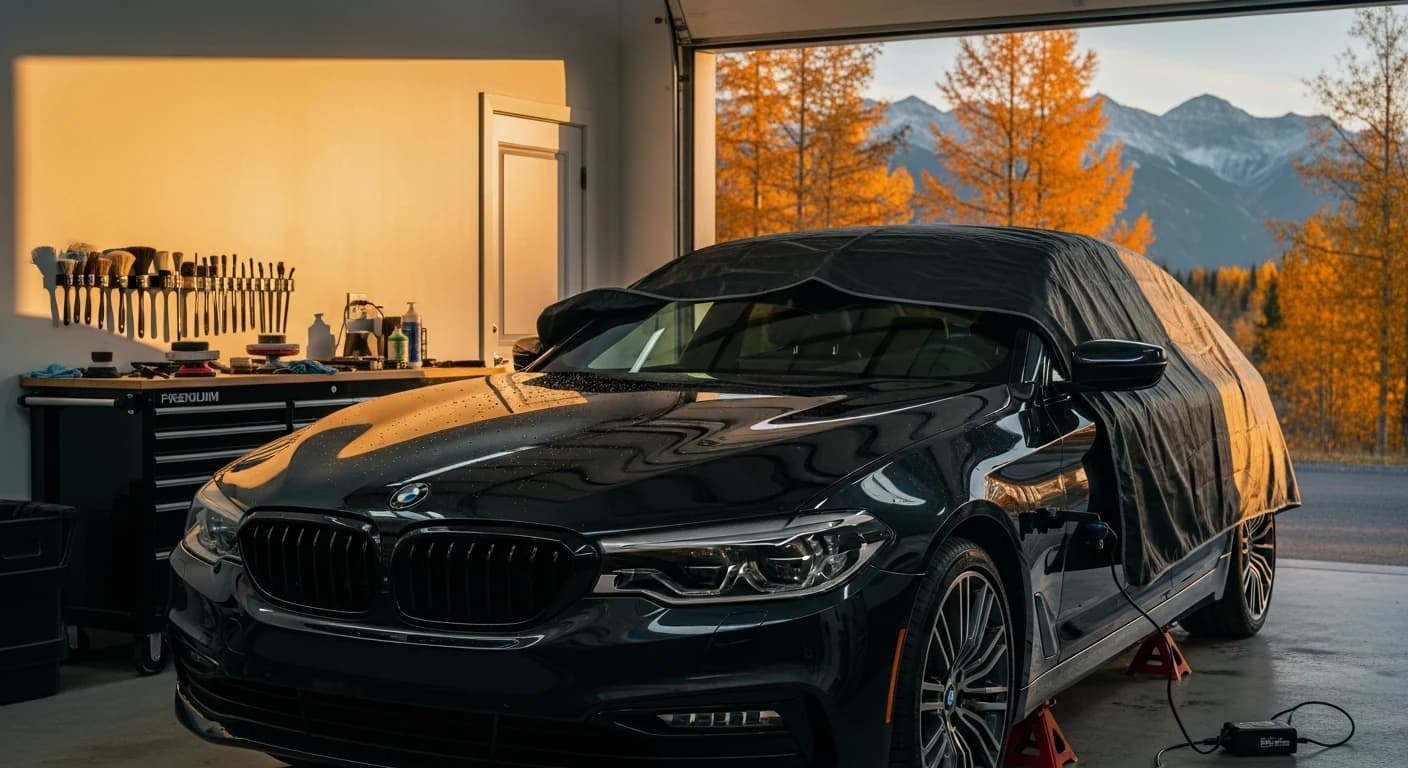
Calgary snowbird car storage and prep is an 8-week countdown, not a last-week scramble. Book paint decontamination, PPF, and ceramic coating by mid-September for a late-October or early-November departure — PPF needs 7–14 days of dry cure before highway exposure and ceramic needs 5–7 days plus a 2–3 week hardening window. Drivers heading to Arizona, Palm Springs, Florida or Baja want the Full package ($3,499–$5,499): full-front PPF, rocker panels, A-pillars, wheel ceramic, undercoating, and a return-day reactivation. Flyers whose car stays garaged Nov–Apr pick Essential or Standard ($799–$2,899): the parked-car scenario is protected far more by fresh ceramic, an AGM-compatible smart battery tender, silica-gel desiccant, and a breathable indoor cover than by film-heavy coverage. Book the April return-day appointment before you leave — locked pricing beats the walk-in April rush.
Calgary sends roughly one in eight retirees south for the winter — a snowbird population large enough (the Canadian Snowbird Association counts over 1 million Canadian snowbirds annually) that Air Canada and WestJet add direct-to-Phoenix daily service every October. Most of those travellers spend six weeks planning the trip and forty minutes planning what happens to the vehicle sitting in the garage back home. That imbalance produces April phone calls we know by heart: rust-welded parking brakes, mildew on cloth seats, cracked clearcoat under a plastic tarp, and dead comfort modules on the German luxury sedans that drained parasitic loads through a five-month absence. The 8-week countdown below is the shop-side playbook we walk snowbird clients through every September — same protocol, whether the car is heading to Yuma with them or staying in a heated garage in Silver Springs.
Every September through October we run 20–35 dedicated snowbird prep packages a week — the majority Calgary vehicles heading to Arizona and Palm Springs, plus a growing share of clients driving to Baja and Gulf Coast Florida. We see the same pattern in April: clients who pre-booked a return-day reactivation appointment during fall install come home to a vehicle that looks the day it parked, while walk-ins pay $400–$800 more for the same combination of decontamination, ceramic booster, and battery diagnostic. The 8-week countdown below is our own scheduling framework — the same one our concierge coordinator uses when a snowbird client calls in mid-September.
Reviewed by Calgary PPF Pros — 4× Consumer Choice Award winner, protecting Calgary vehicles since 2021, 5.0★ rated across 90 verified reviews.
The 8-Week Countdown — What to Book, When
The single-biggest snowbird-prep mistake is calling the studio in mid-October and expecting a full-service install before a November 1 departure. That window does not exist. PPF, ceramic, and undercoating each need cure time in sequence, and every Calgary premium-detail bay is stacked in October with clients who booked in August. Working the calendar backwards from your departure day gives you the eight-week runway the physics actually require.
Book the Studio
Week 8Second week of September. Lock in a mid-October install slot. Peak snowbird season books out two to three weeks in advance and the good bays go first.
Paint Decontamination + Correction
Week 7Iron remover, clay-bar decon, and a single-stage polish. This is the substrate every layer above bonds to for the next five years — skipping it is the fastest way to trap sap and iron contamination under film.
PPF Install Day
Week 6Full-front for drivers heading south, partial-front for garaged flyers who want spring-drive protection ready. Wrapped-edge finish everywhere film meets paint — no flush cuts on cars that will see chinook cycles.
PPF Cure + Edge Inspection
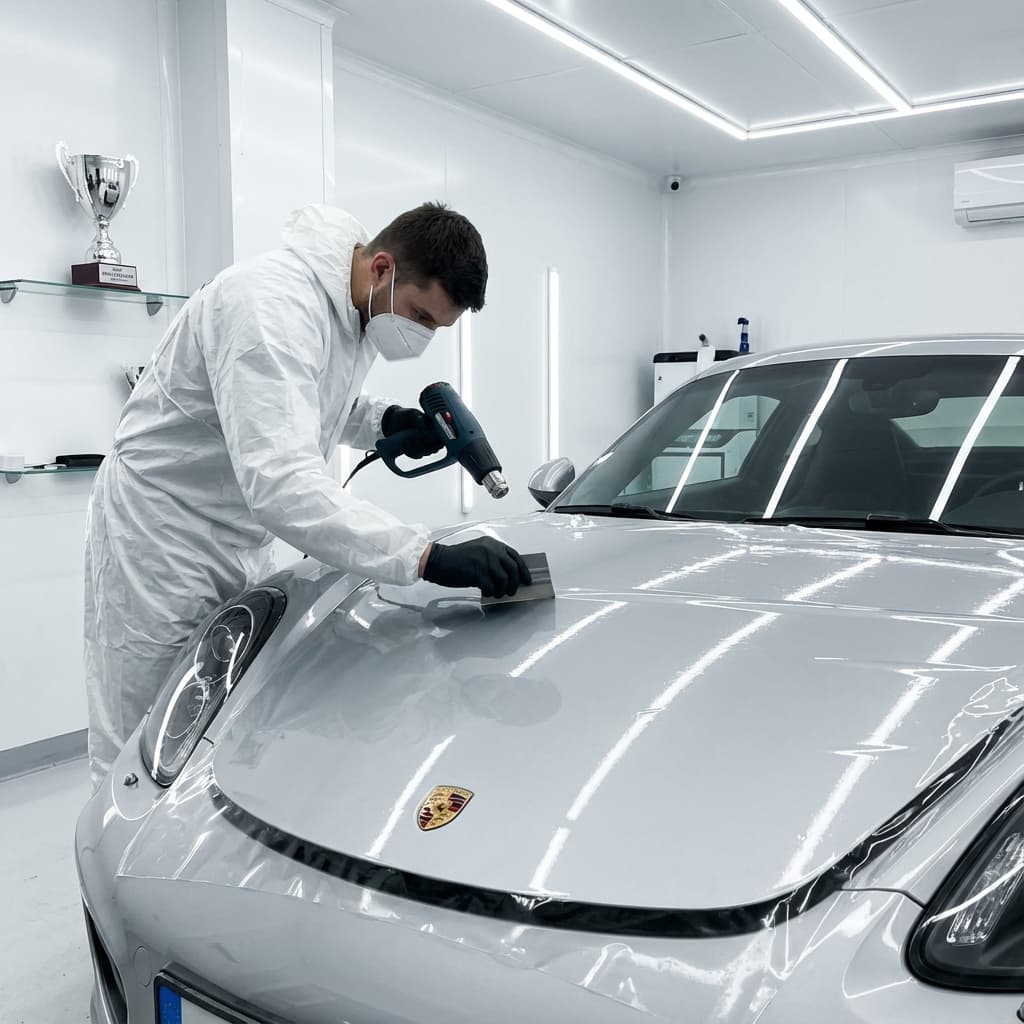
Week 5Seven to fourteen days of dry cure before any highway driving or a car cover. Return to the studio on day ten for a workmanship edge inspection while the shop is still your recourse.
Ceramic Coating Application
Week 4Applied over cured PPF and bare paint zones. Ceramic climate-cures indoors for five to seven days and reaches full hardness at week seven. This is the layer that keeps a garaged car spotless during storage.
Wheels + Interior Protection
Week 3Wheels off, faces and barrels ceramic-coated for brake-dust release. Leather and fabric conditioner. First round of silica-gel desiccant on the floor mats and one tub in the trunk.
Undercoating + Storage Prep
Week 2Oil-based undercoating for the spring return drive. Fuel stabilizer added to a topped-off tank. Tire pressure raised 3–5 PSI over spec. Battery health check — replace if load-test flags weakness.
Final Storage Protocol
Week 1Smart battery tender installed. Wheel chocks placed. Parking brake off. Breathable indoor cover on. Windows cracked 5 mm. Insurance photos taken and emailed to yourself.
A snowbird client who calls the studio the last week of October needs to accept one of two outcomes: pick a scaled-back package that fits the compressed window (ceramic booster instead of full ceramic, no PPF, storage prep only), or delay departure by two weeks. Neither is fun — which is why the September call is the entire game. Related to install-timing more broadly, our month-by-month PPF booking calendar for Calgary lays out exactly which weeks the shop is stacked and which weeks a walk-in wins.
Why PPF and Ceramic Timing Matters More in Fall
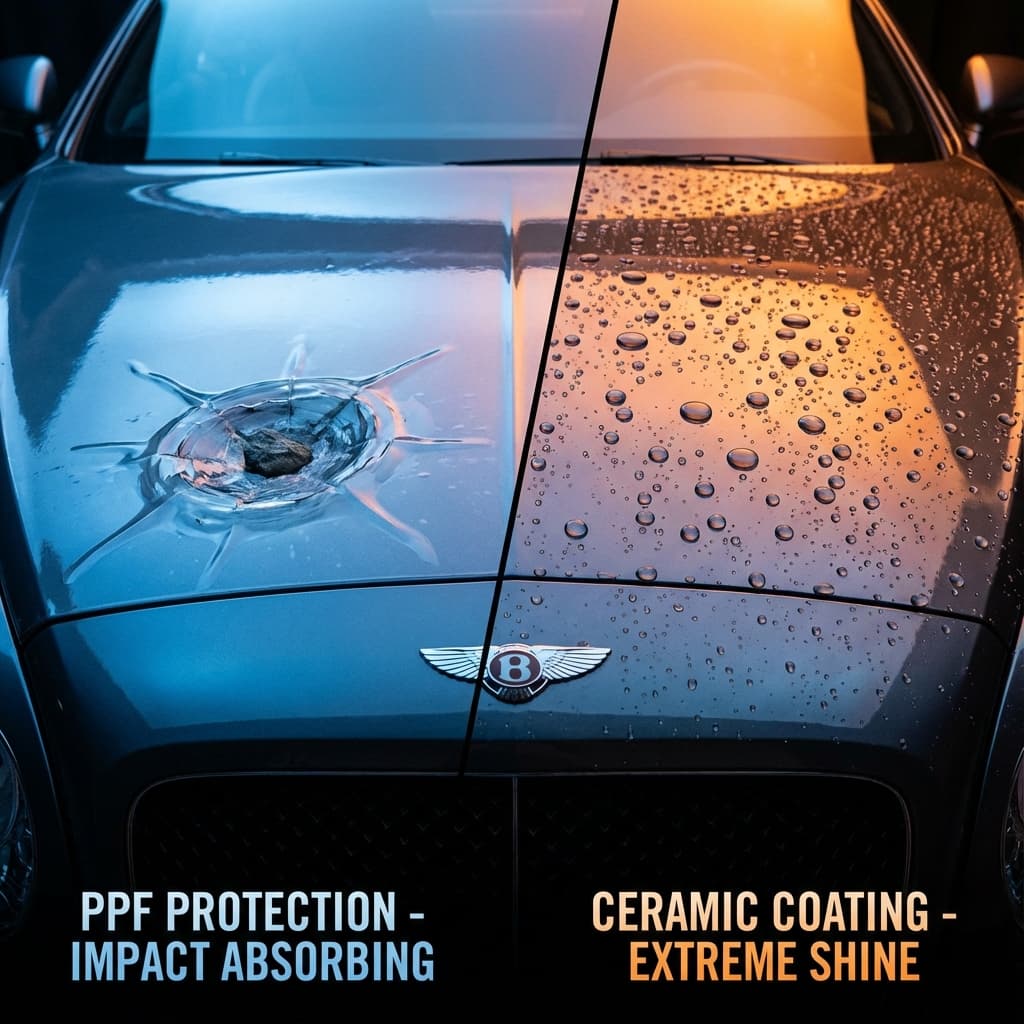
Both PPF and ceramic coating cure by evaporating solvents out of a polymer matrix that then cross-links to reach final hardness. Cool ambient temperatures slow that process — a ceramic that flash-cures in 24 hours at 22°C needs 48–72 hours at 12°C, and cross-links continue for weeks. Calgary garage temperatures in October run 8–16°C without heating and 14–18°C with heating on a thermostat setpoint. That range is workable but adds real days to every stage in the chain. A shop that rushes the cure by delivering the car early usually delivers a coating with softer chemistry than the same product installed in July would show, and edge lift on PPF appears earlier in the film's life. The 8-week runway builds in the temperature-adjusted cure math so the film and coating both hit final hardness before the vehicle sees a highway drive or a car cover.
For the deeper science on how PPF actually cures — the aliphatic-TPU chemistry that makes the film self-heal at all — see our PPF material science explainer. For the chinook-thermal-cycling reason why wrapped edges outlive flush-cut edges on Calgary vehicles, our edge-lift breakdown covers the workmanship-versus-manufacturer distinction that becomes acute during storage temperature swings.
Pick Your Package — Interactive Planner
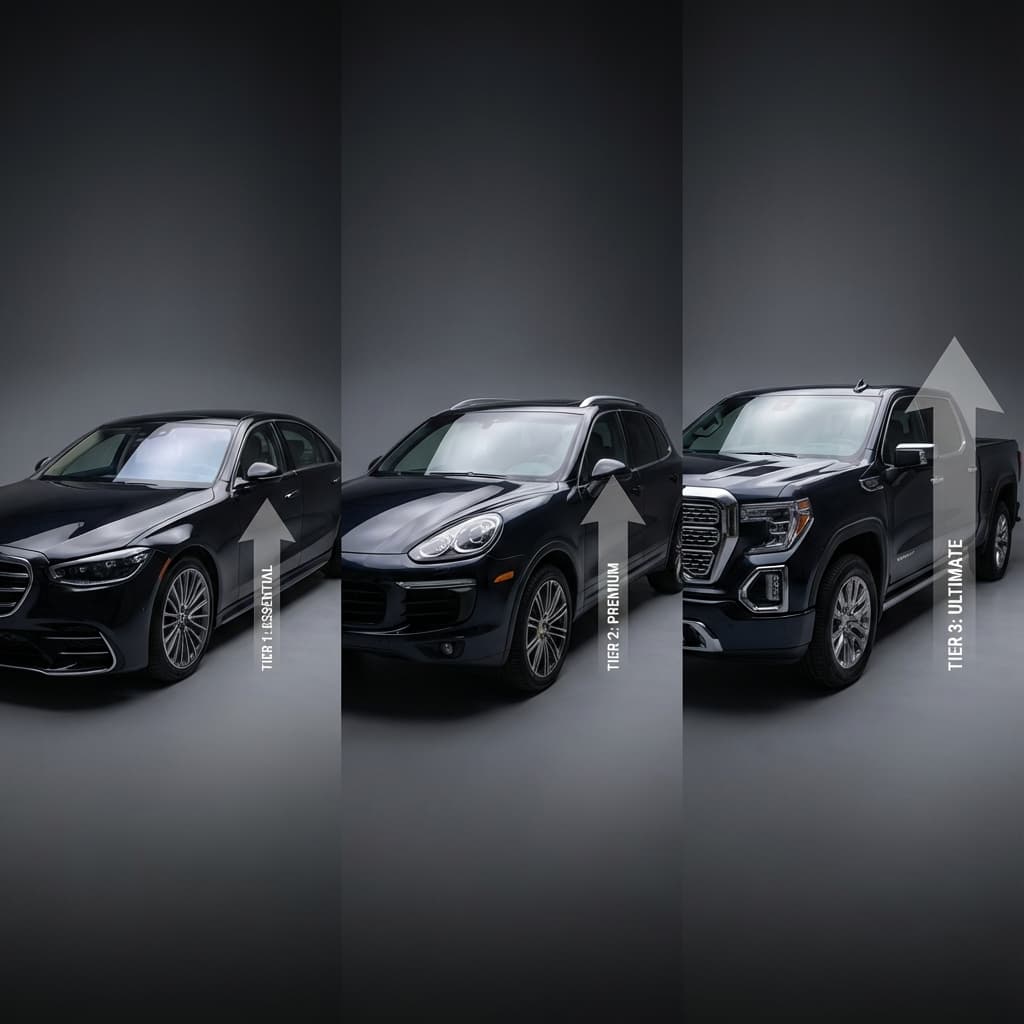
The right prep package depends on two variables: where you're headed and whether you're driving or flying. Drivers who cover 3,000–4,500 km of Prairie-shoulder and Mountain gravel on the way south justify the Full film-heavy package that would be overkill on a garaged vehicle. Flyers who leave the car home for five months justify a coating-and-storage-forward Essential or Standard package that would leave a driven vehicle underprotected. Tap your destination and mode below to see the tier we'd recommend for your situation.
Which Snowbird Prep Package Fits Your Fall?
What's in the Full package: Standard stack + full-front PPF + rocker panels + A-pillars + return-day reactivation package.
3,200 km round-trip on I-15 and I-40 hits the same gravel-and-brine mix that shreds Calgary front ends every spring — full-front PPF pays for itself before you cross the border.
Those three package tiers are the ones we quote most often — every Calgary studio uses similar language even when the exact line items vary. For the film-only side of the decision on high-mileage drivers heading south, our full-front vs partial-front PPF comparison lays out which coverage matches which driving profile.
Calgary 2026 Snowbird Package Costs
Pricing bands below reflect what Calgary premium-detail studios actually charge in fall 2026 for a mid-size sedan or crossover — full-size trucks and three-row SUVs sit at the top of each band, small hatchbacks and coupes at the bottom. Return-day reactivation is priced as an add-on line but locked at fall-install rate when pre-booked with the initial package.
| Package | Best For | Included | Calgary 2026 Cost |
|---|---|---|---|
| Essential | Flying — car garaged Nov–Apr | Paint decon + full-body ceramic + battery tender + silica-gel desiccant + storage inspection | $799–$1,499 |
| Standard | Flying with occasional driving OR short drives south | Essential stack + partial-front PPF (hood, fenders, mirrors) + wheel ceramic + interior conditioner | $1,899–$2,899 |
| Full | Driving to Arizona, Palm Springs, Baja, Florida | Standard stack + full-front PPF + rocker panels + A-pillars + oil-based undercoating | $3,499–$5,499 |
| Return-Day Reactivation (add-on) | Every snowbird | Snow-foam pre-soak wash + ceramic booster + tire pressure reset + undercarriage rinse + battery tender disconnect + interior wipe-down | $299–$599 |
The Full package looks steep on paper, but a driver returning from Baja without film routinely comes back with $1,200–$3,000 of rock-chip repair to the leading edges — a bill that never lands on the pre-wrapped vehicle. Our full 2026 Calgary PPF cost breakdown covers the underlying film pricing that shapes each of the tiers above.
The Storage Protocol — Six Non-Obvious Details
Ninety percent of snowbird vehicle prep advice online is a fuel-stabilizer-and-battery-tender checklist. The six details below are the ones that separate a return-day drive-away from a return-day tow-and-shop visit — the calls we take every April from clients who missed one.
Parking brake stays OFF, wheel chocks stay IN
A parking brake left engaged for 5+ months rust-welds the pads to the rotor. On modern electronic parking brakes, this often requires a caliper service and pad replacement. Place a wheel chock behind one rear tire and leave the transmission in Park (auto) or first gear (manual) — same immobilization, no rust-weld.
Battery tender must match battery chemistry
Modern vehicles use flooded, AGM, or lithium batteries — each needs a compatible charger. A flooded-only trickle charger applied to an AGM battery in a BMW, Mercedes, Volvo, Audi, or Range Rover will overcharge and shorten battery life. Buy a smart tender that auto-detects chemistry — the CTEK MXS 5.0 (see the <a href="https://www.ctek.com/us/en/mxs-5-0" target="_blank" rel="noopener nofollow" className="underline hover:no-underline">chemistry-detection spec</a>) or NOCO GENIUS10 are the two Calgary specs we recommend.
Fuel stabilizer for any absence over 60 days
E10 pump gasoline oxidizes and phase-separates within 90 days at room temperature. Add a fuel stabilizer (Sta-Bil, Star Tron, or equivalent) to a topped-off tank the day before the last drive, then run the engine 10 minutes to circulate treated fuel through the injectors. This is a $12 consumable that saves a $600 fuel-system cleaning on return.
Silica-gel desiccant beats a dehumidifier
Two 500g tubs of reusable silica-gel desiccant on the floor mats and one in the trunk absorb roughly 200g of ambient moisture over a five-month storage window — enough to keep leather seats supple and cloth seats mildew-free. A garage dehumidifier is expensive to run and does not concentrate moisture reduction inside the cabin where it matters.
Breathable indoor cover only — never a tarp
Non-breathable outdoor covers or plastic tarps trap ambient humidity against the paint and etch the clearcoat within 90 days. A spun-polyester or brushed-cotton indoor cover ($120–$250) wicks moisture away and is scratch-safe against fresh ceramic. Skip the cover entirely if your garage is dust-controlled and the vehicle has fresh ceramic — the coating handles light settling dust.
Windows cracked 5 mm, exhaust tip loosely foiled
A 5 mm crack on all four windows allows equalization of internal humidity without letting rodents in. Cover the exhaust tip with a loose foil cap held by a rubber band to prevent mice from nesting in the muffler over winter — a $600 repair we see every April on garaged vehicles that skipped this step.
For the deeper winter-specific care manual on ceramic-coated vehicles that will see any Calgary road time before or after storage, our winter wash technique for ceramic-coated cars covers the pressure-washer PSI and foam-cannon protocol that keeps the coating intact through the season.
Return Day — What Happens in April
The single-biggest ROI item on the entire snowbird prep list is booking the return-day appointment before you leave. Locked pricing beats the April walk-in rush by $200–$400, and the shop reserves a slot for your specific vehicle so the reactivation package is ready the morning you fly home. A pre-booked return day protocol takes 3–4 hours and includes:
- Snow-foam pre-soak exterior wash — lifts any settled dust and light garage-floor efflorescence without contact scratching.
- Ceramic booster spray — refreshes hydrophobic properties suppressed by five months of stationary storage and restores water beading to fall-install levels.
- Undercarriage brine rinse — flushes any residual storage-lot brine that migrated in on garage-tire tracks.
- Tire pressure reset to spec — the 3–5 PSI over-inflation from fall bleeds down naturally, then gets set exactly at door-jamb spec for the first spring drive.
- Desiccant removal + interior wipe-down — both silica-gel tubs pulled, leather quick-wiped, glass cleaned inside.
- Battery tender disconnect + pre-drive health check — voltage load-test to confirm the battery survived storage, tender removed and stowed.
Cars that come home to a booked return-day appointment hit the road looking exactly like the day they parked. Cars that skip the step usually need a $400 April detail plus a $200 wheel service in the first month back — same total cost, worse timing, and no bay reservation. For the broader ceramic maintenance framework across a full Calgary year, our ceramic coating maintenance guide covers the quarterly touchpoints beyond the return day itself.
Six Mistakes We See Every April
Parking brake left engaged all winter
Rust-welds pads to rotors. Modern electronic parking brakes on BMW / Mercedes / Volvo / Land Rover often require a caliper service and pad replacement — $400–$900 you did not budget for.
Cheap outdoor tarp instead of a breathable cover
Traps humidity against paint and etches clearcoat inside 90 days. Correction plus refinish on a single panel starts at $600 and often reaches $1,500 by the time colour-match is done.
No fuel stabilizer in a topped-off tank
Ninety-plus days of ethanol-blend gasoline phase-separates. Injectors gum. A $12 bottle of Sta-Bil the day before departure prevents a $600 fuel-system service on return.
Windows fully closed, cabin humidity uncontrolled
Interior humidity climbs to 70–80% RH during chinooks and grows visible mildew on cloth seats and headliners. A 5 mm window crack fixes this for free.
Wrong battery tender chemistry match
A flooded-only trickle charger on an AGM or lithium battery overcharges and shortens life. On German luxury vehicles this often triggers a dealer reprogramming of comfort modules — $200–$450 in dealer time.
No exhaust-tip rodent cap
Mice nest in mufflers over winter. Cleaning and (in bad cases) replacing a rodent-fouled muffler runs $300–$900. A foil cap held by a rubber band takes 30 seconds and prevents the entire scenario.
Snowbird Vehicle Prep — Pros and Cons
The Pros
- Fresh ceramic + PPF applied before storage protects the vehicle through both the driving and the parked phases of the six-month absence
- Pre-booked April return-day appointment locks fall pricing and reserves a bay before the April walk-in rush
- Drivers heading south with full-front PPF avoid $1,200–$3,000 of rock-chip repair to the leading edges from Prairie and I-15 gravel
- Undercoating applied to a stationary dry vehicle penetrates seams better than any spring roadside application
- A properly stored vehicle needs no dealer intervention in April — no comfort-module reprogramming, no fuel-system cleaning, no caliper service
The Cons
- The full 8-week runway requires booking by mid-September — later calls scale down the package or delay departure
- PPF cure time is climate-dependent — Calgary October garage temperatures add real days to every stage
- The Full driving package ($3,499–$5,499) is a significant single spend that only pays back if the vehicle actually drives south
- Flyers who leave the car home get less mileage out of full-front PPF than out of ceramic + storage protocol; over-buying the film tier is wasted budget
- Non-breathable outdoor covers or plastic tarps do more paint damage over 5 months than no cover at all — the wrong cover is worse than none
Bottom Line
Calgary snowbird vehicle prep is a September calendar decision, not an October scramble. Book the studio by the second week of September, run the 8-week countdown backwards from your departure day, pick the package tier that matches how the car will actually be used (driven south = Full, garaged flyer = Essential or Standard), and pre-book the April return-day appointment before you leave. The math is straightforward: $799–$5,499 in fall prep prevents $1,500–$4,000 of April repair bills on a routine year and $4,000–$12,000 on the year you get unlucky with brake calipers, fuel systems, or rodent damage. Drivers who cover 3,000+ km of gravel-truck highway on the way south almost always come out ahead on the Full film-heavy tier; flyers whose car sees zero winter road time come out ahead on the coating-and-storage-forward tier. The wrong move is the middle-ground compromise — over-buying film on a garaged car, or under-buying film on a car crossing the border.
Booking a snowbird package in Calgary this fall? Contact our Calgary paint protection film studio in the first week of September for a same-week consultation, a package-tier recommendation matched to your travel plan, and a locked spring return-day appointment. We package fall install with April reactivation — including Calgary ceramic coating and undercoating — for every snowbird client, one price at fall booking, guaranteed bay in April.
Related Reading
Fall Car Protection Checklist Calgary
The broader pre-winter protocol every Calgary vehicle needs — snowbird or not — in September and October.
Best Month to Install PPF in Calgary 2026
The month-by-month booking calendar that shows which weeks the shops are stacked and which are open.
Ceramic Coating Maintenance Guide
The quarterly care framework that keeps ceramic performing through storage, chinooks and spring gravel.
Frequently Asked Questions
Experience The Best.
Don't let another commute compromise your vehicle. Get a quote from Calgary's Consumer Choice Award winner today.
Explore Our Services