PPF Edge Lifting Calgary: Why Chinook Cycles Peel Film
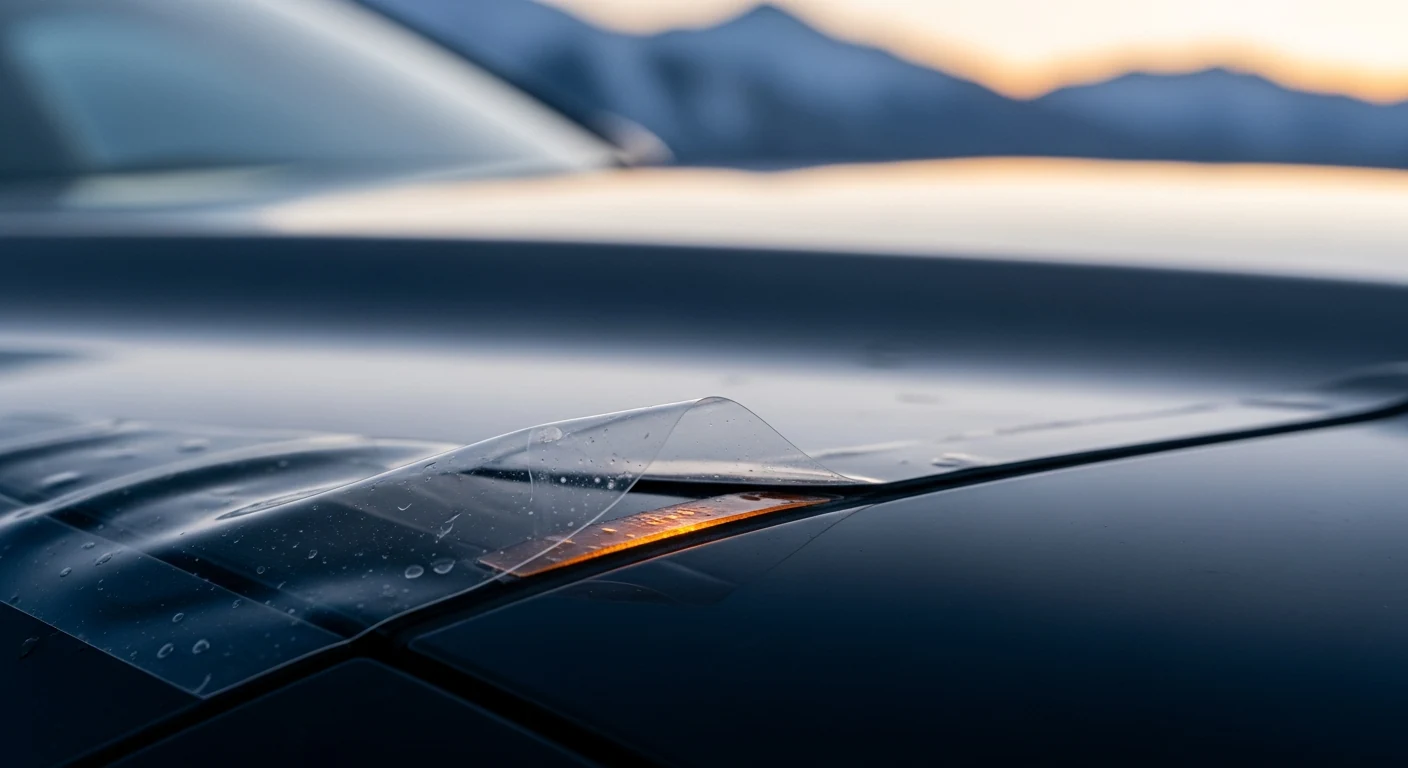
PPF edge lifting in Calgary is rarely just the chinook's fault — it's a workmanship issue that chinook cycling amplifies. Calgary sees 30-40°C same-day temperature swings on chinook days (30-35 of them per winter). A properly wrapped, heat-set edge absorbs that shear stress. A flush-cut or under-heated edge concentrates it, and lifts. Catch a fresh lift inside 2 weeks and it's a $60-150 shop re-tuck. Wait until dirt or salt gets under it and you're looking at $300-800 panel piece replacement. Warranty coverage lives in the installer workmanship guarantee, not the film manufacturer's.
Every Calgary spring we get the same call: a customer with a 2 or 3-year-old paint protection film install from a different shop notices the edge of their hood-piece has lifted a millimeter off the paint. They ask if it's the chinook cycles. Sometimes — but usually it's the install, and the chinook cycles are just doing what wind and cold always do to a stressed adhesive line. Here's what's actually happening under the film, and what a real fix looks like.
We see roughly 8-12 edge-lift diagnostic appointments a month from March through May — the window when winter's cumulative chinook cycling finally shows on marginally-installed film. Of those, about 70% are workmanship problems we can re-tuck for under $150, about 20% are contamination-driven bond failures that need the affected piece replaced, and the remaining 10% are legitimate end-of-life film after 7+ years of Calgary service. What's never been the primary cause: the chinook itself, on a correctly wrapped and heat-set edge. That's the pattern this guide is written from.
Reviewed by Mostafa — Calgary PPF Pros, 4x Consumer Choice Award winner, protecting Calgary vehicles since 2021.
Why Chinook Weather Is Uniquely Hard On PPF Edges
Every major Canadian city sees temperature swings. Calgary's are different in two ways that matter for PPF: they're bigger (a chinook can push same-day temperatures 30-40°C, occasionally more — the Pincher Creek Guinness record was 41°C in one hour, January 1962), and they happen many times per winter (Environment Canada records 30-35 chinook days per season for the Calgary area). No other city on the prairies or in Ontario sees this magnitude of swing at this frequency.
A PPF film is a thermoplastic polyurethane (TPU) sheet, roughly 6-8 mil thick, bonded to your paint by a pressure-activated acrylic adhesive layer. Both the TPU and the acrylic have coefficients of thermal expansion — how much they grow and shrink per degree of temperature change. Both are meaningfully higher than the coefficient of steel, aluminum, or painted composite. In simple terms: when the paint panel heats up, it expands a little; when the film on top heats up, it expands more. That's a shear stress at the adhesive line. A single cycle is trivial. Thirty-five cycles per winter, over 5-8 years, is 200+ stress cycles concentrating at the film's edges — the same way a metal paperclip fails at the bend after enough back-and-forth flexes.
The key word there is edges. In the middle of a bonded panel, film and paint are locked together across a large contact area — shear stress distributes and the bond holds. At an edge, especially a flush-cut edge that's not wrapped under the panel lip, all that stress concentrates at a single line where the film terminates. Every chinook cycle asks that line to hold. A properly installed edge is wrapped 5-10 mm around the panel lip and heat-set — the bond is under compression, not tension, and even large stresses don't peel it. A flush-cut edge sits in tension. Given enough cycles, it walks open.
The Four Causes Of Edge Lift, Ranked
| Cause | What It Looks Like | When It Shows | Fix |
|---|---|---|---|
| 1. Flush-cut instead of wrapped edge | Straight-line lift running along a panel edge; consistent across the length | Any time after 1-2 winters of chinook cycling; often first noticed year 2 or 3 | Re-tuck may be impossible if there is no wrap allowance — piece replacement with a properly wrapped install |
| 2. Contamination trapped under the edge | Lifting starts at a specific spot (a corner or one edge segment) rather than the whole edge; sometimes with visible haze under the film | Weeks to months post-install; accelerated by chinook cycling but not caused by it | Piece replacement — bond failure due to contamination will not respond to a heat re-tuck |
| 3. Inadequate heat-set at install | Broad edge lift across multiple pieces, appearing on a car that's only 12-24 months old | Year 1-2 of ownership; a classic sign of a rushed install | Full re-inspection; often multiple pieces need re-work under installer workmanship guarantee |
| 4. End-of-life adhesive (7+ years) | Even, gradual lift on a well-installed film; often accompanied by mild yellowing or reduced self-healing | Year 7-10 depending on brand and sun exposure | Piece or full-vehicle replacement — this is the film's designed service window |
Chinook cycling is on none of those rows because it's not the root cause — it's the load that reveals whichever of the four causes is present. On a well-wrapped, well-heat-set, clean-bond install, Calgary chinooks don't lift edges. That's why the same chinook that peels a bargain install leaves a well-executed install alone.
Wrapped Vs Flush-Cut Edges — The Photo Comparison
Ask any Calgary PPF shop this single question before you book: “Do you wrap edges around the panel lip, or do you flush-cut at the panel edge?” The answer tells you almost everything about how their work will hold through 5 Calgary winters. Wrapped edges take longer (5-10 extra minutes per edge, sometimes more on complex curves) and consume slightly more film per piece, so shops competing on price will often quietly flush-cut. Flush-cut edges install faster, look identical the day of delivery, and start telegraphing the difference around year 2 of chinook exposure.
The Pros
- Wrapped edges: film continues 5-10 mm under the panel lip; adhesive is under compression, shear stress distributes across the wrap
- Wrapped edges: chinook thermal cycling loads the wrap in compression (safe), not tension (peeling)
- Wrapped edges: dirt and salt cannot enter under the film because the edge is hidden under the panel
- Wrapped edges: re-tuck is possible for the life of the film because a wrap allowance exists
The Cons
- Flush-cut edges: film terminates at the panel edge in tension; every chinook cycle pulls at the termination line
- Flush-cut edges: road grit and salt spray have a direct path to the edge adhesive from day one
- Flush-cut edges: no material available for a re-tuck if the edge starts to lift — you're into a piece replacement
- Flush-cut edges: the appearance advantage on day 1 (no visible wrap-line) has zero durability advantage after year 2
What It Costs — Fresh Re-Tuck Vs Neglected Lift
| Stage | What Is Needed | Cost Range (CAD) | Time |
|---|---|---|---|
| Fresh lift (under 5 mm, first 2 weeks) | Clean underside with isopropyl alcohol; re-tuck edge; infrared heat-set at 60-70°C | Often included in a workmanship-guarantee inspection; $60-150 out-of-warranty | 20-45 min per corner |
| Moderate lift with light dirt (2-8 weeks) | Full edge peel-back; degrease; alcohol wipe; re-set with fresh adhesive activator; heat-set | $150-350 per piece | 1-2 hours per piece |
| Neglected lift with salt or dirt embedded (8+ weeks) | Piece removal; fresh piece cut, contour-fit, and installed with wrapped edge and proper heat-set | $300-800 per piece (fender, bumper corner, hood corner); more for full hood or full bumper | Half day to full day |
| Failing edges across multiple pieces (year 6+) | Full-vehicle inspection; targeted piece replacement or full-vehicle PPF refresh | Package pricing — assessment at our bay first | 1-3 days |
The cost gap between the first row and the third row is the reason we tell every Calgary PPF customer to book an inspection the same week they first notice an edge lifting. In summer that's a schedule of convenience. In winter — once road salt is in play — it's the difference between a $100 fix and a $600 fix, and the clock starts inside a week.
Warranty Reality — Manufacturer Vs Installer Workmanship
Every PPF customer we've met assumes the 10-year premium PPF or LLumar warranty on the box covers edge lift. It doesn't. Read the fine print on any major PPF manufacturer warranty — the premium PPF manufacturer warranty covers yellowing, cracking, staining, and delamination of the film material itself. What it explicitly excludes is damage from improper installation, and edge finishing is treated as installer workmanship — outside the manufacturer's control. That means edge lift almost never gets paid by LLumar or SunTek regardless of how young the film is.
Where edge-lift coverage actually lives is the installer's workmanship guarantee — which varies enormously shop to shop. A shop offering a 1-year workmanship warranty will fix edge lift for one year, then bill you for it. A shop offering a lifetime workmanship guarantee (including ours) will fix edge lift for as long as you own the vehicle, provided the lift was not caused by physical impact or the film being tampered with. The takeaway: who honours the edge-lift warranty is the installer, not the film maker, and it's a much bigger factor in your 5-year total cost than which brand of film sits on your car.
How To Diagnose Your Own Edge Lift In 60 Seconds
- Wash the car first. Dirt at the edge can look like lift, or hide real lift. Foam wash, rinse, dry.
- Run a fingernail across every panel edge. Hood front, hood back, fender edges, bumper corners, mirror caps. A properly bonded edge feels smooth-to-flush. A lifting edge catches the nail.
- Look for direction. A whole-edge straight-line lift = install issue (flush-cut or inadequate heat). A spot lift at one corner = contamination or impact. A general soft lift across many pieces on a 7+ year-old car = end-of-life adhesive.
- Check for dirt under the lift. Shine a phone flashlight at the lift. Clean underneath = re-tuck territory. Visible haze, dirt line, or a dark ring = piece replacement territory.
- Photograph and book. A clear photo of the lift with a coin next to it for scale lets any reputable shop quote you accurately before you drive in.
If any of those checks come back with lift you can catch a fingernail on, book an inspection this week — not next month. For context on what other PPF failure modes look like alongside edge lift (bubbles, yellowing, water intrusion), the full PPF troubleshooting guide walks each one through in the same format.
What This Guide Doesn't Cover
We've intentionally kept this scoped to edge-lift diagnosis and remediation on installed PPF. If you're earlier in the buying journey and trying to avoid this problem in the first place, the signs of a bad edge-wrap install guide explains what to look for at the shop before you sign — that's the highest-leverage moment. If your edge lift showed up after a summer hailstorm rather than after a chinook winter, our post-hail 48-hour film-inspection playbook covers the insurance-timing sequence for storm-torn film. And if you're curious about the chemistry side of why acrylic adhesive behaves the way it does under thermal cycling, our how PPF's acrylic adhesive layer actually bonds post covers the TPU-and-adhesive layer stack in detail. If you are pre-purchase inspecting a used car with existing film, edge lift after three or more Calgary winters is a workmanship red flag — our used-car PPF inspection checklist walks through the full 12-point pass/fail.
The Bottom Line
Calgary's 30-40°C chinook cycles don't peel a well-installed edge — they stress-test a poorly-installed one until it fails.
Ask “wrapped or flush-cut edges?” before you book any Calgary PPF install. That answer is a bigger 5-year cost factor than the film brand.
Book a re-tuck inside 2 weeks of first noticing edge lift — same week in salt season. $100 fresh, $500+ once dirt gets in.
Edge-lift coverage lives in the installer workmanship guarantee, not the LLumar manufacturer warranty. Verify before you buy.
Related Reading
Paint Protection Film Calgary
Our PPF packages, wrapped-edge install standard, and lifetime workmanship guarantee.
Calgary Winter Car Protection
How chinook cycles and road salt attack paint, film, and undercarriage together.
PPF Troubleshooting Guide
Bubbles, yellowing, water lines, and edge lift — the field guide.
Catching a fingernail on an edge? Book a free edge-lift inspection before Calgary's salt season starts. 4x Consumer Choice Award winner, wrapped-edge install standard, backed by our lifetime workmanship guarantee.
Book Your Edge InspectionFrequently Asked Questions
Experience The Best.
Don't let another commute compromise your vehicle. Get a quote from Calgary's Consumer Choice Award winner today.
Explore Our Services