Bug Splatter & Mosquito Paint Damage: Calgary 2026 Guide
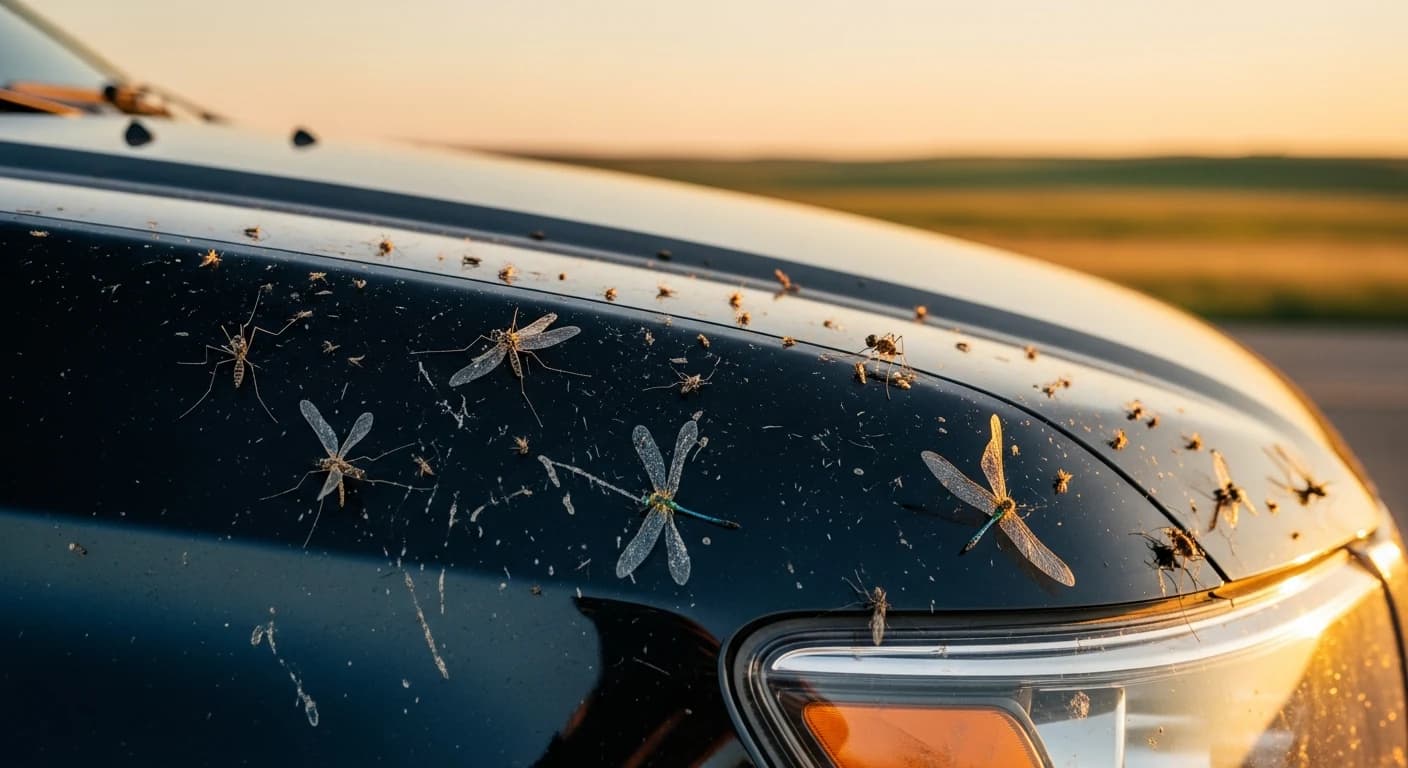
Bug splatter on Calgary car paint — mosquitoes, dragonflies, lake-fly hatches, prairie grasshoppers — etches unprotected clear coat in as little as 1–4 hours on a hot Highway 2 hood (50–65°C in July sun), 4–12 hours in shade, and a 24–48 hour outer bound under cool overcast. Bug splatter runs roughly pH 4.0–4.8 and combines formic acid, protein binder, and exoskeleton grit that gouges the clear coat during careless removal. The protection stack that actually works on Calgary highway commutes: full-vehicle ceramic coating ($799–1,499) extends the safe-removal window to 12–24 hours, and front-end PPF ($1,299–1,799 standard, $1,499–1,799 Signature at Calgary PPF Pros) eliminates etching risk entirely on the panels that catch ~85% of impacts. For DIY removal — cool the panel below 30°C first, soak with warm water for 5–10 minutes, dwell a dedicated bug remover for 60–90 seconds, lift in one direction with microfibre. Never use razor blades, WD-40, dryer sheets, or household solvents. The 48-hour rule is the outer bound, not the target — on a Calgary July highway commute, you have hours.
Mid-June through August, Calgary detail shops field the same call several times a week: a driver pulls into a south Calgary driveway after an evening Highway 2 run from Red Deer or a Stampede-week QE2 commute and finds the hood and front bumper carpeted in mosquito and lake-fly splatter that already looks half-baked into the paint. By the next afternoon, the splatter has been rinsed off — but a constellation of faint rings remains in the clear coat at every impact point. This guide is what we tell those callers, and what every Calgary highway commuter parked under a prairie sky in summer needs to know about bug-acid chemistry, the 4-hour rule, and the protection stack that actually solves it.
Mid-June through late August is when our paint correction bookings spike a second time after the spring rock-chip wave — and roughly six out of ten of those summer jobs trace back to dried bug splatter sitting on a hot hood for a Friday-evening commute that ran into Saturday. The pattern is consistent enough that we now ask new highway-commuter customers two questions before quoting: how many kilometres of unbroken Highway 2, QE2, or Stoney Trail are in your weekly drive, and where do you park overnight in summer? The answers usually tell us whether a ceramic top-up plus a same-shift wash habit is enough, or whether front-end PPF is the only thing that breaks the bug-acid etch cycle on a daily driver.
Reviewed by Calgary PPF Pros — Consumer Choice Award winner, protecting Calgary vehicles since 2021.
The 4-Hour Rule (And Why the Generic 48-Hour Advice Misleads Calgary Drivers)
The 48-hour rule that AAA-style generic guides cite is the outer bound for splatter sitting on a cool panel in mild coastal conditions — not the target, and not Calgary. Bug splatter is corrosive for two stacked reasons: the formic-acid-and-hemolymph fraction sits at roughly pH 4.0–4.8, and the protein-and-chitin binder traps that acid in intimate contact with the clear coat as the surface water flashes off. Calgary's climate accelerates the reaction harder than most North American cities, for three specific reasons that no generic page covers.
First, surface temperature. A black or dark blue hood in direct Calgary July sun routinely hits 60–75°C surface temperature by mid-morning even when ambient air sits at a moderate 22°C — Calgary's 1,048-metre elevation drives roughly 10–12% higher UV intensity than at sea level (see our Calgary altitude and paint damage guide for the underlying physics), which drives panel temps well past the threshold where formic-acid etching turns from hours-scale to minutes-scale. Second, humidity. Calgary's summer humidity often drops under 30%, which crystallizes the protein binder into an abrasive shell within roughly an hour — a shell that abrades the clear coat as soon as anyone attempts to wipe it off without softening first. Third, highway impact velocity. Most generic bug-removal guides assume residential city driving; the Calgary daily-driver reality is 30–90 minute unbroken runs on Highway 2, QE2, or Stoney Trail where impact energy is 15–20× higher than city driving, driving the acidic hemolymph past any wax or aged sealant and directly into the clear coat pore structure. None of the standard "48-hour rule" articles ranking on page 1 of Google factor for any of these effects.
The Etching Timeline by Panel Temperature & Commute Type
| Panel Temperature | Safe Removal Window | Damage at Outer Bound | Calgary Real-World Match |
|---|---|---|---|
| Under 20°C (overcast / morning shade) | 24–48 hours | Faint outline ring, polishes out | May overcast, indoor parkade pickup |
| 20–30°C (mild shade) | 8–12 hours | Halo + slight dimpling, needs polish | Shaded driveway after evening commute, June |
| 30–45°C (light sun, light paint) | 2–6 hours | Visible etch ring, needs paint correction | White vehicle, July morning, partial sun |
| 45–60°C (direct sun, mid-temp paint) | 1–3 hours | Etched into clear coat, may need panel polish | Silver/grey on QE2 July noon |
| 60–75°C (direct sun, dark paint) | 30–90 minutes | Permanent etch likely, panel correction | Black SUV after Highway 2 lake-fly run, July |
Why the 48-Hour Rule Fails on Calgary Highway Commutes
If you take the generic "48 hours is safe" advice at face value and leave a Friday-evening QE2 bug strike on a black hood through a Saturday in July sun, you are nearly guaranteed permanent etching by Sunday morning. The 48-hour figure was developed in coastal, lower-altitude conditions on city driving — not Alberta highway summer at 1,048 metres of elevation. Treat any bug splatter from a Highway 2, QE2, Stoney Trail, or Highway 1 commute as a same-shift problem in the warm months. The cost of a same-night wash is zero; the cost of a single-panel correction is $349–649.
The Alberta Bug Hierarchy — What's Actually Hitting Your Hood
Not every bug strike damages paint equally. The Calgary highway-commuter reality is that five categories of insect produce nearly all the etching damage we see in the shop, and they peak in a predictable seasonal sequence from mid-June through early September. Knowing which bug is hitting your car this week determines how aggressively you need to clean it the same evening.
Prairie grasshoppers (August–September peak)
Highest single-impact damage on the Alberta highway map. Grasshopper hemolymph runs more acidic than typical fly splatter, the impact mass is roughly 10–20× heavier than a mosquito, and the chitin exoskeleton fragments embed in the clear coat during careless wiping. A 60-minute Highway 2 run through grasshopper season near Okotoks or High River in late August can produce hundreds of impacts that look minor individually but layer into a sandblasted finish on the hood leading edge by Labour Day.
Dragonflies (June–August lake-fly hatches)
Calgary's freshwater corridors — Chestermere, Sylvan Lake, Gull Lake, Pine Lake, and the Bow River near Strathmore — produce dragonfly hatches that follow the mosquito and midge hatches by 2–3 weeks. Dragonfly impacts carry a heavy protein load and dry into a sticky amber crust that bonds harder than mosquito splatter. Calgary owners returning from a late-June Sylvan Lake weekend regularly find a full bumper-and-grille pattern of dragonfly impacts that need to be addressed before the next sun cycle.
Lake flies and midges (June evening hatches)
Lower individual damage but staggering volume. Evening hatches over Chestermere, Crawling Valley, and the QE2 corridor between Airdrie and Olds can deposit a thousand-plus individual lake-fly impacts on a single hood during a 90-minute Friday-evening run. The cumulative protein load is enough to overwhelm a 4-week-old wax layer and start etching by Saturday lunch on a sun-facing driveway.
Mosquitoes (May–July, peak after May runoff)
Smallest individual impact but the highest contact count for most Calgary commuters because mosquito habitat — wetland, drainage ditches, irrigation canals — surrounds every highway corridor leaving the city. Mosquito hemolymph alone rarely etches paint at city-driving impact energy, but at Highway 2 / Stoney Trail speeds the cumulative pH-4.5 load on a hot black hood absolutely will. Mosquitoes are the highest-frequency strike in the May–July window before the dragonfly and grasshopper cohorts take over.
Moths, small beetles, and bees (summer-long, lower acid load)
Lower-acidity splatter but stubborn protein staining. Moth and beetle impacts produce the classic yellow halo most Calgary owners associate with bug splatter — the visible stain is partly pigment from broken wing scales, partly oxidized protein. These respond well to a same-day wash but tend to bond hard within 24 hours and require a dedicated bug remover plus dwell time once dried.
Calgary Highway Corridors Ranked by Bug-Storm Density
| Corridor / Route | Worst Bug Cohort | Peak Window | Calgary Commuter Risk |
|---|---|---|---|
| QE2 (Hwy 2) — Calgary ↔ Edmonton | Lake flies, dragonflies, mosquitoes | Mid-June – early August evenings | Very High |
| Hwy 2 South — Calgary ↔ Lethbridge | Prairie grasshoppers, mosquitoes | Late July – mid-September | Very High |
| Hwy 22X / Stoney Trail SE — Bow River corridor | Mosquitoes, midges, mayflies | May – early July | High |
| Hwy 1 East — Calgary ↔ Strathmore / Brooks | Dragonflies, grasshoppers | Late July – August | High |
| Hwy 1 West — Calgary ↔ Banff | Moths, lake midges (mountain corridors) | June – August | Moderate |
| Hwy 8 / Hwy 22 — Calgary ↔ Bragg Creek / Kananaskis | Mountain mosquitoes, moths | June – early August | Moderate |
| City Calgary (Crowchild / Glenmore / Deerfoot urban) | Mosquitoes, occasional dragonflies | June – July | Low–Moderate |
| Beltline / downtown short commutes | Minimal — urban heat island reduces insect density | Year-round | Low |
Risk ratings reflect Calgary PPF Pros field experience with customer drop-off contamination patterns through the 2024 and 2025 seasons. Lake-fly and midge hatch density tracks Alberta Environment's water-level reporting at Alberta Rivers — late-June peaks correspond to peak QE2 evening commute exposure. For broader Alberta summer insect biology, see alberta.ca. Short-haul drivers stuck inside the urban heat island can also browse our Beltline downtown-commuter protection options, tuned for the lighter-exposure profile that bottom row of the table reflects.
What Actually Stops Bug-Acid Etching on Calgary Highways
The protection hierarchy for formic-acid bug etching follows the same surface-chemistry physics as every other Calgary summer contaminant — hydrophobicity and pore-blocking, the mechanism we broke down in our explainer on how ceramic coatings work. What changes with bug splatter specifically is the impact-plus-acid combination: the same pH 4.0–4.8 chemistry magpie droppings produce, but delivered at 110 km/h on a continuously hot panel. Wax-based protection fails fastest of all under this load because a 0.5-micron carnauba layer cannot survive sustained mechanical impact plus acid attack.
| Surface | Safe Window (hot Hwy 2 panel) | Outcome After 24h in Sun | Cleanup Difficulty |
|---|---|---|---|
| Bare clear coat | 1–4 hours | Permanent etch, panel correction | High — solvent + polish |
| Carnauba wax (4–8 weeks old) | 2–6 hours | Light etch, polish required | Moderate — wax fails fast under impact |
| Synthetic sealant (3–6 months old) | 4–10 hours | Possible halo, light correction | Moderate |
| Professional ceramic coating | 12–24 hours | Standard wash clears it | Low — pH-neutral shampoo |
| PPF (our flagship self-healing PPF / 3M Pro Series / SunTek) | Indefinite | Standard wash; faint stains fade with sun | Very Low — wash only |
The honest comparison: why wax fails against bug acid in a Calgary summer comes down to thickness, pH tolerance, and impact resistance — a 0.5-micron wax layer simply does not survive repeated pH 4 attacks combined with highway impact velocity the way a 2-micron ceramic does. For drivers commuting Highway 2 or QE2, the practical question is whether ceramic alone is enough or whether front-end PPF is required. The deciding factor is weekly highway kilometres and how dark the vehicle paint is.
The Pros
- Front-end PPF ($1,299–1,799) eliminates etching risk on the panels that catch ~85% of bug impacts on Hwy 2 / QE2 / Stoney Trail commutes
- Full-vehicle ceramic coating ($799–1,499) extends the safe-removal window from hours to 12–24 hours — the single highest ROI move for moderate-mileage commuters
- Same-night wash habit during peak bug weeks — 3-minute coin-wash or hose-down breaks the bonding cycle before sunrise
- Top off washer fluid with bug-cleaner formula (Rain-X Bug Remover, Prestone Bugs & Tar) on every fill-up between mid-June and Labour Day
- Pre-treat the front end with a hydrophobic spray sealant (Adam's Detail Spray, Meguiar's Hybrid Ceramic Spray) before any long highway run
- Carry a 500ml spray bottle of pH-neutral bug remover plus two clean microfibres in the vehicle from May through September
The Cons
- Razor blades or plastic scrapers on dried splatter — guaranteed scratch and the chitin fragments will leave swirl marks across half the panel
- Dryer sheets — the fragrance oils dissolve wax and sealant prematurely, leaving the clear coat unprotected for the next bug strike
- WD-40 — silicone residue interferes with future ceramic coating bonding and the smear marks need a separate decontamination pass before any coating
- Household solvents (acetone, paint thinner, gasoline) — dissolve clear coat as fast as they dissolve formic acid
- Brush-style automatic car washes on dried splatter — drag the chitin grit across the rest of the panel and embed it into fresh clear coat
- Letting splatter dry through a second sun cycle — the etch becomes effectively permanent and only paint correction or PPF replacement can address it
The Safe Removal Procedure (Calgary Bare Paint)
If you catch bug splatter the same evening on unprotected paint, the safe removal procedure takes about 15 minutes for a full front-end pattern. The key insight: dwell time matters more than scrubbing pressure, and panel temperature matters more than either.
- Cool the panel first. Move the car to shade, a parkade, or a garage. Wait 20–30 minutes until surface temperature drops below 30°C (panel should no longer feel hot to the touch). Working in direct Calgary sun is the single largest cause of failed bug removal — the solvent flashes off before it can soften the protein binder.
- Soften with warm water. Drape a microfibre cloth soaked in lukewarm (not hot) water over the worst splatter zones — hood leading edge, front bumper, mirror faces. Leave it for 5–10 minutes. Do not scrub during this step. The water rehydrates the protein binder and lifts the chitin fragments off the clear coat surface so they can be lifted away rather than dragged across the paint.
- Apply dedicated bug remover. Stoner Tarminator, Meguiar's Bug & Tar Remover, Chemical Guys Bug & Tar Heavy Duty Cleaner, or 3M All-Purpose Cleaner — all stocked at Canadian Tire Calgary locations and Walmart Auto Centres. Spray onto the softened spots and let dwell 60–90 seconds.
- Lift in one direction with a clean microfibre. Fold the cloth to a clean section for each pass. Never wipe back-and-forth — that drags abrasive exoskeleton fragments across the clear coat. If a splatter resists, re-soak and dwell longer; do not increase pressure.
- Rinse and inspect. Light rinse with a pH-neutral car shampoo, dry with a clean microfibre, then inspect at a 45° angle in direct sun. If you see a faint outline, halo, dimpling, or rainbow sheen, the clear coat is etched and needs correction — stop and book a detailer assessment before making it worse with DIY polish.
- Reapply protection. Spot-apply a quick-ceramic spray (Adam's Ceramic Spray, Turtle Wax Hybrid Ceramic, Meguiar's Hybrid Ceramic Spray) over the cleaned area to re-establish hydrophobic protection on the affected panel before the next highway run.
If the Splatter Is Dried Hard (Multiple Sun Cycles)
Increase the warm-water soak to 15–20 minutes and add a clay-bar pass after the bug-remover step. Mother's Speed Clay 2.0 or Meguiar's Smooth Surface Clay Kit with the included lubricant spray will lift bonded protein and chitin that solvent alone cannot break loose, without abrading the clear coat the way scraping does. Resist the temptation to scrape with a plastic spatula until the splatter is fully hydrated and chemically softened — premature mechanical removal is how hard-edge scratches happen. If after a clay pass the splatter still resists or you can feel texture change under a fingernail, you are now looking at Level 2 etch damage at minimum; stop and book a paint correction estimate. Calgary detailer spot correction runs $79–149 per splatter zone, panel correction $349–649, full vehicle correction $1,200–2,000.
The Damage Severity Triage (CAD 2026)
When customers send us photos before booking, we triage by severity. Use this matrix to decide whether you are looking at a DIY job, a detailer visit, a paint correction, or a single-panel respray.
| Severity | Visual | Removal Cost (CAD) | Time Window |
|---|---|---|---|
| Level 1 — Fresh, surface only | Wet/recent, no halo, lifts with light pressure | DIY: $0 in time + microfibre | Same evening, cool panel |
| Level 2 — Dried film | Hard crust, faint outline ring after lift | Detailer: $79–149 per panel | 6–24 hours after impact |
| Level 3 — Etched halo | Visible ring, slight dimple feel under fingernail | Paint correction: $349–649 panel | 24–72 hours under hot sun |
| Level 4 — Through clear coat | Dull patch, no gloss, colour layer visible | Single-panel respray: $1,500–3,500 | Multiple sun cycles untreated |
Pricing reflects 2026 Calgary market averages from independent detail shops and ICBC-rated body shops. For broader paint-correction economics context, see our companion piece on rock chip protection economics.
The Calgary Highway-Commuter Protection Stack
For owners with more than ~150 km of weekly highway driving on Highway 2, QE2, Stoney Trail, or Highway 1, the protection economics favour a layered approach. Here's what we typically recommend in priority order for a daily-driven vehicle commuting Calgary's bug-storm corridors.
| Layer | What It Solves | Cost (2026 Calgary) | Lifespan |
|---|---|---|---|
| Front-end PPF (hood, fenders, bumper, mirrors) | ~85% of typical bug-splatter impact damage on horizontal and leading-edge panels | $1,299–1,799 | 8–10 years |
| A-pillar + roof-leading-edge PPF add-on | Remaining ~10–15% — high-speed impacts that vault over the hood line | $299–599 | 8–10 years |
| Full-vehicle ceramic coating | Doors, trunk, rear glass area — extends wash window to 12–24 hours | $799–1,499 | 2–5 years |
| Maintenance ceramic spray (quarterly during bug season) | Restores hydrophobics worn by repeated acid + impact attacks | $60–90 per visit | 3–4 months |
| Bug-formula washer fluid + same-night wash habit | Catches the strikes that protective layers do not stop | ~$15 per jug + 5 min/night | Per-event |
For the deeper logic on hood-versus-full-coverage PPF decisions, see full-front vs partial-front PPF. For ceramic coating durability under repeated contaminant exposure, see is ceramic coating worth it for Calgary daily drivers.
A Bug-Season Weekly Routine
For Calgary highway commuters, a short structured routine eliminates most preventable damage during the mid-June through early September peak window. The cost is roughly 15–20 minutes per week.
- Pre-commute prep (Monday morning, 60 seconds): Spritz a quick-detail spray with hydrophobic additive across the hood, bumper, and mirrors before the week's first highway run. Establishes a sacrificial release layer so the week's splatter rinses off easily.
- Same-night rinse after long highway runs (3 minutes): Touchless coin-wash visit or garden hose-down on any evening you covered more than 60 km of Highway 2, QE2, Stoney Trail, or Highway 1. Breaks the bonding cycle before the splatter dries through a sun cycle.
- Mid-week wash (10 minutes): Two-bucket pH-neutral wash with a dedicated bug-remover pre-treat on the front end. Pay extra attention to hood leading edge, headlights, front bumper, and mirror faces — the impact zones.
- Weekend protection check (5 minutes): Walk the front end at a 45° angle in direct sun. Look for faint outline rings, halos, or matte spots where the clear coat has lost gloss. Catch Level 1 etching while it still polishes out instead of letting it progress to Level 3.
- Quarterly ceramic refresh (May, July, September): Top up the hydrophobic layer with a quick-ceramic spray on a freshly washed vehicle. Restores protection that thirty consecutive bug-storm commutes will degrade.
The Calgary-Specific Twist: Bug Splatter Plus Hail Plus Wildfire Smoke
One pattern no generic bug-splatter guide covers: Calgary's mid-June through August window stacks three threats that target the same panels using different chemistry. Bug splatter at pH 4.0–4.8 attacks from the acid side, wildfire ash from BC and northern Alberta fires attacks from the pH 9–11 alkaline side, and Calgary's notoriously severe convective storms drop hail on the same hood the same afternoon. A single weekend in mid-July 2024 saw QE2 commuters hit by a lake-fly hatch on Friday evening, a hailstorm on Saturday afternoon, and an air-quality advisory from BC wildfire smoke by Sunday — every one of those events targets the same hood, fender, and roof surfaces.
The practical implication is the same as every other Calgary summer contaminant guide we publish: the front-end-plus-roof protection stack pays back faster in this climate than almost any other Canadian market, because the threats compound rather than rotate. If your vehicle parks under prairie sky and commutes any Alberta highway in summer, you are facing acid, alkaline, and impact threats simultaneously. The protection stack needs to address all three — front-end PPF for impact and bug acid, ceramic coating for wash-window extension on the alkaline side, and a same-shift wash habit that catches whatever the protective layers do not stop.
Related Reading
Magpie Bird Droppings on Paint
Same pH 3–5 acid family, similar etch timeline — the residential-driveway analogue to highway bug splatter.
Ceramic vs Wax in Calgary
Why a 0.5-micron wax layer fails against pH 4 bug acid where a 2-micron ceramic survives.
Calgary Altitude & UV Damage
How 1,048-metre elevation and 10–12% higher UV intensity drive panel temps past the etch threshold.
External references: Alberta Rivers — water level monitoring (lake-fly hatch correlation) and AAA Club Alliance — bug removal fundamentals.
Stop Bug-Acid Etching Before It Starts
Free 15-minute consultation. We'll review your weekly highway kilometres, vehicle colour, and parking pattern, then recommend the right combination of front-end paint protection film on the panels that take the splatter, a professional ceramic coating with bug-acid hydrophobics, and pre-summer decontamination to clear any residual spring contamination that accelerates etching. Calgary AB. Consumer Choice Award winner. 10-year manufacturer-backed warranty.
Frequently Asked Questions
Experience The Best.
Don't let another commute compromise your vehicle. Get a quote from Calgary's Consumer Choice Award winner today.
Explore Our Services