Magpie Bird Droppings on Car Paint: Calgary 2026 Guide
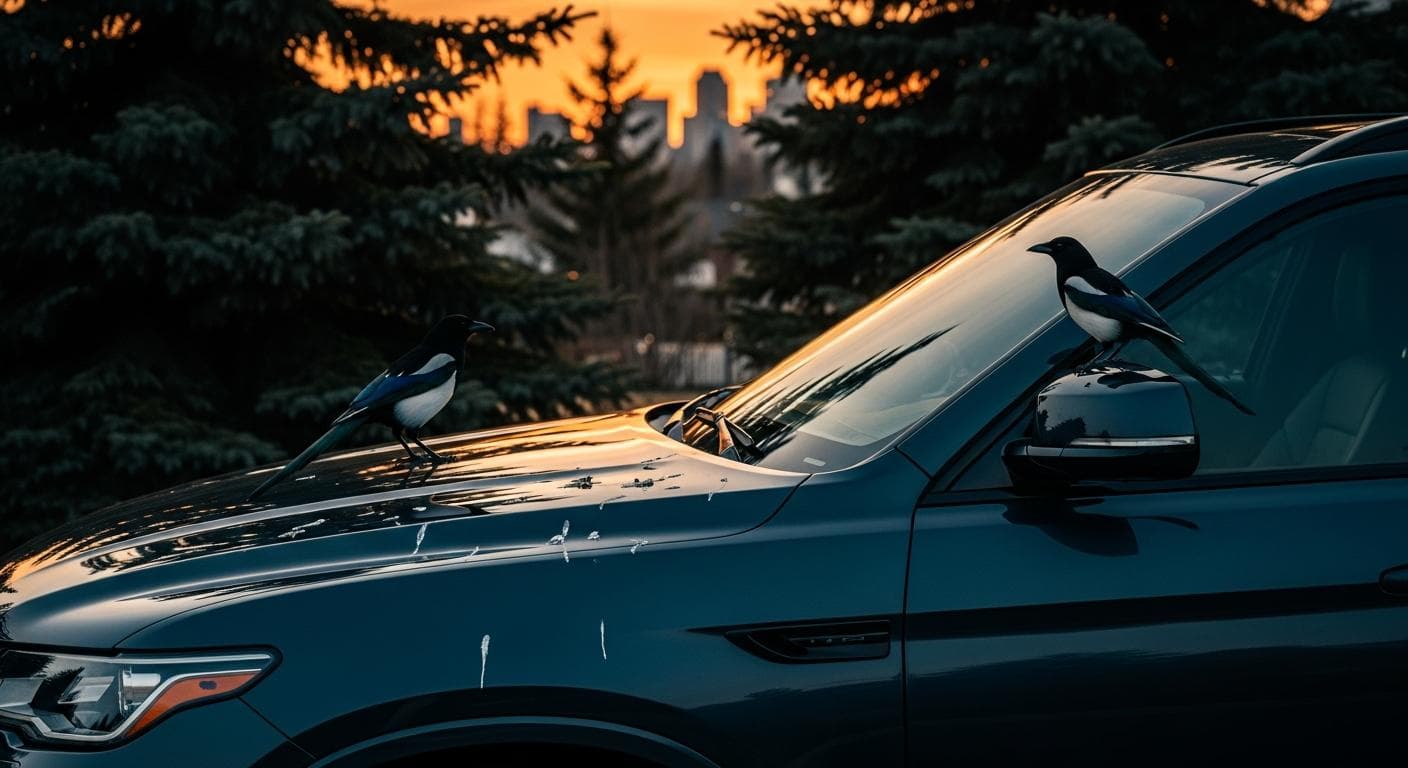
Bird poop damage to Calgary car paint — especially from resident black-billed magpies — etches unprotected clear coat in as little as 10–15 minutes on a hot hood (60–70°C in July sun), 4–8 hours in shade, and a 24–48 hour outer bound under mild conditions. Bird droppings are acidic (roughly pH 3–5, comparable to vinegar) and contain water-insoluble uric acid plus calcium-rich grit that gouges the clear coat during careless removal. The protection stack that actually works in Calgary: ceramic coating ($799–1,499) extends the safe-removal window to 24–48 hours; front-end PPF plus roof coverage ($1,499–2,499) eliminates etching risk entirely on the panels magpies bomb most. For DIY removal — cool the panel below 30°C first, soak with warm water for 10 minutes, lift with microfibre in one direction, never use razor blades, baking soda, WD-40, or household solvents. The 48-hour rule is the outer bound, not the target — in a Calgary July, you have minutes.
Mid-June through August, Calgary detail shops field the same call several times a week: a Mount Royal or Inglewood owner walks out of the alley on a sunny morning and finds three white-and-grey smears already drying on the hood of an otherwise pristine SUV. By the time they look closer at lunch, the smear has been rinsed off — but a dull halo remains in the clear coat. This guide is what we tell those callers, and what every Calgary driver parked under a tree, alley power line, or downtown light standard needs to know about magpie droppings, the 48-hour rule, and the protection stack that actually solves it.
Mid-June through early August is when our paint correction bookings spike — and roughly seven out of ten of those jobs trace back to a magpie or crow drop sitting on a hot hood for an afternoon. The pattern is consistent enough that we now ask new customers two questions before quoting: where do you park, and how close is the nearest mature spruce or alley power line? The answers usually tell us whether a ceramic refresh is enough or whether we need to recommend hood-plus-roof PPF to break the cycle.
Reviewed by Calgary PPF Pros — Consumer Choice Award winner, protecting Calgary vehicles since 2021.
The 48-Hour Rule (And Why Calgary Sun Cuts It to Minutes)
The 48-hour rule that every detailer quotes is the outer bound for a dropping sitting on a cool panel in mild conditions — not the target. Bird droppings are corrosive for one core reason: uric acid. Unlike mammalian urea, uric acid is essentially water-insoluble, which is why hosing alone fails to clean it and why the acid stays in contact with the clear coat as the water flashes off. Calgary's climate accelerates the reaction harder than most cities, for three specific reasons that no other detailer page covers.
First, surface temperature. A black or dark blue hood in direct Calgary July sun routinely hits 60–75°C surface temperature by mid-morning even when ambient air sits at a moderate 22°C — Calgary sits at 1,048 metres with UV intensity roughly 10–12% higher than at sea level (see our Calgary altitude and paint damage guide for the underlying physics), which drives panel temps well past the threshold where uric-acid etching turns from hours-scale to minutes-scale. Second, humidity. Calgary's summer humidity often drops under 30%, which dries droppings into a hardened calcium-grit crust within roughly an hour — a coating that abrades the clear coat as soon as anyone attempts to wipe it off without softening first. Third, Chinook freeze-thaw. In spring and fall, overnight temperature swings of 15–25°C crystallize moisture out of droppings, concentrating the uric-acid acidity into a more aggressive residue by morning. None of the generic "48-hour rule" articles ranking on page 1 of Google factor for any of these effects.
The Etching Timeline by Panel Temperature
| Panel Temperature | Safe Removal Window | Damage at Outer Bound | Calgary Real-World Match |
|---|---|---|---|
| Under 20°C (overcast / morning shade) | 24–48 hours | Faint outline ring, polishes out | May overcast morning, indoor parkade pickup |
| 20–30°C (mild shade) | 4–8 hours | Halo + slight dimpling, needs polish | Late afternoon shaded driveway, June |
| 30–45°C (light sun, light paint) | 1–4 hours | Visible etch ring, needs paint correction | White vehicle, summer morning, partial sun |
| 45–60°C (direct sun, mid-temp paint) | 20–60 minutes | Etched into clear coat, may need single-panel polish | Silver/grey vehicle, July noon |
| 60–75°C (direct sun, black/dark blue) | 10–15 minutes | Permanent etch likely, panel-level correction | Dark vehicle on south-facing driveway, July afternoon |
Why the 48-Hour Rule Misleads Calgary Owners
If you take the generic "48 hours is safe" advice at face value and leave a magpie drop on a black hood through a July workday, you are nearly guaranteed permanent etching by 5pm. The 48-hour figure was developed in moderate-climate, lower-altitude conditions — not Calgary summer. Treat any dropping you see as a same-shift problem in the warm months. The cost of removal is essentially zero; the cost of correction is $79–649 per panel.
Why Calgary Magpies Are the Real Threat
The black-billed magpie (Pica hudsonia) is Calgary's dominant car-damaging corvid. Three of its biological and behavioural traits make it the most aggressive paint-damaging bird Canadian drivers regularly encounter — meaningfully worse than sparrows, starlings, or even crows.
Diet — alley garbage and bone grit
Magpies are omnivorous scavengers eating dog kibble left in yards, alley refuse, small carrion, and crushed-shell calcium from gravel. The droppings carry a higher load of undigested bone fragments and shell grit than typical songbirds, which abrades the clear coat during careless removal. Wiping a dried magpie drop without softening is a guaranteed scratch event.
Territorial display behaviour (April–June)
During fledging season Calgary magpies react to their own reflection on side mirrors, windshields, and chrome trim — perching on or near these surfaces for extended bouts of display. The behaviour concentrates droppings around mirrors and door pillars at much higher density than elsewhere on the vehicle. Owners in Mount Royal, Britannia, and Bowness regularly find clusters of fresh waste on mirrors and front fenders during spring.
Communal roosting on alley power lines
Magpies roost communally on power lines running over Calgary back alleys — exactly above where most inner-city homeowners park on rear pads. Communal roost waste accumulates predictably overnight, so cars parked unprotected in alleys in Inglewood, Bridgeland, Mission, Hillhurst, or Sunnyside collect repeat strikes on the same panels week after week. (Owners parking in the inner-city core can compare our Mission neighbourhood protection pricing against street-pad realities, or pull up the Bridgeland alley-pad parking protection options built for the magpie-canopy blocks east of the river.) The cumulative damage hits the same square foot of clear coat dozens of times per summer.
Calgary Neighbourhoods Ranked by Magpie Density
| Neighbourhood | Why High Risk | Risk Level | Best Defence |
|---|---|---|---|
| Mount Royal / Elbow Park / Britannia | Mature elm + spruce canopy, alley garbage, dog yards | Very High | PPF hood + roof + mirrors, ceramic full body |
| Bowness | Older spruce/poplar canopy, alley parking, Bow River corridor | Very High | PPF hood + roof, ceramic full body, weekly rinse |
| Inglewood / Bridgeland / Ramsay | Alley parking pads, mature trees, restaurant garbage | High | PPF hood + roof, ceramic |
| Hillhurst / Sunnyside / West Hillhurst | Communal alley roosts, dense canopy, foot traffic | High | PPF hood, ceramic, garage when possible |
| Mission / Cliff Bungalow | Power-line roosting above pad parking, mature trees | High | PPF hood + roof, ceramic |
| Crescent Heights / Renfrew | Older canopy, alley parking, magpie nests in spruce | Moderate–High | PPF hood, ceramic |
| Suburban communities (Auburn Bay, Mahogany, Cranston) | Newer canopy, fewer mature trees, less alley life | Low–Moderate | Ceramic coating, garage parking |
| Downtown / Beltline parkades | Underground or covered parking removes overhead exposure | Low | Ceramic coating sufficient |
Risk ratings reflect Calgary PPF Pros field experience with customer drop-off contamination, cross-referenced against Calgary's published urban-canopy mapping. Magpie nests are protected under Alberta's Wildlife Act while active (roughly April through July) — see the Alberta Wildlife Act overview for current rules on nest removal.
What Actually Stops Bird-Dropping Etching
The protection hierarchy for uric-acid etching follows the same surface-chemistry physics as every other Calgary summer contaminant — hydrophobicity and pore-blocking, the mechanism we broke down in our explainer on how ceramic coatings work. For the mosquito and lake-fly splatter equivalent on Calgary highways, the chemistry is acidic from the same pH 3–5 band but the panel-temperature curve runs harder because the hits land at Hwy 2 speed. What changes with bird droppings specifically is the acidity vector: pH 3.5–4.5 attacks the topmost protective layer faster than the alkaline contaminants we usually wrestle with, which is why wax-based protection fails so quickly under repeated magpie strikes.
| Surface | Safe Contact Window (hot panel) | Outcome After 24h in Sun | Cleanup Difficulty |
|---|---|---|---|
| Bare clear coat | 10–15 minutes | Permanent etch, panel correction | High — solvent + polish |
| Carnauba wax (4–8 weeks old) | 15–45 minutes | Light etch, polish required | Moderate — wax fails fast on acid |
| Synthetic sealant (3–6 months old) | 2–6 hours | Possible halo, light correction | Moderate |
| Professional ceramic coating | 24–48 hours | Standard wash clears it | Low — pH-neutral shampoo |
| PPF (premium self-healing film / 3M Scotchgard Pro / SunTek) | Indefinite | Standard wash; faint stains fade with sun | Very Low — wash only |
The honest comparison: why wax fails against bird-dropping acid in a Calgary summer comes down to thickness and pH tolerance — a 0.5-micron wax layer simply does not survive repeated pH 3.5 attacks the way a 2-micron ceramic does. For drivers parked under magpie territory, the practical question is whether ceramic alone is enough or whether front-end-plus-roof PPF is required. The deciding factor is parking location and panel temperature exposure.
The Pros
- Ceramic coating ($799–1,499) extends safe-removal window from minutes to 24–48 hours — the single highest ROI move for most Calgary owners
- PPF on hood, roof, and mirrors ($1,499–2,499) eliminates etching risk entirely on the panels magpies bomb most
- Park in a garage or under cover during peak magpie activity hours (5am–9am, 5pm–9pm in summer)
- Weekly rinse during summer — three-minute coin-wash visit between full washes breaks the bonding cycle on coated cars
- Same-day cleanup when you spot a drop — cost is minutes, savings is hundreds of dollars in correction
The Cons
- Razor blades on dried droppings — guaranteed scratch and the calcium grit will leave swirl marks across half the panel
- Baking-soda paste — abrasive on modern soft clear coats, can dull the surface even when it removes the dropping
- WD-40 — silicone residue interferes with future ceramic coating bonding, and the smear marks need a separate decontamination pass
- Household solvents (acetone, paint thinner, gasoline) — dissolve clear coat as fast as they dissolve uric acid
- Brush-style automatic car washes on dried droppings — drag the calcium grit across the rest of the panel and embed it into fresh clear coat
The Safe Removal Procedure (Calgary Bare Paint)
If you catch droppings within an hour of contact on unprotected paint, the safe removal procedure takes about ten minutes. The key insight: dwell time matters more than scrubbing pressure, and panel temperature matters more than either.
- Cool the panel first. Move the car to shade, a parkade, or a garage. Wait 20–30 minutes until surface temperature drops below 30°C (panel should no longer feel hot to the touch). Working in direct Calgary sun is the single largest cause of failed DIY removal — the solvent flashes off before it can soften the uric acid.
- Soften the dropping with warm water. Drape a microfibre cloth soaked in lukewarm (not hot) water over the dropping. Leave it for 5–10 minutes. Do not scrub during this step. The water rehydrates the uric acid and lifts the calcium grit off the clear coat surface so it can be lifted away rather than dragged across the paint.
- Apply pH-neutral quick-detail spray. Meguiar's Ultimate Quik Detailer, Chemical Guys Speed Wipe, or Adam's Detail Spray — all stocked at Canadian Tire Calgary locations. Spray onto the softened spot, do not rub.
- Lift in one direction with a clean microfibre. Fold the cloth to a clean section for each pass. Never wipe back-and-forth — that drags the abrasive grit across the clear coat. If the dropping resists, re-soak and dwell longer; do not increase pressure.
- Rinse and inspect. Light rinse with a pH-neutral car shampoo, dry with a clean microfibre, then inspect at a 45° angle in direct sun. If you see a faint outline, halo, dimpling, or rainbow sheen, the clear coat is etched and needs correction — stop and book a detailer assessment before making it worse.
- Reapply protection. Spot-apply a quick-ceramic spray (Adam's Ceramic Spray, Turtle Wax Hybrid Ceramic, Meguiar's Hybrid Ceramic Spray) over the cleaned area to re-establish hydrophobic protection on the affected panel.
If the Dropping Is Dried Hard (Several Hours+ in Sun)
Increase the warm-water soak to 15–20 minutes. Add a dedicated bird-and-insect remover (Stoner Spot Free Bird Dropping Remover, Wizards Bug & Tar) as a second softening pass after the water soak. Resist the temptation to scrape with a plastic spatula until the dropping is fully hydrated — premature mechanical removal is how hard-edge scratches happen. If after two soaking passes the dropping still resists, you are now looking at Level 2 damage at minimum; stop and book a paint correction estimate. Calgary detailer spot correction runs $79–149 for a single dropping etch; full panel runs $349–649; full vehicle paint correction runs $1,200–2,000.
The Damage Severity Triage (CAD 2026)
When customers send us photos before booking, we triage by severity. Use this matrix to decide whether you are looking at a DIY job, a detailer visit, a paint correction, or a single-panel respray.
| Severity | Visual | Removal Cost (CAD) | Time Window |
|---|---|---|---|
| Level 1 — Fresh, surface only | Wet/recent, no halo, lifts with light pressure | DIY: $0 in time + microfibre | 0–60 minutes, cool panel |
| Level 2 — Dried film | Hard crust, faint outline ring after lift | Detailer: $79–149 spot | 1–6 hours under sun |
| Level 3 — Etched halo | Visible ring, slight dimple feel under fingernail | Paint correction: $349–649 panel | 6–48 hours under sun |
| Level 4 — Through clear coat | Dull patch, no gloss, colour layer visible | Single-panel respray: $1,500–3,500 | 48 hours+ in heavy sun |
Pricing reflects 2026 Calgary market averages from independent detail shops and ICBC-rated body shops. For broader paint-correction economics context, see our companion piece on rock chip protection economics.
The Calgary Magpie-Zone Protection Stack
For owners parked anywhere near a Calgary alley, mature spruce, or downtown power line, the protection economics favour a layered approach. Here's what we typically recommend in priority order for a daily-driven vehicle in the magpie-density neighbourhoods listed above.
| Layer | What It Solves | Cost (2026 Calgary) | Lifespan |
|---|---|---|---|
| Front-end PPF (hood, fenders, bumper, mirrors) | ~70% of typical magpie strafing damage on horizontal panels | $1,299–1,799 | 8–10 years |
| Roof PPF add-on | Remaining ~25–30% — magpies drop most on the highest horizontal surface | $399–699 | 8–10 years |
| Ceramic coating (full vehicle) | Vertical panels, doors, trunk — extends wash window to 24–48 hours | $799–1,499 | 2–5 years |
| Maintenance ceramic spray (quarterly) | Restores hydrophobics worn by repeated acid attacks | $60–90 per visit | 3–4 months |
| Same-shift cleanup habit | Catches the 70% of strikes that protective layers do not stop | Free (microfibre + detail spray) | Per-event |
For the deeper logic on hood-versus-full-coverage PPF decisions, see full-front vs partial-front PPF. For ceramic coating durability under repeated contaminant exposure, see is ceramic coating worth it for Calgary daily drivers.
A Magpie-Season Weekly Routine
For Calgary drivers in high-magpie-density neighbourhoods, a short structured routine eliminates most preventable damage during the May–September peak window. The cost is roughly 15 minutes per week.
- Daily glance (30 seconds): Before leaving for work, walk around the hood, roof, and side mirrors. Anything visible gets removed before driving anywhere.
- Mid-week rinse (3 minutes): Touchless coin-wash visit, garden hose, or a quick wipe-down with a ceramic spray. Breaks the bonding cycle on coated vehicles and catches the cumulative dust from alley-pad parking.
- Weekend full wash (45 minutes): pH-neutral two-bucket wash. Pay extra attention to mirrors, A-pillars, hood leading edge, and roof — the panels magpies hit hardest.
- After any extended outdoor parking (post-work dinner, downtown event, summer festival): Walk the hood before driving home. The 10-minute hot-sun window matters most in July and August.
- Quarterly ceramic refresh: Top up the hydrophobic layer with a quick-ceramic spray on a freshly washed vehicle. Restores protection that thirty consecutive hot days will degrade.
The Calgary-Specific Twist: Magpies + Cottonwood Season Overlap
One pattern no other detailer page covers: Calgary's resident magpies nest predominantly in the same mature poplar and cottonwood trees that release their seed fluff and sticky resin from late May through July. The result is a compounding double-hazard window — the cottonwood fluff and resin sit on the hood as a contaminant net while magpie droppings land on top of the fluff, where the acid concentration is amplified by the trapped moisture. We covered this dynamic from the tree side in our cottonwoods that magpies nest in guide.
The practical implication is the same: if your car parks under a Calgary cottonwood between late May and mid-July, you are facing both threats simultaneously, and the protection stack needs to address both — front-end-plus-roof PPF plus a maintenance ceramic refresh, ideally booked before mid-June so the film and coating are fully cured before peak magpie and cottonwood activity overlap.
Related Reading
Tree Sap & Cottonwood Damage
The other June paint threat — sap chemistry, magpie nesting overlap, and the protection stack.
Ceramic vs Wax in Calgary
Why a 0.5-micron wax layer fails against pH 3.5 magpie acid where a 2-micron ceramic survives.
Calgary Altitude & UV Damage
How 1,048-metre elevation and 10–12% higher UV intensity drive panel temps past the etch threshold.
External references: Alberta Wildlife Act — protected nests and Cornell Lab — Black-billed Magpie life history.
Stop Magpie Etching Before It Starts
Free 15-minute consultation. We'll review your neighbourhood, parking pattern, and vehicle colour, then recommend the right combination of front-end paint protection film for the panels magpies hit hardest, professional ceramic coating in Calgary to extend your safe-removal window, and pre-summer decontamination to clear winter mag-chloride residue that accelerates etching. Calgary AB. Consumer Choice Award winner. 10-year manufacturer-backed warranty.
Frequently Asked Questions
Experience The Best.
Don't let another commute compromise your vehicle. Get a quote from Calgary's Consumer Choice Award winner today.
Explore Our Services