PPF Troubleshooting Guide: Bubbles, Yellowing, Peeling & What To Do
Most PPF concerns in the first 30 days are normal curing — small water bubbles, slight edge hazing, and minor film movement are expected. Real problems are: air bubbles that persist past 2 weeks, edge lifting after the first month, yellowing within 3 years, or haze that doesn't clear after 60 days. Use this guide to diagnose what you're seeing.
You just picked up your vehicle after PPF installation and something looks off. Before you panic, read this. Most things new PPF owners worry about are completely normal parts of the curing process. Here's how to tell the difference between a curing phase and a real installation problem. If you want to understand what a proper installation looks like from the start, that guide is the right companion to this one.
1Water Bubbles (Usually Normal)
PPF is applied using a wet installation method — a slip solution is used to position the film precisely before it's squeegeed down and the adhesive bonds to the paint. Some residual moisture is trapped between the film and the paint surface during this process. As that moisture slowly evaporates through the film over the next few weeks, it can create small, hazy-looking bubbles, particularly near edges and in areas where the panel curves make complete moisture evacuation slower.
Normal — Don't Worry
- • Small, hazy water pockets within first 30 days
- • Bubbles concentrated near film edges
- • Bubbles that look smaller each week
- • Milky haze that clears with warm weather
Call Your Installer
- • Bubbles larger than 5 mm after 60 days
- • Bubbles in the centre of panels (not edges)
- • Bubbles that are growing, not shrinking
- • Bubbles that feel raised and firm, not flat
What to do: Nothing. Leave water bubbles alone. Don't try to press them out, apply heat, or peel the film edge to "release" them. Warm weather (parking in sunlight for a few hours) accelerates evaporation. Most water bubbles are gone within 2–4 weeks in Calgary summers; in cooler months it may take 6–8 weeks.
2Air Bubbles (Usually an Installation Issue)
Air bubbles are different from water bubbles. They're dry, clearly defined, and typically don't change over time. Small air bubbles very near film edges can sometimes work themselves out as the adhesive continues to cure and the film settles — particularly in warm temperatures. Large air bubbles anywhere on the panel, or any air bubble that persists past 2 weeks, are installation errors.
Air bubbles occur when the installer fails to completely squeegee out trapped air during application, or when the film is applied too quickly without adequate time to reposition over complex curves. Quality shops re-lift and re-work problem areas during installation rather than leaving air trapped under the film.
Verdict on Air Bubbles
Small air bubbles near edges: wait 2 weeks and see if they resolve. Any air bubble in the centre of a panel, or bubbles that persist beyond 2 weeks: contact your installer and request an inspection. Reputable installers will fix installation-caused air bubbles at no charge under warranty.
3Edge Lifting
Some edge movement in the first week of installation is normal — the adhesive is still curing and the film is settling. Very slight lifting at corners or along panel edges that self-corrects within a week is typically nothing to worry about. What you're watching for is progressive lifting that worsens over time, especially after car washes.
Cause: Contaminants Under the Film
If the paint surface wasn't properly decontaminated (clay bar, iron decon) before installation, wax residue, silicone, or bonded contamination can prevent the adhesive from bonding fully. The film may look fine initially but lift progressively as the adhesive tries to grip a contaminated surface. This is also why whether paint correction is needed before PPF is a question worth asking at the consultation stage — not after the film is already on.
Cause: Vehicle Washed Too Soon
Washing within the first 48 hours — especially with a pressure washer — can interrupt the adhesive curing process and cause edge lifting. Always follow post-installation instructions: no washing for 48 hours, no pressure washer on film edges for at least 7 days.
Cause: Inadequate Edge Tucking
Quality PPF installations wrap the film around panel edges (hood, bumper, doors) and tuck it under, rather than cutting the film flush with the edge. Flush-cut edges are more exposed to lifting because wind, washing, and temperature changes act directly on the exposed edge. Lifted edges on a tucked install are a stronger warranty claim than lifted edges on flush-cut film.
What to do: If edges are lifting after 2 or more weeks and you followed all post-installation care instructions, contact your installer for a warranty claim. Bring the car in promptly — a small lifted edge that gets caught in a high-speed car wash can become a large lifted section fast.
4Yellowing
Yellowing is the most common reason people distrust PPF — because older, lower-quality PPF films from the early 2000s would yellow significantly within a few years, often ruining the paint appearance they were meant to protect. Modern premium films are a different product entirely. When yellowing does appear at the expected end-of-life stage, it's useful to understand when PPF reaches end of life and what replacement involves.
| Yellowing Timeline | What It Means | What To Do |
|---|---|---|
| Within 3 years | Product defect — substandard film or manufacturing issue | Warranty claim — covered under lifetime manufacturer warranty |
| 3–7 years | Possible early end-of-life; check edge tucking for UV exposure | Inspect with installer; may warrant early panel replacement |
| 7–10 years | Normal end-of-life for most premium films | Plan for panel or full film replacement |
| Edge yellowing only | UV degradation at exposed edge (film not tucked) | Re-tuck or replace affected sections; check full installation |
The STEK DYNOshield and GSWF Defender Platinum self-healing PPF we install carries a 10-year manufacturer warranty against yellowing. If your film is yellowing within the warranty period, Calgary PPF Pros will handle the warranty claim with the manufacturer directly — you don't need to navigate that process on your own.
5Haze or Cloudiness
A slight haze or cloudiness in the first 30 days is part of the moisture cure — as the adhesive fully cures and residual water evaporates, the film transitions from slightly milky to optically clear. This is normal and resolves without intervention.
Persistent haze after 60 days is a different story. It can indicate adhesive failure (the film is beginning to delaminate at a microscopic level), low-quality film with poor optical clarity from the start, or — a common DIY error — applying a ceramic coating product that is incompatible with PPF topcoats. Some ceramic coatings will react with the urethane topcoat on PPF and create a hazy, streaked appearance that doesn't wash off. Always confirm your ceramic coating is PPF-compatible before application.
6Spot Repair vs. Full Panel Replacement
Not every PPF problem requires replacing an entire panel. Here's a practical guide to when spot repair works and when full panel replacement is the right call. If you're weighing the cost of replacement, current prices are on our price list, from a partial front ($399) to full body ($4,999).
| Issue | Spot Repair Possible? | Full Panel Needed? |
|---|---|---|
| Small lifted corner (< 3 cm) | Yes | Not usually |
| Tear from road debris (< 5 cm) | Yes | If cosmetically visible |
| Large lifted section (> 30% of panel) | No | Yes |
| Yellowing | No | Yes |
| Persistent air bubble (centre) | Sometimes — small ones can be re-lifted and re-applied | If large or multiple |
| Deep cut / puncture through film | Yes | Yes |
| Haze from ceramic incompatibility | No | Yes |
Call Your Installer Immediately If You Notice:
- → Any bubbles larger than 5 mm that haven't shrunk after 30 days
- → Edge lifting that progresses or worsens after the first week
- → Yellowing or amber tint appearing within 3 years
- → Haze or cloudiness that hasn't cleared after 60 days
- → Any section of film that is peeling away from the panel freely
- → Film that has been hit by road debris and has a visible puncture or tear
Don't wait and watch. Film that lifts or fails gets harder (and more expensive) to address the longer it's left.
Calgary PPF Pros customers can contact us directly for any post-installation concerns. Send us photos and describe what you're seeing — in most cases we can give you a diagnosis before you even come in, and warranty-covered issues are resolved at no cost to you.
Related Reading
Issue With Your PPF? We'll Fix It.
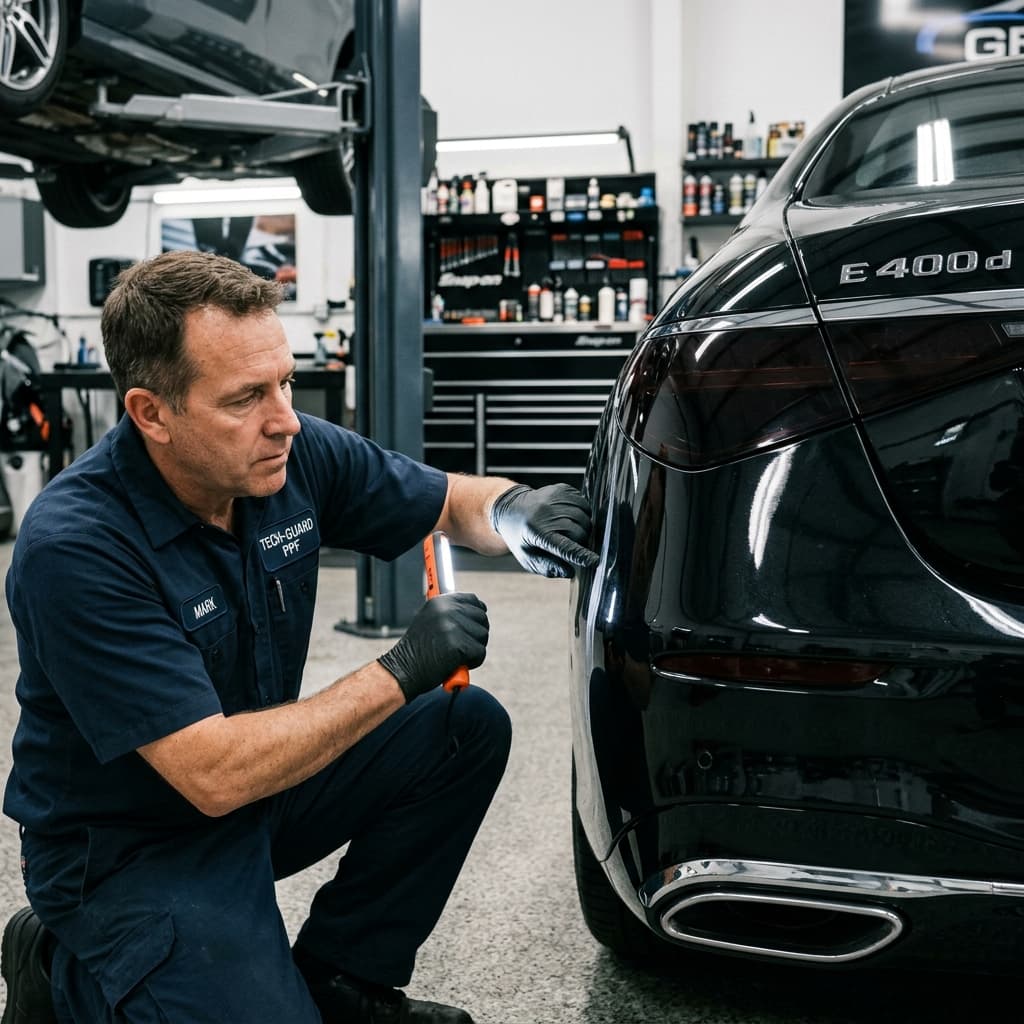
Whether you're a Calgary PPF Pros customer or you had your film installed elsewhere and want a second opinion, bring us your concerns. We inspect PPF under professional lighting and give you an honest assessment — warranty claim, repair, or peace of mind.
Book a PPF InspectionFrequently Asked Questions
Are bubbles in PPF normal?
Why is my PPF turning yellow?
Can PPF be spot-repaired?
My PPF is peeling at the edges — is it covered by warranty?
Experience The Best.
Don't let another commute compromise your vehicle. Get a quote from Calgary's Consumer Choice Award winner today.
Explore Our Services