Buying a Used Car with PPF in Calgary? 12-Point Inspection Checklist
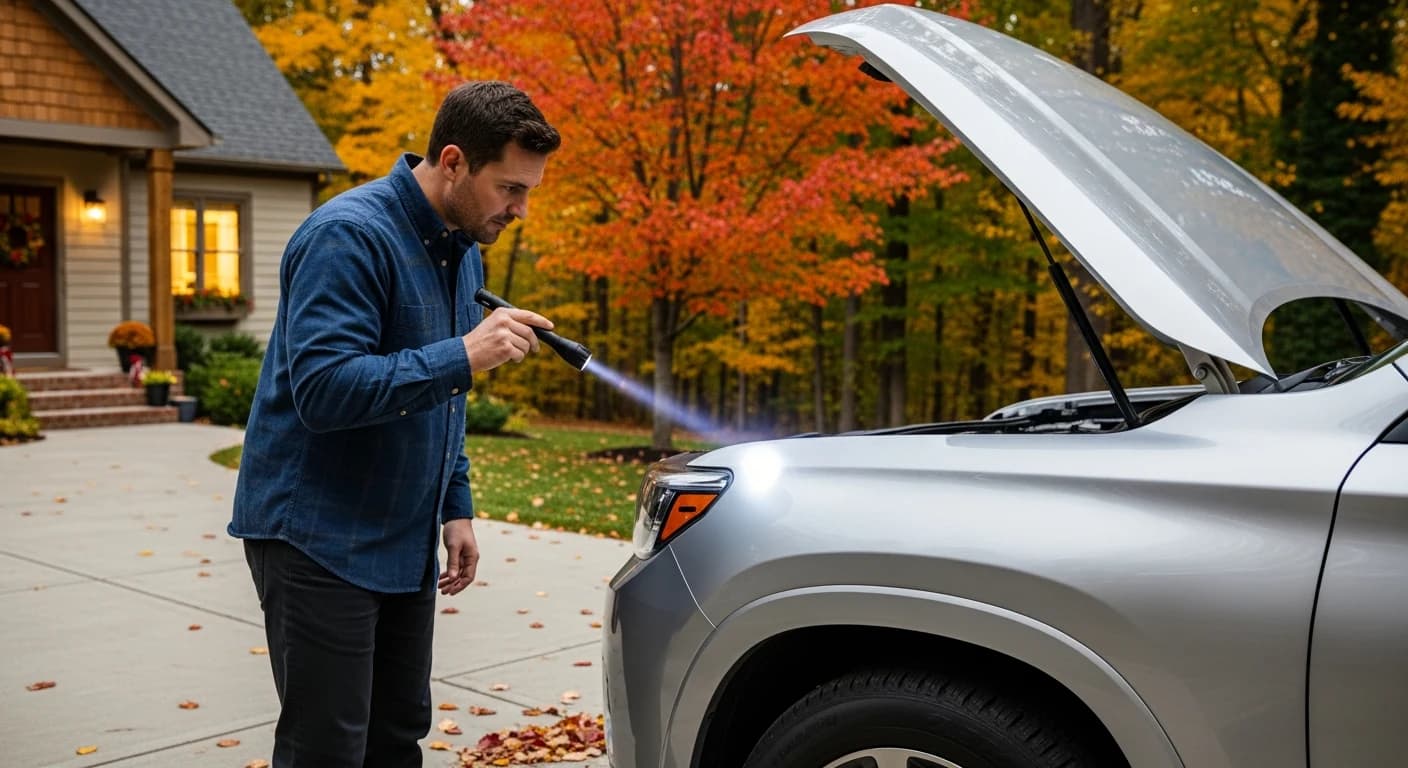
A used-car PPF inspection in Calgary is a 30-minute driveway checklist plus an optional $60–$150 studio evaluation. PPF on a used car is worth keeping if the film is under 5 years old, shows no visible yellowing, has no edge lift longer than 2 mm, and comes with an original install invoice showing the batch or lot number. Anything past year 7 in Calgary UV, any workmanship-only warranty with no batch record, or any film covering unrepaired rock chips should be priced as removal-and-replace (Calgary 2026: $400–$1,200 partial-front removal, $1,200–$2,400 full-front, plus $300–$800 for a single-stage paint correction if adhesive lifts topcoat). The 12-point inspection below takes 30 minutes in the seller's driveway and produces a repair-or-replace number that becomes your negotiating point — sellers cannot hold a "+$1,500 because it has clear bra" premium once your inspection report shows 18 months of remaining life.
Fall used-car listings in Calgary spike every year between mid-August and October — private sellers cleaning up before winter storage, dealers turning trade-ins from spring buying season, and a wave of two-year-old lease returns hitting AMVIC lots. A growing share of those listings advertise "clear bra" or "PPF" as a value-adding feature, and most buyers have no framework to evaluate whether the film is worth the asking premium. This is the 30-minute checklist we walk private buyers through at the shop counter — the same one our inspection service uses when we get called out for a paid pre-purchase evaluation. It reduces the PPF variable from a soft feature to a hard dollar number you can put on paper.
Every August through October we run 8–15 paid pre-purchase PPF inspections a week for Calgary private buyers — usually on cars listed between $28,000 and $80,000 where the film premium is 3–8% of the ask. Roughly one in three inspections identifies a film with less than 24 months of practical life left, which becomes a $1,200–$2,400 removal-and-replace credit against the negotiating price. The other pattern we see: sellers who cannot produce an install invoice, which drops the film from "transferable warranty" to "decorative wrap" on the valuation. The 12-point checklist below is the same field procedure our inspectors use.
Reviewed by Calgary PPF Pros — Consumer Choice Award winner 2026, protecting Calgary vehicles since 2021, 5.0★ rated across 96 Google reviews.
Before the Inspection — 4 Things to Get From the Seller
Do not walk up to the car cold. Text or email the seller these four questions before you show up. Their answer (or non-answer) tells you whether the film is worth 30 minutes of your afternoon, and whether they are pricing it as a real feature or a marketing bullet.
Who installed the film and when?
The answer should include a specific Calgary or Alberta shop name and an install date. "A friend" or "it came with the car" means workmanship-only warranty with no transferability. Reserve the right to walk if the seller cannot name a shop.
Do you have the original install invoice?
The invoice should show: shop name, vehicle VIN, install date, film brand (STEK DYNOshield, GSWF Defender Platinum, another premium film, or a budget alternative), and coverage panels. No invoice = no warranty transfer, regardless of what the seller believes.
What is the film batch or lot number?
Premium film brands record batch numbers on install for warranty registration. Ask the seller to text you the batch number from the invoice. If they cannot produce one, the manufacturer warranty is unlikely to transfer even if paperwork exists.
Was the warranty registered in your name at install?
Premium film manufacturers (STEK, GSWF, and others) generally require the installer to register the warranty within 30 days of install. Ask the seller to check their email for the manufacturer registration confirmation — the seller should be able to forward it to you as proof.
A seller who answers all four cleanly and forwards the paperwork before you visit is telling you the film is a real feature and the ask is defensible. A seller who dodges or claims "the shop lost the paperwork" is telling you to price the film as decorative. Both outcomes are useful — you know which conversation to have when you arrive. For the wider question of whether film pays back at all, see our is PPF worth it? guide.
The 12-Point Inspection — 30 Minutes in the Driveway
Run these 12 points in order, in daylight (indirect is best — direct sun overexposes the film edges you are trying to see). Bring a phone with a flashlight, a clean microfiber cloth, and a notepad. Score each point pass, fail, or note. Anything below Point 6 pass at three or more failures is a walk-away or a heavy negotiation.
| # | Inspection Point | What Pass Looks Like | What Fail Looks Like |
|---|---|---|---|
| 1 | Sight-line the panel edges | Clean hairline; no visible edge on wrapped install | Rough or curled edge; visible film shrinkage |
| 2 | Fingernail edge test | No lift; film feels flush with paint | Nail slides > 2 mm under film edge |
| 3 | Yellowing on white or silver | Uniform tone; no yellow cast under film | Visible yellow tint; film noticeably warmer than paint |
| 4 | Orange-peel texture match | Consistent texture panel-to-panel | Wavy or peel-y texture different from adjacent panels |
| 5 | Rock chips trapped under film | Clean film surface with no bubbles | Bubbles, brown spots, or moisture rings visible |
| 6 | Contaminant staining | Film surface wipes clean with microfiber | Bug or sap stain visible in the topcoat after wipe |
| 7 | Film brand identification | Batch or lot stamp legible; install-shop sticker present | No branding visible anywhere on the vehicle |
| 8 | Warranty transfer paperwork | Invoice + batch # + registration in seller's email | Seller cannot produce all three documents |
| 9 | Edge lift after 3+ Calgary winters | Vehicle is 3+ years old with zero visible edge lift | Vehicle < 3 years old with 2+ mm edge lift |
| 10 | Painted-over film | Clean film-to-paint transition; no clear-coat overlap | Paint overspray visible on the film edge |
| 11 | Door handles, mirrors, A-pillars | Film condition uniform across trim and body | Trim film yellowed or lifted while body film is clean |
| 12 | Written removal-and-replace estimate | Fixed-price quote in your hand before you buy | No independent evaluation obtained |
Any single fail on points 4, 5, or 10 is a walk-away — those signal hidden collision or bodywork the seller is not disclosing. Fails on points 2, 3, 9, or 11 are removal-and-replace budget items you deduct from the ask. Fails on points 7, 8, or 12 are warranty-value deductions — the film loses its transferability multiplier and gets priced as a bare wrap. Our PPF troubleshooting guide covers the workmanship-versus-manufacturer distinction that comes up when a seller blames the film brand for edge lift on a young car — usually the brand is fine and the install was rushed.
Grading Yellowness — The White Paint Test
Yellowness is the fastest way to date a film. Modern aliphatic-TPU PPF (top three brands, 2016 onwards) resists true UV yellowing for 8–10 years in Calgary UV; when you see visible yellow on a young car, it is almost always contaminant staining in the topcoat rather than film failure. Older polyurethane-only films (pre-2016 budget stock, some 2018–2020 economy brands) yellow structurally within 3–5 years and cannot be cleaned. The distinction matters because contaminant staining is often a $200 detail; film-yellowing is a full $1,200+ removal-and-replace.
| Yellowness Grade | What You See | Likely Cause | Fix |
|---|---|---|---|
| 0 — Clean | Film indistinguishable from paint under indirect light | Modern film, well maintained | None; keep the film |
| 1 — Faint | Subtle warm cast under film on white/silver — visible only at 15° angle | Contaminant film on topcoat | Chemical decontamination ($150–$300) |
| 2 — Moderate | Clear yellow tint under direct sun, not visible in shade | Older-generation TPU, or long-standing contaminant | Try decon first; if unchanged, budget removal |
| 3 — Heavy | Visible yellow in ambient light on any paint colour | Film past useful life (7+ years) or budget polyurethane | Full removal-and-replace ($1,200–$2,400) |
| 4 — Failed | Amber tint; film feels brittle or shows micro-cracks | Structural film failure; often accompanied by edge lift | Immediate removal to prevent adhesive bake-on ($400–$800 extra) |
On the passenger fender of a white car, place a piece of white printer paper against the paint and rotate it under the film edge. If the film-covered zone reads noticeably warmer than the paper, you are at Grade 2 or above. On darker cars this test does not work — you have to trust the batch date on the invoice and the visible edge condition instead. For what end-of-life PPF actually looks like, see how long PPF lasts and the signs it is done.
Warranty Transferability — What Each Brand Actually Requires
A big part of the resale value premium for PPF is the manufacturer warranty. But warranties do not automatically transfer with the vehicle title — every major brand requires documentation the installer had to file at install time. If that paperwork is missing, the warranty premium disappears regardless of what the seller advertises. This is where most private-sale PPF valuations get inflated. For the seller-side view of how film affects resale, see our is PPF worth it? guide.
| Film Brand | Warranty Term | Transfers to 2nd Owner? | Required Documents |
|---|---|---|---|
| No | 10 years | Yes, with documentation | Original invoice, batch #, STEK installer registration |
| GSWF Defender Platinum | 10 years | Ask the installer — documentation required | Original invoice, batch #, installer registration |
| Budget / no-name TPU | 5 years or less | Rarely | Workmanship warranty from installer; typically non-transferable |
| Dealer pre-cut kit | Varies | Rarely | Often no batch #; ties to original dealer relationship |
Each manufacturer publishes their transfer terms directly — premium brands typically require the batch number and installer registration to survive an ownership change, and STEK publishes its transfer terms for its own registered installers.
Practical rule: if the seller cannot produce the invoice, the batch number, AND the installer registration confirmation, price the film as if it carries a workmanship-only warranty from a shop you have no relationship with — worth roughly one-third of a documented transferable warranty on the same film. Our brand comparison — STEK DYNOshield and GSWF Defender Platinum warranty comparison — details what each manufacturer actually covers when a valid transfer is on file.
Removal Cost Math — Calgary 2026
If your inspection lands the film in the removal-and-replace band, price the job before you agree to anything. Calgary 2026 PPF removal pricing sits in three tight bands by coverage and age. Add paint correction on top if the adhesive damaged the underlying clear coat during removal.
| Removal Scope | Film Age | Base Removal Cost | Typical Add-Ons | Total Budget |
|---|---|---|---|---|
| Partial-front (hood, fenders, mirrors, bumper) | < 5 years | $400–$700 | Minor decon $100–$200 | $500–$900 |
| Partial-front | 5–7 years | $600–$900 | Adhesive residue $150–$300 | $750–$1,200 |
| Partial-front | 7+ years | $800–$1,200 | Paint correction $300–$600 | $1,100–$1,800 |
| Full-front or full-body | < 5 years | $900–$1,400 | Minor decon | $1,000–$1,600 |
| Full-front or full-body | 5–7 years | $1,200–$1,800 | Adhesive residue $200–$500 | $1,400–$2,300 |
| Full-front or full-body | 7+ years | $1,600–$2,400 | Paint correction $500–$800 | $2,100–$3,200 |
For the reinstall side of the math, our PPF lifespan and replacement guide covers what replacement involves; new film runs from partial front ($399) through full front ($1,499) to full body ($4,999). Put the two numbers together and you have your negotiating position: if the seller wants a $1,500 PPF premium on the car and your inspection shows $1,800 in removal-and-replace budget, the film is a net-negative valuation and the ask needs to drop $1,800–$3,300 rather than climb $1,500.
Six Deal-Killers — When to Walk Away
Some inspection findings are not negotiations — they are exits. Six patterns should end the conversation:
PPF laid over unrepaired rock chips
Film over chip damage traps moisture between the clear coat and the film adhesive. In Calgary's freeze-thaw cycling, that moisture pocket becomes corrosion under the film within 12–24 months. If you can see brown spots or bubbles under film on the leading edge of the hood, the vehicle has hidden paint damage that is spreading.
Film painted over during collision repair
A body shop that oversprays clear coat onto existing PPF is either hiding the fact that the panel was repaired, or making the film impossible to remove without stripping the entire panel. Either way, the vehicle history is not what the seller is representing.
Edge lift longer than 2 mm on a car under 3 years old
Young cars with visible edge lift indicate poor prep — the installer did not clean the panel or did not use the correct edge tuck. That workmanship failure will spread panel-to-panel through the film's remaining warranty window and there is no manufacturer path to fix it (workmanship is on the installer, not the film brand).
No install invoice, no batch number, no warranty registration
This is not a red flag — it is a warranty-value writeoff. The film is worth its physical protection only, not its transferable warranty premium. If the ask price includes a warranty premium, the ask is fictional.
Orange-peel texture underneath the film different from adjacent panels
Almost always indicates a prior respray hidden under the wrap. Body shops sometimes use PPF as a way to bury an amateur paint job. Combined with a CarProof or VHR check that shows no reported claim, this is a vehicle-history disclosure issue.
Film covering the front bumper with visible impact damage
A cracked bumper cover under PPF signals the installer wrapped over undisclosed collision damage. Combined with any Point 10 finding (paint runs, clear-coat overlap), it is grounds to end the transaction and move to the next listing.
Six Green Flags — When the Film is a Real Feature
Named premium film brand with transferable warranty
STEK DYNOshield, GSWF Defender Platinum, or a comparable premium film with the batch number recorded on a Calgary or Alberta shop invoice. Premium brands honour transfers to a second owner when the paperwork is intact.
Installer name is a shop you can call
A shop you can look up (Google reviews, physical address, response on phone) is one that will honour their workmanship warranty even after a resale. That is a genuine value transfer, not just paper.
Zero edge lift after multiple Calgary winters
A car that has been through 3+ chinook cycling seasons with clean edges everywhere is telling you the installer prepped the panels correctly. That workmanship holds through the rest of the film's life.
Coverage matches typical Calgary daily-driver spec
Full front (hood, fenders, mirrors, front bumper, headlights) covers the panels that take 90% of rock-chip damage on Deerfoot, Stoney, and QE2. Anything less is partial protection; anything more is a bonus.
Ceramic coating layered on top
A car with fresh ceramic over PPF is one that was maintained by an owner who took protection seriously. That correlates strongly with the rest of the vehicle being well-kept.
Film is under 3 years old
A modern premium film under 3 years old with clean edges represents 7+ years of remaining warranty. That is a genuine $2,000–$4,000 of practical protection value transferring with the sale.
When to Get a Paid Pre-Purchase Inspection
For vehicles priced under $20,000 the 12-point driveway checklist is enough. Above $30,000, or when the PPF premium on the ask exceeds $1,500, a paid pre-purchase inspection pays for itself the first time it identifies a fail. Calgary PPF studio inspections in 2026 run $60–$150 for a 15–30 minute in-bay evaluation and produce:
- Film brand identification — often from residual batch markings, adhesive-line inspection, or edge geometry that identify a brand even without paperwork.
- Remaining useful life estimate — years-remaining number based on age, UV exposure, edge condition, and topcoat condition.
- Warranty transferability check — a phone call to the installer or manufacturer with the batch number to confirm transfer eligibility on the spot.
- Fixed-price removal-and-replace estimate — the number you take to the seller as your negotiating floor.
- Coverage gap map — which panels the previous owner did not protect, so you can budget the follow-on install (rocker panels, A-pillars, door cups are the usual gaps).
Bring the seller with you to the inspection when possible — it is much harder for a seller to reject a fair valuation when the film professional is standing next to the car explaining why the film has 18 months of life left. Our fresh PPF install in Calgary pipeline includes same-week appointments for inspection-service customers during the fall used-car buying window, and removal-plus-reinstall packages priced against your inspection report.
Used-Car PPF — Pros and Cons at Purchase
The Pros
- Modern premium film (STEK, GSWF, or similar) with intact paperwork is a genuine $2,000–$4,000 of transferable protection value
- Zero-edge-lift film that has survived 3+ Calgary winters signals installer quality and correlates with rest-of-vehicle maintenance
- A car pre-wrapped in the panels you would install film on anyway saves 2–3 weeks of downtime after purchase
- Warranty transfer converts to years of manufacturer coverage on your ownership window when paperwork is complete
- Ceramic coating layered on top signals a maintenance-first previous owner and adds hydrophobic wash-day benefits
The Cons
- Undocumented film loses transferable-warranty value and should be priced as a decorative wrap only
- Film past year 7 in Calgary UV is usually into removal-and-replace territory regardless of visual condition
- Edge lift on young cars indicates workmanship failure that will spread panel-to-panel through remaining life
- PPF over unrepaired chip damage traps moisture and accelerates corrosion — a $500 fix becomes a $2,000+ panel replacement
- Painted-over film during collision repair is a vehicle-history disclosure red flag; walk away rather than negotiate
Bottom Line
PPF on a used car is a real feature worth 3–8% of the ask if the film is a documented premium brand under 5 years old with clean edges, and if the seller can produce the invoice, batch number, and warranty registration. Anything past those thresholds prices as a wrap only, and film in the 7+ year band is usually a removal-and-replace budget item that turns the PPF premium into a negotiating deduction. Run the 12-point inspection in the driveway, follow up with a paid $60–$150 studio inspection on any vehicle above $30,000, and you convert a soft feature into a hard number. Sellers who have documented their film welcome the process; sellers who have not are telling you exactly what the film is worth to keep.
Booking a used-car PPF inspection in Calgary this fall? Contact us for a same-week 15–30 minute in-bay evaluation with a written repair-or-replace report you can bring to the negotiation. We inspect film from every major manufacturer and quote fixed-price removal, correction, and reinstall against the panels your inspection identifies.
Related Reading
Is PPF Worth It?
The ROI framework for adding PPF to a car you already own — pairs with this pre-purchase inspection guide.
How Long Does PPF Last?
What a film that is done actually looks like, and what removal and replacement involve.
PPF Troubleshooting: Bubbles, Yellowing & Peeling
Which film problems are normal curing, which are install defects, and which are warranty claims.
Frequently Asked Questions
How do I tell if a used car already has PPF?
Is old paint protection film worth keeping on a used car?
How much does it cost to remove old PPF in Calgary?
Does a PPF warranty transfer to the second owner?
What are the biggest red flags when inspecting used-car PPF?
Should I get a professional pre-purchase inspection of the PPF?
What if the used car has PPF but I want to install more film?
Experience The Best.
Don't let another commute compromise your vehicle. Get a quote from Calgary's Consumer Choice Award winner today.
Explore Our Services