Tree Sap & Cottonwood Damage: Calgary Paint Guide 2026
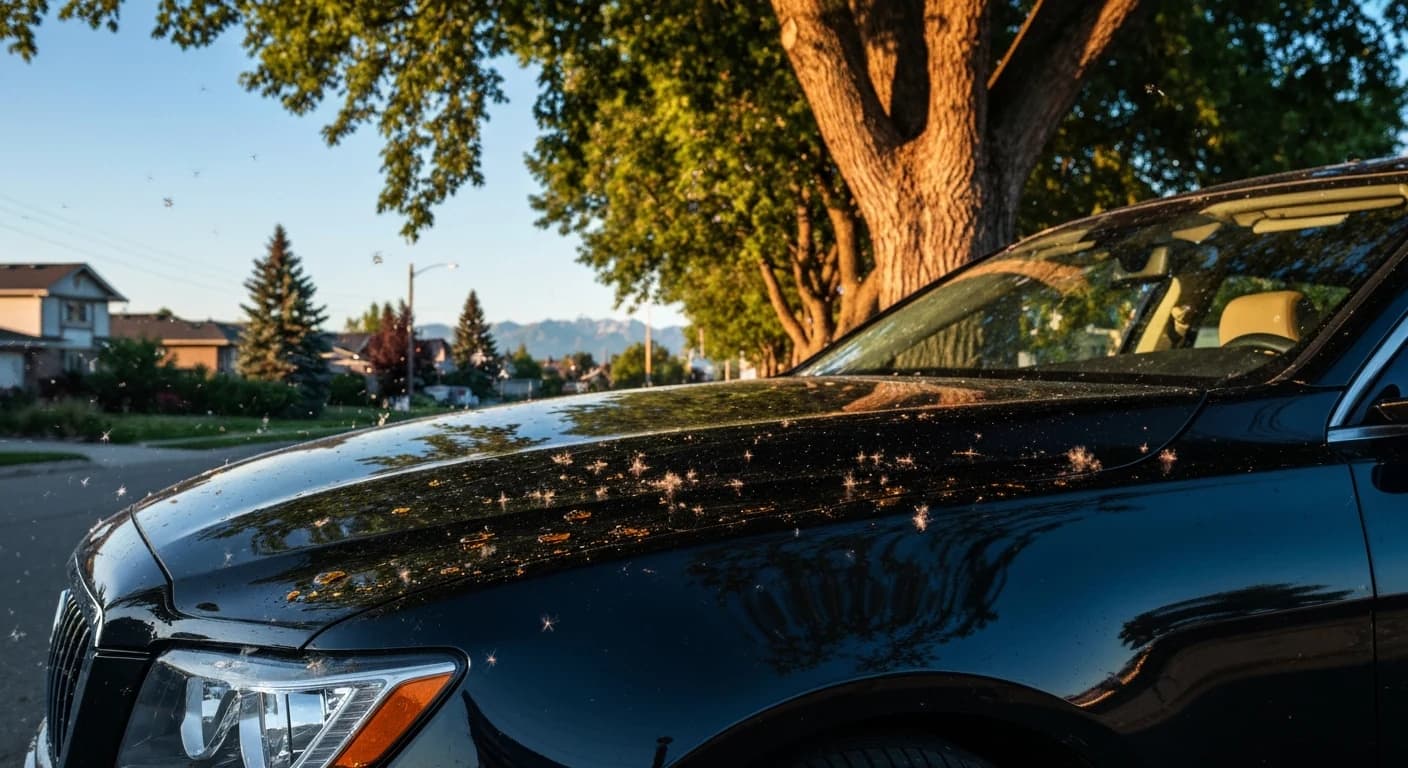
Tree sap etches Calgary clear coat in 24–48 hours once panel temperature exceeds 40°C — typical for any dark vehicle parked in June, July, or August sun. Cottonwood fluff season runs late May through early July, peaking mid-June, and is heaviest in mature inner-city neighbourhoods (Bowness, Inglewood, Sunnyside, Bridgeland, Kensington, Mission, Elbow Park). Sap itself does the etching; fluff traps moisture in door seals and crevices. The protection sweet spot: ceramic coating refresh before May 15 ($799–1,499, 2–5 year lifespan), with PPF on the front impact zones for drivers parking under mature trees daily. On unprotected paint, rinse every 48–72 hours during peak season and remove visible sap within 24 hours.
Every June, the same wave of phone calls hits Calgary detail shops. A driver parks under what looked like a perfectly nice tree on a quiet Bowness side street for a long weekend, comes back to find dozens of amber droplets dotting the hood, and discovers that twenty minutes of scrubbing has only spread the mess. This guide is the playbook we give Calgary drivers when they ask why their tree-lined street keeps wrecking their paint — and exactly which protection actually solves it. (Owners parking along the Bow-valley canopy can also browse our Bridgeland local protection menu under the river canopy.)
The 24–48 Hour Etch Window
The single most important fact about tree sap and Calgary summer paint is the timeline. Fresh sap is not particularly aggressive — left on a cool panel in shade, it can sit for a week without permanent damage. The chemistry only turns destructive when heat enters the equation. Once panel surface temperature climbs above roughly 40°C, the sugars in the sap caramelize and the volatile terpenes evaporate, leaving behind a sticky organic polymer that mechanically and chemically bonds to the microscopic pore structure of automotive clear coat.
A black or dark blue panel in direct Calgary June sun routinely hits 55–70°C surface temperature by early afternoon. This is the exact range where the polymerization reaction accelerates fastest. The acidic compounds in the sap (pH around 4.5–5.5, similar to the fatty acids in spring pollen) then etch microscopic pits in the now-bonded contact zone. Calgary's altitude makes this worse: at 1,048 metres, UV intensity is 10–12% higher than at sea level, and UV accelerates the chemistry further — the same reason we wrote about how Calgary's altitude intensifies UV damage on clear coat.
The Real Risk Pattern
A car that catches a few sap droplets and gets washed within 24 hours: low risk, no permanent damage. A car parked under a cottonwood for a long weekend (96+ hours) in late June sun: high risk of permanent clear-coat etching that requires polishing or paint correction to remove. The bonding reaction is exponential with both time and temperature, so the difference between a Friday-morning catch and a Monday-evening one is far larger than you would expect.
Cottonwood Season: What It Actually Does
Calgary's mature cottonwood and balsam poplar populations along the Bow and Elbow river corridors release seed fluff over a roughly six-week window from late May through early July, with peak release in mid-June. The fluff itself is biologically inert — pure plant cellulose seed cotton — and does no direct chemical damage to paint. The fluff also acts as a sponge for any airborne particulate landing on the vehicle that week — including the fine grey ash from Calgary's summer wildfire-smoke window, which usually overlaps the back half of cottonwood season. What matters is what travels with it: ultra-fine pollen, road grit, brake dust, and microscopic droplets of cottonwood resin shed from the same trees. The fluff acts as a transport mechanism, carrying these contaminants into every crevice on your vehicle and holding them in contact with metal, rubber, and paint surfaces for days at a time.
The City of Calgary stopped planting new fluff-producing poplars in public parks and along public streets over a decade ago, but the mature trees that remain are concentrated in the oldest neighbourhoods — exactly where street-parked vehicles spend the most time. Pollen damage is a related April–May issue we covered in the Calgary pollen season guide; cottonwood and tree sap pick up the relay roughly the day birch pollen finishes.
Calgary Neighbourhoods Ranked by Tree-Canopy Risk
| Neighbourhood | Canopy Maturity | Sap / Fluff Risk | Typical Source Trees |
|---|---|---|---|
| Bowness | 60–90 years | Very High | Balsam poplar, narrowleaf cottonwood, Manitoba maple |
| Inglewood | 70–110 years | Very High | Black cottonwood, American elm, willow |
| Sunnyside / Hillhurst / Kensington | 50–80 years | Very High | Cottonwood, Manitoba maple, white spruce |
| Bridgeland | 60–90 years | High | Cottonwood, balsam poplar, elm |
| Mission / Cliff Bungalow / Erlton | 50–80 years | High | Cottonwood, ornamental linden, ash |
| Elbow Park / Roxboro / Britannia | 50–100 years | High | Cottonwood, white spruce, ash |
| Mount Royal / Hounsfield Heights | 40–80 years | Moderate–High | Spruce, pine, mature aspen |
| Tuscany / Royal Oak / Citadel | 15–30 years | Low | Younger linden, mountain ash, ornamental crab |
| Mahogany / Auburn Bay / Cranston | 5–20 years | Very Low | Young ornamental species only |
Risk ratings reflect 2026 Calgary PPF Pros field experience with customer-vehicle drop-off conditions. The City of Calgary publishes detailed tree-management notes — see the City's official poplar-tree page for the planting-policy history.
How Tree Sap Bonds (and Why Removal Gets Harder Every Day)
Tree sap is a complex mixture: sugars (sucrose, fructose), organic acids (mostly malic and citric in deciduous Calgary species), and volatile terpene resins. When it first lands on a clear coat, only the sugar and acid fractions are sticky — the terpenes are still liquid and free to evaporate. As the panel heats, three things happen in sequence:
Volatiles evaporate (0–6 hours)
The lighter terpene fractions evaporate, leaving behind a concentrated sugar-acid-resin paste. In this window the sap is at its softest and most easily removed — a 70–90% isopropyl alcohol wipe lifts it cleanly with no residue. This is the easy fix window.
Polymerization begins (12–48 hours)
Heat-driven crosslinking turns the residue into a hard, glass-like polymer that mechanically grips the clear-coat surface texture. Removal now requires solvent dwell time of 5–10 minutes before any wiping. Aggressive scrubbing during this stage is the most common cause of swirl marks on Calgary cars in July.
Acid etching (48+ hours)
The organic acids trapped beneath the polymer continue to react with the clear coat itself. By 72 hours under hot Calgary sun, microscopic pits and a dull halo form in the contact zone. Even after the sap is fully removed, the etch ring remains visible. Light etching responds to machine polishing; deeper etching needs full paint correction.
What Protection Actually Works (and What Doesn't)
The protection landscape for tree sap maps cleanly onto the same hierarchy as other summer contaminants — the underlying physics is hydrophobicity and surface chemistry, which is exactly the mechanism we break down in our explainer on how ceramic coatings work at the molecular level. What changes with sap specifically is that the contact times are longer and the chemistry is more aggressive, which exaggerates the gap between unprotected and protected surfaces.
| Surface | Safe Contact Window | Etch Risk | Removal Difficulty |
|---|---|---|---|
| Bare clear coat | < 24 hours | High after 48hr in sun | Solvent + clay-bar + possible polish |
| Carnauba wax (4–8 weeks old) | 24–48 hours | Moderate — wax degrades fast in heat | Solvent + reapply wax after |
| Synthetic sealant (3–6 months old) | 48–72 hours | Moderate | Solvent + clay-bar usually sufficient |
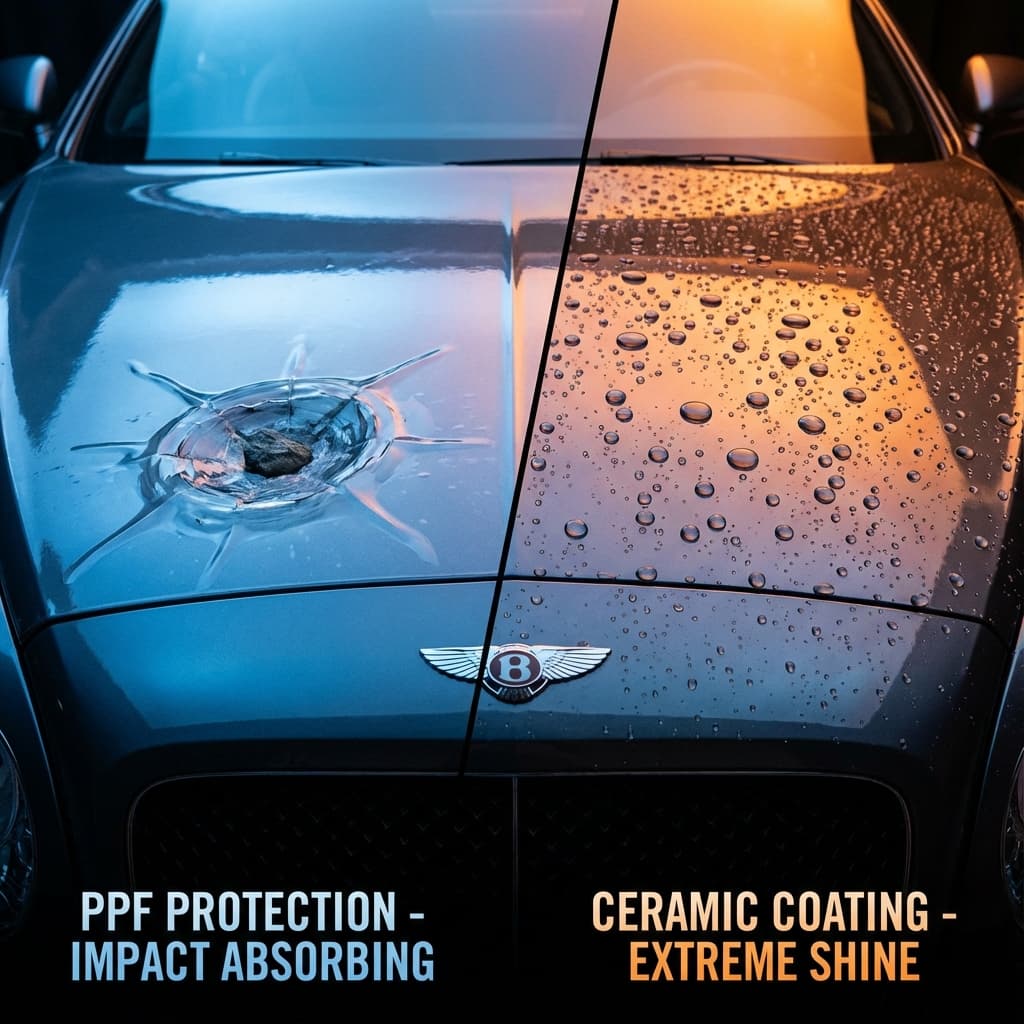
| Ceramic coating (in lifespan) | 5–10 days | Low — sits on top of coating | Plain car wash soap, single pass |
| PPF (self-healing / 3M Pro) | Indefinite (paint protected) | Very low — film absorbs the chemistry | Standard wash, no solvent needed |
The Pros
- Pre-season ceramic coating refresh (book by May 15) provides 2–5 year passive protection
- Front-end PPF (hood, bumper, fenders) protects the panels most often hit by overhead sap drips
- Touchless rinse every 48–72 hours during peak season breaks the polymerization cycle
- Garage parking during cottonwood week eliminates 90% of the exposure
- Quick alcohol-wipe within 12 hours of sap landing reliably prevents etching
The Cons
- Razor blades and metal scrapers — never use these on hot polymerized sap; the swirl marks will exceed the original damage
- Brush-style automatic car washes — drag bonded sap across the rest of the panel and grind contaminants into fresh clear coat
- Generic household solvents (acetone, paint thinner, gasoline) — will dissolve clear coat as fast as they dissolve sap
- Heat-gun methods — soften the sap but also soften clear coat, causing imprinting and orange-peel texture
- Doing nothing during the long weekend — the single highest-cost decision Calgary drivers make every June
The 24-Hour Removal Procedure (Bare Paint)
If you catch sap within 24 hours of landing on unprotected paint, the safe DIY removal procedure is short. The same procedure works for bug splatter, with longer dwell times — we covered the related approach for film and bug residue in our bug and tar removal guide.
- Wash the panel first. A pH-neutral rinse and gentle wash removes any dust or grit that would otherwise scratch the paint when you start working on the sap itself.
- Dampen a clean microfibre with 70–90% isopropyl alcohol. Do not over-saturate — alcohol that runs off the contact spot can dull adjacent wax or sealant.
- Lay the cloth on the sap. Let it dwell 2–3 minutes. Dwell time matters more than scrubbing pressure. The alcohol penetrates the polymer; pressure does not.
- Wipe gently in one direction. Never back-and-forth — that smears the dissolved sap across new paint. Fold to a clean section of the cloth for each pass.
- Re-wash and inspect. Wash the area with car shampoo to neutralize the alcohol. Then look at the spot in direct sunlight at a 45° angle — if you see a dull halo, the clear coat is etched and needs polishing.
- Reapply wax or sealant if removed. Alcohol strips wax and most synthetic sealants. Spot-reapply your maintenance product after the area dries.
Hardened Sap (24–72 hours old)
For sap that has cured into a hard amber bead, swap isopropyl alcohol for a dedicated automotive sap-and-tar remover (Stoner Tarminator, Meguiar's Gold Class Bug & Tar, or 3M Adhesive Remover all work well in Calgary climate). Increase dwell time to 5–10 minutes. If a plastic spatula can lift the softened bead without dragging, that is the safest mechanical removal — never use metal. Anything older than 72 hours under summer sun is a job for a professional detail shop with the equipment to assess whether polishing or full correction is needed.
Cottonwood Fluff: The Underrated Damage
Cottonwood fluff itself does no paint damage, but it causes three indirect problems most Calgary drivers ignore until they become expensive. First, it packs into door seals, window channels, and the cowl trough below the windshield, where it traps moisture and accelerates rust on exposed metal — particularly problematic on older vehicles where the original cataphoretic coating has worn thin. This is the same moisture-trap mechanism we covered in the context of winter salt; see the Chinook freeze-thaw paint damage guide for the broader rust pattern.
Second, the fluff acts as a contaminant net — every piece of fluff stuck to your hood is holding pollen, road grit, and sometimes fresh sap droplets in contact with the paint for as long as the fluff sits there. Third, sucking fluff into the cabin air intake clogs filters and can encourage mould growth in damp HVAC components by August. A 10-minute weekly routine during peak fluff season — compressed-air or vacuum out the cowl, door seals, and lower windscreen channels — eliminates most of the indirect risk. Cottonwoods also concentrate the wildlife load — Calgary's resident magpies nest in mature poplars and broadcast acidic droppings onto the same hoods parked beneath them, a hazard we unpack in our magpie droppings from the same canopy guide.
The Calgary Summer Protection Stack (2026 Pricing)
For drivers who park under mature trees daily, the protection economics favour a stack rather than any single product. Here's what we typically recommend for a Calgary daily-driver in a high-canopy neighbourhood, in priority order.
| Layer | What It Solves | Cost (2026 Calgary) | Lifespan |
|---|---|---|---|
| Ceramic coating (full vehicle) | Sap, pollen, bird droppings, UV fade, washing time | $799–1,499 | 2–5 years |
| Front-end PPF (hood, bumper, fenders) | Overhead sap drips, gravel chips, bug-splatter etch | $1,299–2,499 | 8–10 years |
| Maintenance ceramic spray top-up | Restores hydrophobics worn by summer contaminants | $60–90 per visit | 3–4 months |
| Garage parking (where available) | Eliminates 80–90% of exposure entirely | Free–$150/mo | Indefinite |
For the underlying logic on why ceramic outperforms wax across an entire Calgary summer, see our ceramic vs wax comparison. Ask about pre-cottonwood protection bundles →
A Weekly Routine for Tree-Lined Streets
For Calgary drivers who simply cannot avoid parking under cottonwoods or balsam poplars between June and August, a structured 10-minute weekly routine prevents almost all of the avoidable damage:
- Monday: Visual scan of horizontal surfaces (hood, roof, trunk). Spot-clean any visible sap droplets with isopropyl alcohol within 12 hours of landing.
- Wednesday: Touchless rinse — coin wash or garden hose. No soap needed. Three minutes. This breaks the wet-contact cycle and removes loose pollen and fluff.
- Friday or Saturday: Full pH-neutral hand wash. Pay extra attention to door jambs, the windscreen cowl, and wheel wells where fluff accumulates.
- Every 3 weeks: Vacuum or compressed-air out cabin filter and HVAC intake during peak fluff season. Takes 5 minutes; prevents mould.
- Every 3 months (summer): Ceramic spray top-up on a freshly washed vehicle. Restores hydrophobics that thirty consecutive hot days will degrade.
Related Reading
Calgary Pollen Season Guide
The April–May etching threat that hands off the relay to cottonwood and sap in June.
How Ceramic Coatings Work
The molecular mechanism that turns a sap-prone clear coat into a sap-shedding one.
Calgary UV & Paint Damage
Why high-altitude sun accelerates the etching chemistry behind every summer contaminant.
External references: City of Calgary — Poplar tree management and Consumer Reports — Sap and bug removal.
Pre-Cottonwood Protection, Booked Before June 15
Free 15-minute consultation. We'll recommend the right combination of ceramic coating, paint protection film, and pre-summer detail for your vehicle, parking pattern, and neighbourhood. Calgary AB. Consumer Choice Award winner. 10-year manufacturer-backed warranty.
Frequently Asked Questions
Experience The Best.
Don't let another commute compromise your vehicle. Get a quote from Calgary's Consumer Choice Award winner today.
Explore Our Services