Calgary Road Construction: Tar & Asphalt Paint Damage 2026
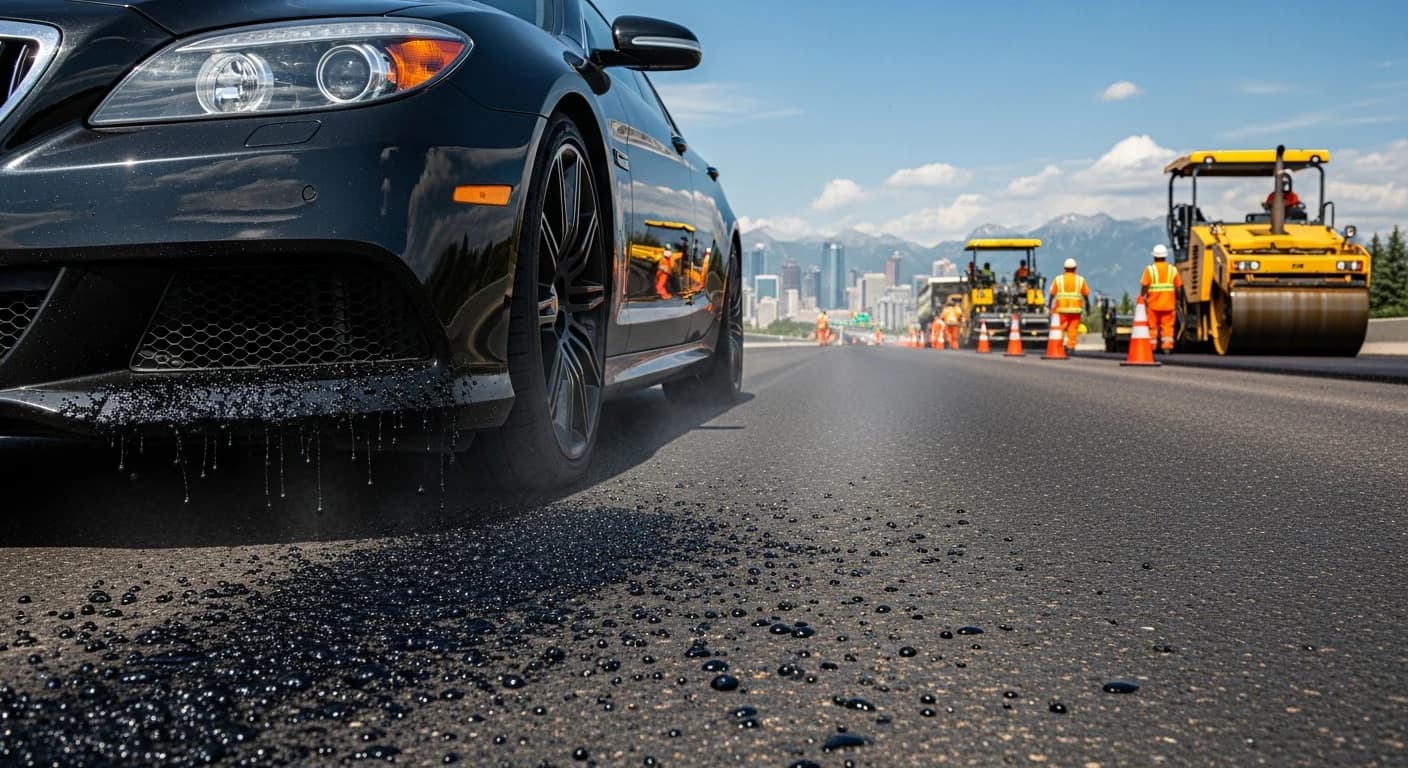
Fresh asphalt and tar bond to unprotected Calgary clear coat within 2 hours once panel surface temp exceeds 30°C — typical for any vehicle in June sun. After 24–72 hours, the bitumen etches a permanent stain ring that solvent removal alone cannot clear. Calgary's 2026 Annual Paving Program covers 303 lane-km across 148 locations, with the highest-risk corridors being the Deerfoot Glenmore/Southland interchange, Anderson Rd SE, and Stoney Trail NW tie-ins. The protection sweet spot: front-end PPF ($1,299–2,499) plus ceramic coating ($799–1,499) for commuters on these corridors. On unprotected paint, work in shade with a dedicated bug-and-tar remover (Turtle Wax, Meguiar's Gold Class, or 3M 38500) within 2 hours of contact; never use razor blades, brush washes, or household solvents.
Every June, the same wave of phone calls hits Calgary detail shops. A driver commutes Deerfoot Trail on a Monday morning, parks at the office, and steps out at lunch to find dozens of black tar pinpoints freckled across their bumper, rockers, and lower doors. Twenty minutes of scrubbing only smears the mess. This guide is what we tell those drivers — and exactly which protection actually solves it for the rest of Calgary's 2026 paving season.
The 2-Hour Asphalt-to-Paint Bond Window (Calgary Summer)
The single most important fact about asphalt-on-paint chemistry in a Calgary summer is the timeline. Fresh hot-mix asphalt and tack-coat emulsion contain bitumen — a residue of polar aromatic hydrocarbons left over from petroleum refining. On a cool surface (below 20°C) bitumen is essentially inert; you can leave it on paint for hours and wipe it off with mild solvent. The chemistry only turns destructive when heat enters the equation. Once panel surface temperature climbs above roughly 30°C, bitumen softens, its molecules become mobile, and the polar aromatic groups start gripping the microscopic pore structure of modern polyurethane clear coat.
A black or dark blue panel in direct Calgary June sun routinely hits 55–70°C surface temperature by mid-morning — even on a 22°C ambient day. This is the exact range where bitumen bonding accelerates fastest. Within two hours the tar transitions from sticky droplet to a hardened bead that has mechanically gripped the clear coat texture. The same Calgary altitude that intensifies summer UV (Calgary sits at 1,048 metres, where UV intensity is 10–12% higher than at sea level) accelerates the next stage — oxidation of the bitumen into a polymerized resin that stains permanently. We covered the underlying UV mechanism in our guide on Calgary altitude and paint damage, and the same pattern applies to every summer contaminant — including the tree sap and cottonwood damage we wrote about yesterday.
The Real Risk Pattern
A car that picks up a few tar drops on the rocker and gets washed within two hours: low risk, no permanent damage. A car that drives Deerfoot at 8am, sits in a downtown parkade all day, and gets washed Saturday morning: high risk of permanent etch staining on the bumper, hood, and rocker panels that requires machine polishing or full paint correction to remove. The bonding reaction is exponential with both time and panel temperature, so the difference between a Monday-afternoon catch and a Saturday-morning one is far larger than most drivers expect.
Calgary's 2026 Construction Risk Map
Not every Calgary road is equally dangerous. The City of Calgary's 2026 Annual Paving Program lists 303 lane-kilometres of resurfacing work across 148 separate locations, but the real damage risk concentrates in a small number of corridors where active interchange rebuilds and mill-and-pave operations overlap heavy commuter traffic. Below is our 2026 working risk map, compiled from City of Calgary paving notifications, Alberta Transportation contract awards, and field experience at customer drop-offs.
Calgary Corridors Ranked by Tar Damage Risk
| Corridor | 2026 Activity | Risk Level | Primary Hazard |
|---|---|---|---|
| Deerfoot Trail (Glenmore to Southland interchange) | Major rebuild, ongoing through 2027 | Very High | Fresh tack coat, chip-seal fines, debris drift |
| Anderson Road SE (Deerfoot to Macleod) | Fall 2026 mill-and-pave | Very High | Hot-mix splatter, lane-edge sealer overspray |
| Stoney Trail NW tie-ins (Hwy 1 interchange) | Active 2026 paving | High | Tack-coat mobility on hot days, gravel |
| 16 Avenue NE (Mayland Heights to Falconridge) | Resurfacing, summer 2026 | High | Hot-mix splatter, brake-dust + tar combo |
| Macleod Trail SW (downtown to Anderson) | Spot patching + Annual Program zones | Moderate–High | Tack-coat patches, sealer overspray |
| Glenmore Trail (Stoney to 14 St SW) | Annual Program resurfacing | Moderate | Hot-mix splatter near active zones |
| Inner-city collector streets (Bowness, Inglewood, Bridgeland) | Rotating Annual Program weeks | Moderate | Driveway sealcoat overspray, tack patches |
| Suburb collector streets (Mahogany, Auburn Bay, Cranston) | Light Annual Program touch-ups | Low | Occasional spot patching only |
Risk ratings reflect 2026 Calgary PPF Pros field experience with customer drop-off contamination. The City of Calgary publishes ongoing notifications — see the official City of Calgary transportation projects page for the current paving schedule, and the Deerfoot Trail Improvements site for the interchange rebuild timeline. Owners on the suburb collector streets above can also browse our Mahogany and Cranston collector-street PPF menu, which maps coverage to the lighter sealer-overspray exposure those rows carry.
The Three Contaminants (and Why They're Not the Same)
Most articles treat "tar" as one thing. It isn't. A Calgary commute through a 2026 paving zone exposes paint to three distinct contaminants, each with different chemistry and a different removal strategy. Treating all three the same is the most common reason DIY removal makes the damage worse rather than better.
Hot-mix asphalt splatter (paving)
Sticky black pinpoints kicked up by paving rollers and trucks leaving freshly laid asphalt. The most common Calgary form. Bonds within 2 hours on a hot panel. Removal: dedicated bug-and-tar remover with 90-second dwell, then microfibre wipe in one direction. Critical: cool the panel below 30°C first.
Liquid tack coat / emulsion overspray
Sprayed between asphalt lifts as an adhesive layer. Atomizes into the air for 30–60 minutes after application. Lands as a fine brown mist that often goes unnoticed until it dries into a haze. Hardest to remove because it covers a large area uniformly rather than as discrete spots. Requires bug-and-tar remover, clay-bar pass, and often a follow-up iron-fallout decontaminant.
Chip-seal fines (gravel + emulsion)
Used heavily on Alberta secondary highways and rural roads — small aggregate stones broadcast onto a tack coat, which become loose projectiles for the first 1–2 weeks. The combo damage is the killer: gravel chips the clear coat, then the emulsion oozes into the chip and bonds permanently. Removal requires both tar remover and chip repair; prevention is the only economic answer for daily-driven vehicles.
What Protection Actually Works (and What Doesn't)
The protection hierarchy for construction-zone contaminants follows the same physics as every other summer threat — hydrophobicity and surface chemistry, the mechanism we break down in our explainer on how ceramic coatings work. What changes with bitumen specifically is the bonding strength: the polar aromatic hydrocarbons grip much harder than tree sap or bug acids, which exaggerates the gap between protected and unprotected surfaces.
| Surface | Safe Contact Window | Etch / Stain Risk | Removal Difficulty |
|---|---|---|---|
| Bare clear coat | < 2 hours (hot panel) | High after 24hr in sun | Solvent + clay-bar + likely polish |
| Carnauba wax (4–8 weeks old) | 2–6 hours | Moderate — wax fails fast in heat | Solvent + reapply wax after |
| Synthetic sealant (3–6 months old) | 6–24 hours | Moderate | Solvent + clay-bar usually sufficient |
| Ceramic coating (in lifespan) | 5–7 days | Low — sits on top of coating | Mild solvent + standard wash |
| PPF (premium self-healing film / 3M Pro) | Indefinite (paint protected) | Very low — film holds, paint safe | Standard wash; sun-heat releases bond |
The Pros
- Front-end PPF (bumper, hood, fenders, rockers) intercepts ~90% of construction-zone splatter
- Pre-season ceramic coating refresh (book by May 15) extends safe-removal window to 5–7 days
- Park in shade or a parkade during commute hours to keep panel temp below the bonding threshold
- Wash same-day after driving through a fresh paving zone — pH-neutral, two-bucket, no brush wash
- Identify the active corridors and reroute when possible during the first 48 hours after paving
The Cons
- Razor blades — never on hot bitumen; the smear marks will exceed the original damage
- Brush-style automatic car washes — drag bonded tar across the rest of the panel and grind contaminants into fresh clear coat
- Household solvents (acetone, paint thinner, gasoline, kerosene) — dissolve clear coat as fast as they dissolve tar
- WD-40 on PPF — works on bare paint but the silicone residue degrades some PPF topcoats and stains light films
- Driving the same construction corridor daily without front-end PPF — the single highest-cost decision Calgary commuters make each summer
The 2-Hour Tar Removal Procedure for Calgary Bare Paint
If you catch tar within two hours of contact on unprotected paint, the safe DIY removal procedure is short. The same procedure works for bug splatter with longer dwell times; we covered the broader film-and-bug approach in our bug and tar removal guide for PPF, and the seasonal side in the dedicated Calgary mosquito and lake-fly splatter playbook. The key difference for fresh asphalt is the panel-cooling step — bitumen removal fails on a hot panel because the solvent flashes off before it can dissolve the binder.
- Cool the panel first. Move the car to shade or a parkade. Wait 20–30 minutes until panel surface temperature drops below 30°C (a panel hot to the touch is still too hot). Working in direct sun is the single biggest cause of failed DIY tar removal.
- Pre-wash the area. A pH-neutral rinse and gentle wash removes grit and loose contaminants that would otherwise scratch the paint when you start working on the tar.
- Apply dedicated bug-and-tar remover. Turtle Wax Bug & Tar Remover, Meguiar's Gold Class Bug & Tar, or 3M 38500 — all stocked at Canadian Tire Calgary locations and most NAPA stores. Spray directly on the tar; do not rub.
- Let it dwell 90 seconds (fresh) or 3–5 minutes (24–72 hours old). Dwell time matters more than scrubbing pressure. The solvent penetrates the bitumen; pressure does not.
- Lift gently with a clean microfibre in one direction. Never back-and-forth — that smears dissolved tar across new paint. Fold to a clean section of the cloth for each pass. If the tar resists, re-apply and dwell longer.
- Iron-fallout decontaminant if you commuted through tack-coat overspray. Iron-X or similar will turn purple where embedded metallic fines lurk. Rinse, then move to clay-bar.
- Clay-bar the affected panels. Fine-grade clay with detail spray as lubricant. Glide across the panel; do not press. The clay lifts mechanically bonded residue the solvent couldn't get.
- Re-wash, dry, inspect, reapply protection. Wash with car shampoo, dry with a microfibre, then inspect in direct sun at a 45° angle. If you see a yellow halo or dull ring where tar sat, the clear coat is etched and needs polishing. Reapply wax or ceramic spray to the area afterward.
Hardened Tar (24–72 hours old)
For tar that has cured into a black bead under hot Calgary sun, increase dwell time to 5 minutes and consider a double-application. If a plastic spatula can lift the softened bead without dragging, that is the safest mechanical removal — never use metal. Anything older than 7 days under summer sun is usually a job for a professional detail shop with the equipment to assess whether light polishing or full paint correction is needed. Expect $349–649 for spot paint correction on a single hood or bumper; $1,200–2,000 for full-vehicle correction on a heavily stained car.
The Damage Severity Matrix (CAD 2026)
When customers send us photos before booking, we triage by severity. Use this matrix to decide whether you are looking at a DIY job, a detailer visit, a paint correction, or a body-shop respray.
| Severity | Visual | Removal Cost (CAD) | Time From Contact |
|---|---|---|---|
| Level 1 — Surface splatter | Black pinpoints, wipe away with finger pressure | DIY: $20–40 in supplies | 0–2 hours, cool panel |
| Level 2 — Bonded film | Hard beads, gripping clear coat texture | Detailer: $150–300 | 2–24 hours under sun |
| Level 3 — Etched stain | Yellow/brown ring remains after tar is gone | Paint correction: $349–649 spot, $1,200–2,000 full | 24 hours – 7 days |
| Level 4 — Through clear coat | Visible dull patch, no gloss | Refinish single panel: $1,500–3,500 | 7+ days, heavy sun |
Pricing reflects 2026 Calgary market averages from independent detail shops and ICBC-rated body shops. For broader context on paint correction economics versus PPF prevention, see our companion piece on rock chip protection economics.
The Calgary Commuter Protection Stack (2026)
For drivers running Deerfoot, Stoney Trail, or Anderson Road daily through 2026 construction season, the protection economics favour a stack rather than any single product. Here's what we typically recommend in priority order for a Calgary daily commuter.
| Layer | What It Solves | Cost (2026 Calgary) | Lifespan |
|---|---|---|---|
| Front-end PPF (bumper, hood, fenders, rockers) | ~90% of construction-zone splatter zones | $1,299–2,499 | 8–10 years |
| Ceramic coating (full vehicle) | Sealer overspray, sun heat, washing time | $799–1,499 | 2–5 years |
| Maintenance ceramic spray top-up | Restores hydrophobics worn by summer contaminants | $60–90 per visit | 3–4 months |
| Same-day wash after a paving zone | Breaks the bonding cycle before bitumen sets | Free (DIY) or $25–40 (touchless) | Per-event |
For why ceramic outperforms wax across a Calgary summer, see our ceramic vs wax comparison, and for the deeper logic on front-end PPF coverage decisions, see full-front vs partial-front PPF.
A Weekly Routine for the 2026 Paving Season
For Calgary drivers who cannot avoid construction corridors between May and September, a short structured routine eliminates most of the avoidable damage:
- Monday morning: Quick visual scan of the front bumper, rockers, and lower doors before leaving for work. Spot-clean any visible tar with bug-and-tar remover within 2 hours of finding it.
- Wednesday: Touchless rinse — coin wash or garden hose. No soap needed. Three minutes. Breaks the wet-contact cycle and clears loose sealer mist.
- Friday or Saturday: Full pH-neutral hand wash, two-bucket method. Pay extra attention to lower rockers, bumper edges, and wheel-well linings where chip-seal fines collect.
- After any drive through a fresh paving zone: Don't wait until the weekend — wash within 24 hours, sooner if the panel was hot. The City of Calgary publishes paving notifications worth checking before commuting.
- Every 3 months (summer): Ceramic spray top-up on a freshly washed vehicle. Restores hydrophobics that thirty consecutive hot days will degrade.
The Calgary-Specific Twist: Mag Chloride Meets Fresh Tar
One chemistry quirk no other detailer page covers: Calgary's winter magnesium chloride brine residue reacts with fresh summer tack coat in a way that ordinary tar removal cannot fully clear. The residual chloride ions trapped in microscopic clear-coat pores from January and February road treatments accelerate the oxidation of fresh bitumen that lands on the same panels in June. Translation: a car that survived a Calgary winter without a thorough spring detail and decontamination will stain faster from summer construction zones than a car that was properly stripped and resealed in April. If you skipped spring prep this year, the next-best move is a clay-bar pass plus iron-fallout decontaminant before the first hot week — your local detailer can do this in roughly 90 minutes for $150–250.
Related Reading
Safe Bug & Tar Removal from PPF
Companion procedure for film-covered panels — how to lift bonded contaminants without damaging the topcoat.
Calgary Spring 2026 Gravel Protection
Why early PPF is critical for the spring chip-seal and gravel season that hands off the relay to summer tar.
Tree Sap & Cottonwood Damage
The other June paint threat — sap chemistry, neighbourhood risk map, and the protection stack.
External references: City of Calgary — Transportation projects and Deerfoot Trail Improvements (Alberta Transportation).
Front-End PPF, Booked Before Peak Paving Season
Free 15-minute consultation. We'll recommend the right combination of paint protection film for Calgary construction season, ceramic coating to repel asphalt and sealer overspray, and pre-summer decontamination for your commute pattern, vehicle, and parking situation. Calgary AB. Consumer Choice Award winner. 10-year manufacturer-backed warranty.
Frequently Asked Questions
Experience The Best.
Don't let another commute compromise your vehicle. Get a quote from Calgary's Consumer Choice Award winner today.
Explore Our Services