Headlight PPF Calgary 2026: Cost Per Lens, Deerfoot Yellowing Timeline & Why a $250 Film Beats a $2,200 LED Assembly
- Written by
- By Calgary PPF Pros
- Published
- Aug 26, 2026
- Updated
- Reading time
- 12 Minute Read

Professional headlight PPF in Calgary runs $150–$250 per pair on a sedan, $200–$350 on an SUV or half-ton, and $300–$450 on a luxury matrix-LED lens. A single OEM replacement runs $500–$900 (halogen/basic LED), $900–$1,700 (projector-LED half-ton), or $1,800–$3,500 (matrix-LED / adaptive premium) — plus $300–$650 typical Calgary shop ADAS recalibration on the 2024+ vehicles where forward sensors mount near the headlight assembly. Premium 8-mil TPU film lasts 7–10 years with a matching manufacturer warranty; the $30–$60 Amazon vinyl kits yellow inside 12–18 months and often strip the factory hard-coat when removed. Calgary's altitude (1,048 m), 2,400+ sunshine hours, and Oct 1 anti-icing brine sandblast unprotected lenses on a year-3-to-4 yellowing curve. Book by late September to have the film cured before the first brine truck rolls.
Headlights are the cheapest premium repair on any car to prevent — and one of the most expensive to fix once damage is done. A pair of factory-clear polycarbonate lenses degrades through UV oxidation from above and gravel sandblasting from below at the same time, and in Calgary both attacks run harder than almost anywhere else in Canada. This is the honest breakdown of what Calgary paint protection film on your headlights actually costs, what it saves, and why the fall booking window is closing 5 weeks from today.
Headlight film is the single most under-sold and over-delivering line item in our shop. Customers who came in for full-front hood PPF and added the $200 headlight pair as an afterthought are the same customers texting us four years later with a photo of the lower-half pit pattern on the film and asking about a re-layer — meanwhile the polycarbonate underneath still looks like the delivery day. The customers who skipped it are the ones we hear from when a Highway 22 rock takes out a $2,400 Matrix-LED assembly on a three-year-old X5, or when a lease inspector on a Mercedes-Benz Financial return quotes $850 per lens for "excess wear" on a car that would have shown clean under $250 of film. This post is the pre-purchase math we walk every hood-PPF customer through as a bundle add-on, written out.
Reviewed by Calgary PPF Pros — 4-Time Consumer Choice Award Winner, protecting Calgary vehicles since 2021, 5.0★ rated across 100+ Google reviews.
$150–$250
Pair Install (Sedan)
$1,800–$3,500
Matrix-LED Lens (each)
7–10 Years
Premium Film Life
Sept 25–Oct 1
Fall Booking Window Closes
Why Calgary Headlights Fail Faster — The Altitude + Brine + Gravel Stack
Three Calgary-specific factors stack against your factory polycarbonate hard-coat. First, altitude: Calgary sits at 1,048 m, and UV intensity rises roughly 10–12% per 1,000 m of elevation gained — the same lens in Vancouver (0 m) or Toronto (76 m) sees measurably less UV per year. Second, sunshine hours: Calgary averages 2,400+ annually, ahead of Toronto (2,066) and Vancouver (1,938), so both intensity AND exposure hours are elevated at once. Third, the winter grit multiplier: City of Calgary anti-icing brine plus a "pickle mix" of salt and 5–7 mm crushed stone starts hitting the road roughly October 1 and runs through April, and every Deerfoot, Stoney Trail, or Highway 1 commute during that window is a low-grade sandblasting event on the lower half of the lens.
The result on the average unprotected Calgary daily driver: visible yellowing on the upper half of the lens (UV degradation of the polycarbonate hard-coat) plus a hazy sandblast band on the lower half (physical pitting from winter grit) by year 3–4 — compared to year 5–7 for the same car in a coastal climate. Once the factory hard-coat has failed, either through UV oxidation or physical abrasion, the exposed polycarbonate degrades exponentially faster because it has nothing left protecting it. That is why headlight restoration in Calgary without a follow-up film re-yellows in 6–24 months — the sanding process removes what is left of the hard-coat, and unprotected polycarbonate cannot survive one more winter here.
The fourth Calgary factor, easy to miss, is chinook thermal cycling. Calgary sees 30+ chinook events per year — rapid temperature swings of 15–25°C in under 24 hours (occasionally more), typically between November and March. Polycarbonate expands and contracts through those swings at a rate meaningfully higher than the surrounding aluminum or steel headlight housing. Every chinook cycle stresses the factory hard-coat at the housing seam and the aging film-to-lens edge, which is why we specifically inspect headlight-film edges at the 30-day post-install check on any fall install. City of Calgary Roads publishes the annual salt and anti-icing program on their winter road maintenance page if you want the source data on brine timing and volume.
The Real 2026 Cost Math — Film vs Assembly Replacement
The reason headlight PPF has one of the highest ROI ratios of any protection product in the catalogue is the enormous gap between what the film costs to install and what the replacement lens costs to buy. Below is real 2026 Calgary pricing across the vehicle classes we film most often, matched against dealer parts-counter quotes on a same-VIN replacement assembly. Numbers are for the pair on the film side and per-side on the replacement side (because damage almost always takes one lens at a time, not both).
| Vehicle Class | PPF Pair Install | OEM Lens (Each) | ADAS Recal Risk | Break-Even After |
|---|---|---|---|---|
| Compact / Sedan (Civic, Corolla, Elantra) | $150–$220 | $450–$800 | Rare (pre-2022) | First cracked lens |
| Mid-Size / SUV (RAV4, CR-V, Rogue, Escape) | $180–$280 | $650–$1,100 | Occasional (2023+) | First cracked lens |
| Half-Ton Truck (F-150 Lariat, RAM Laramie, Silverado LTZ) | $220–$350 | $900–$1,700 | Common (2022+ FCA/GM/Ford) | First cracked lens |
| Luxury / Matrix-LED (X5, GLE, Q7, Range Rover Sport) | $300–$450 | $1,800–$3,500 | Standard (2022+) | First minor pitting event |
| EV / Premium EV (Rivian R1S, Lucid Air, Lightning Platinum) | $280–$400 | $1,500–$3,200 | Camera-integrated on some trims | First cracked lens |
Two rows deserve callouts. First: the matrix-LED row. On a 2023 BMW X5 xDrive50e where a Highway 22 gravel strike takes out a driver-side lens, the real bill is $2,850 for the assembly, $210 for dealer install labour, and $450 for lane-keep camera recalibration — $3,510 out the door for what a $200 pair of film installed on delivery day would have absorbed. Second: the ADAS recalibration column. On any 2022+ vehicle where the forward-facing driver-assist camera lives in or near the headlight housing, the assembly swap itself misaligns the camera and mandates a recalibration whether the film would have prevented the damage or not — same failure mode our windshield protection film explainer covers on the glass side.
The Film Itself — What You Are Actually Buying
Not all "clear headlight film" is the same product. The category runs from a $30 eBay vinyl cutout that yellows the first summer to a professionally installed 8-mil thermoplastic polyurethane (TPU) laminate with a UV-stabilized topcoat and a matching 7–10 year manufacturer warranty. The material science difference is not marketing — it is measurable.
| Property | Budget Vinyl Kit ($30–$60) | Premium 8-mil TPU (Pro Install) |
|---|---|---|
| Material | PVC (polyvinyl chloride) | TPU (thermoplastic polyurethane) |
| Thickness | 4–6 mil | 8 mil |
| UV stabilizer | No | Yes |
| Self-healing | No | Yes |
| Yellowing timeline (Calgary) | 12–18 months | 7–10 years |
| Removal risk | Often strips factory hard-coat | Clean removal, lens intact |
| Impact absorption | Minimal | Absorbs pea-to-marble gravel at 100 km/h |
| Warranty | None | 7–10 year manufacturer + install workmanship |
The self-healing behaviour is worth noting because it is what keeps the film looking new for years in Calgary conditions. The self-healing threshold for the TPU films we use sits around 45–55°C surface temperature — above that, minor scratches and swirl marks flow back to a smooth surface because the polymer briefly re-arranges. Summer sun on a dark hood or headlight lens routinely takes the surface above 60°C in Calgary; heated indoor washes and pressure-wash warm water do the same in winter. The same mechanism our PPF self-healing science post covers on the hood applies to the headlight — the film absorbs impact and micro-abrasion, then flattens itself back out.
Yes, It Works on Matrix-LED, Adaptive Beam, and ADAS-Integrated Headlights
Every second install we do now is on a projector-LED, matrix-LED, or adaptive-beam headlight (BMW Adaptive LED / Laserlight / Laser, Audi Matrix LED — see our Audi PPF coverage for Matrix-LED equipped Q5, Q7 and Q8, Mercedes Multibeam, Porsche PDLS+, Range Rover Pixel LED). Two questions come up on every quote: does the film reduce brightness, and does it interfere with adaptive-beam pattern shaping. Both answers are no. Optically clear 8-mil TPU transmits 99.4–99.7% of visible light — the loss at the road is undetectable to the human eye and does not affect Transport Canada lens-output ratings. Matrix beam-shaping happens inside the projector optics behind the lens, not on the outer surface, so a film properly heat-formed to the compound curve of the lens has zero effect on pattern. The single install nuance is on 2024+ vehicles with a forward-assist camera integrated INTO the headlight housing (early implementations on Genesis, Rivian, and Lucid) — we mask around the camera aperture during install, the same way we do around the sensor cluster on windshield film.
The Pros
- Prevents 100% of UV-driven polycarbonate yellowing for the film life (7–10 years)
- Absorbs pea-to-marble sized gravel impacts from Deerfoot, Stoney, and Highway 22
- Preserves OEM lens for resale — lease inspectors do not flag it
- Self-healing surface flattens swirls and light scratches at summer surface temps
- 99.4–99.7% light transmission — no measurable brightness loss
- No ADAS recalibration triggered (unlike an assembly replacement)
The Cons
- Does not prevent windshield-sized rock impacts that shatter a lens (rare but possible)
- Adds $150–$450 to the delivery-day protection stack
- Requires a shop with a heated bay and installer experience on compound lens curves
- Film itself is sacrificial — outer surface will pit over years and need re-layering at year 5–7
- Not effective on already-yellowed lenses without restoration first
When to Book — Fall 2026 Window Closes with the First Brine Truck
The install itself can happen year-round in a heated bay, but the strategic booking window in Calgary is late August through the last week of September — because the film needs to be cured and on the lens BEFORE City Roads starts spraying anti-icing brine on the major arterials (historically the first week of October). Every Deerfoot, Stoney, or Macleod commute after Oct 1 on an unprotected lens is measurable degradation. Cure time for headlight film is fast because the surface area is small: surface water OK at 24 hours, touchless wash at 7 days, full cure at 14 days — much faster than the full-body PPF cure schedule on a hood or fender.
Inspection & Cost Quote
Day 0Installer inspects lens condition, checks for existing yellowing or pitting, confirms ADAS/camera layout, and quotes for film-only OR restoration-plus-film. 15–20 minutes.
Restoration (if needed)
+45–90 minOnly for already-yellowed lenses: multi-stage wet-sand at 800/1500/3000/5000 grit, compound to factory clarity, hard-coat re-seal. Adds $150–$250 to the invoice.
IPA Prep & Plotter-Cut Film
15 minFull isopropyl alcohol clean, hard-water spot check, plotter-cut film loaded from a vehicle-specific pattern (or hand-cut for exotics without stock patterns).
Heat-Form & Squeegee Install
60–120 minFilm applied wet with slip solution, heat-formed to compound lens curves with heat gun at 60–70°C, squeegeed edge-out to remove all trapped fluid. 25–60 min per side depending on complexity.
Cure & Pickup
Day 1–14Vehicle sits under IR lamp for 20 min to accelerate initial tack, then released. Surface water OK at 24 hours, touchless wash at 7 days, full cure at 14 days.
Most customers stack headlight PPF into the same shop visit as a hood full-front install, wheel ceramic, or the pre-winter tire swap coordination — one drop-off, everything cured before winter. The timing question is covered in our guide to getting PPF before or after winter, and the parallel wheel-side story runs in our wheel ceramic coating post — same Oct 1 brine calendar drives both bookings.
Maintenance Schedule — 5 Minutes a Month Through Winter
Headlight film needs less maintenance than body PPF because the surface area is small and the location (front of vehicle, always exposed) means winter grit washes off with normal rain rather than baking on. Follow this schedule — customers who do get 7–10 years of factory-clear lenses; customers who skip it get 3–5 years and a hazy outer surface.
First 7 Days — No Wash
Days 1–7Surface water OK at 24 hours, but skip any wash (touchless, coin-op, hand) for the first 7 days. Film is still curing to the lens surface. Plain-water rinse only if bugs or debris hit the film.
Days 8–30 — Neutral Only
Days 8–30Touchless wash OK from day 7, hand wash from day 14. pH-neutral car soap only. Skip acid-based wheel cleaners near the front bumper — ammonium bifluoride sprayers used at some coin-op bays can etch film edges if they drift.
Brine Season Rinse (Oct–Apr)
OngoingPlain water rinse at a touchless bay every 7–14 days minimum, more often after a heavy brine event on Deerfoot or Stoney. This is the single most important habit — the coating repels the brine, but the brine still deposits solids that scratch the film if driven on and dried in.
Post-Chinook Reset
As neededAfter a chinook cycle or hard brine event, a plain-water touchless rinse resets the film surface and lets self-heal do its work overnight in an above-freezing garage.
Never — Ever
RuleNo automatic wash with spinning bristles at any age. The brush leaves micro-abrasions the film cannot heal because the abrasion goes through the topcoat. Same warning as our full-body PPF care guide.
Year 5–7 Re-Layer
Year 5–7Outer surface will become visibly hazy from doing its job absorbing gravel impact. Book a fresh pair install — the lens underneath will still be factory-clear, and the second layer restores full protection for another 7-year cycle.
Full washing protocol for the film side of the vehicle is in our touchless car wash safety post. The rule for headlight film is stricter than body PPF only in the acid-cleaner department — otherwise, if it is safe for hood PPF, it is safe for the lenses.
The Traps — Where the Headlight PPF Math Goes Sideways
Every one of these is a real scenario we have seen a customer hit. Every one is preventable with a five-minute pre-booking conversation.
The $40-Amazon-vinyl-kit trap
Owner buys a pre-cut PVC film kit off Amazon or eBay for $30–$60, applies it themselves, and 12–18 months later it has yellowed opaque. Pulling it off often takes the factory hard-coat off with the film — turning a $250 preventable install into a $350–$550 restore-plus-film job. Fix: professional 8-mil TPU or nothing; the eBay kit is worse than no film.
The already-yellowed-lens shortcut
Owner sees lenses are yellowed but skips restoration and asks for film over the top to save $150. Result is a $250 film install that permanently locks in the yellow tint for 7–10 years. Fix: if the lens is yellowed, restoration first (multi-stage sand + hard-coat re-seal), then film applied same-day over the restored surface.
The restoration-without-film trap
Owner pays $150–$250 for a headlight restoration package at a shop that does not offer film, expecting a permanent fix. The sanding removes what is left of the factory hard-coat and unprotected polycarbonate re-yellows in 6–24 months here. Fix: any restoration in Calgary needs the film step or the whole spend is wasted inside two years.
The dealer-prep-wax trap on delivery day
New-car buyer takes delivery and the dealer applies a "prep wax" to the entire front end including the headlights. Two weeks later at the PPF appointment, the wax is a chemical barrier that has to be stripped before film will adhere. Adds $50–$100 to the install and delays cure. Fix: tell the dealer NO wax on any exterior surface at delivery — same reasoning as our new-car 48-hour playbook.
The waited-past-Oct-1 trap
Owner books the film install for late October or early November, thinking "the shop has a heated bay so weather doesn't matter." Install and cure are fine — but the lenses already took 3–5 weeks of anti-icing brine on the drive to the appointment. The film goes on over an already-pitted surface, locking the damage in for the film life. Fix: book before Oct 1, or accept restoration + film as the combo cost.
The camera-integrated-headlight surprise
Owner books film on a 2024+ premium vehicle without confirming the ADAS layout. Installer discovers a forward sensor mounted in or near the headlight housing at the pre-install inspection and either has to mask around it (fine) or decline the install pending a manufacturer-specific procedure (annoying). Fix: bring the VIN when you quote, and we confirm the sensor layout before your appointment slot.
The lease-turn-in-only-did-hood trap
Lessee installs PPF on the hood at lease signing to prevent chip charges but skips the $200 headlight pair as an upsell. Three years later the lease-return inspector flags lens yellowing at $250–$500 per side. The saved $200 becomes a $500–$1,000 lease-end chargeback. Fix: on any 3+ year captive lease, headlight film pays for itself at turn-in inspection alone.
Bottom Line
Headlight PPF is the highest-ROI premium repair on any Calgary vehicle to prevent — measured in dollars-per-dollar-of-avoided-damage. Real 2026 Calgary prices: $150–$250 for a sedan pair, $200–$350 on SUVs and half-tons, $300–$450 on luxury matrix-LED lenses. Real OEM replacement costs on the same lenses: $500–$3,500 per side depending on trim, plus $300–$650 in ADAS recalibration on 2024+ vehicles where sensors mount near the assembly. Premium 8-mil TPU film with a UV-stabilized topcoat lasts 7–10 years with a matching warranty; the $30–$60 Amazon vinyl kits yellow inside 12–18 months and often take the factory hard-coat off with them on removal. Calgary's altitude (1,048 m), 2,400+ sunshine hours, City Roads anti-icing brine (Oct 1 start), and 30+ chinook cycles per year stack against factory polycarbonate on a year-3-to-4 yellowing curve. Book by the last week of September to have the film cured and on the lens before the first brine truck rolls. On our end, headlight film is the default add-on we quote alongside any hood full-front install — because a $200 upsell that prevents a $2,000–$3,500 lens replacement is not a decision customers should have to make at pickup.
Booking against the Oct 1 brine calendar? Talk to our Calgary paint protection film studio about the headlight pair package that matches your vehicle tier. Bundle with a hood full-front install for a discount and one-visit cure schedule. Cross-shopping the Calgary PPF cost breakdown against a shop that will not tell you whether their headlight film is 4-mil PVC or 8-mil TPU — that gap is the difference between a film that yellows the first summer and one that outlasts your ownership window.
Related Reading
Headlight Restoration Calgary
The multi-stage sand + hard-coat re-seal process for already-yellowed lenses — the step that comes before film when the polycarbonate is already gone.
How Windshield Protection Film Works
The glass-side version of the same problem: how windshield film stops rock-chip cracks, and whether it is worth it for Deerfoot commuters.
The Best Ways to Protect Your Car Paint
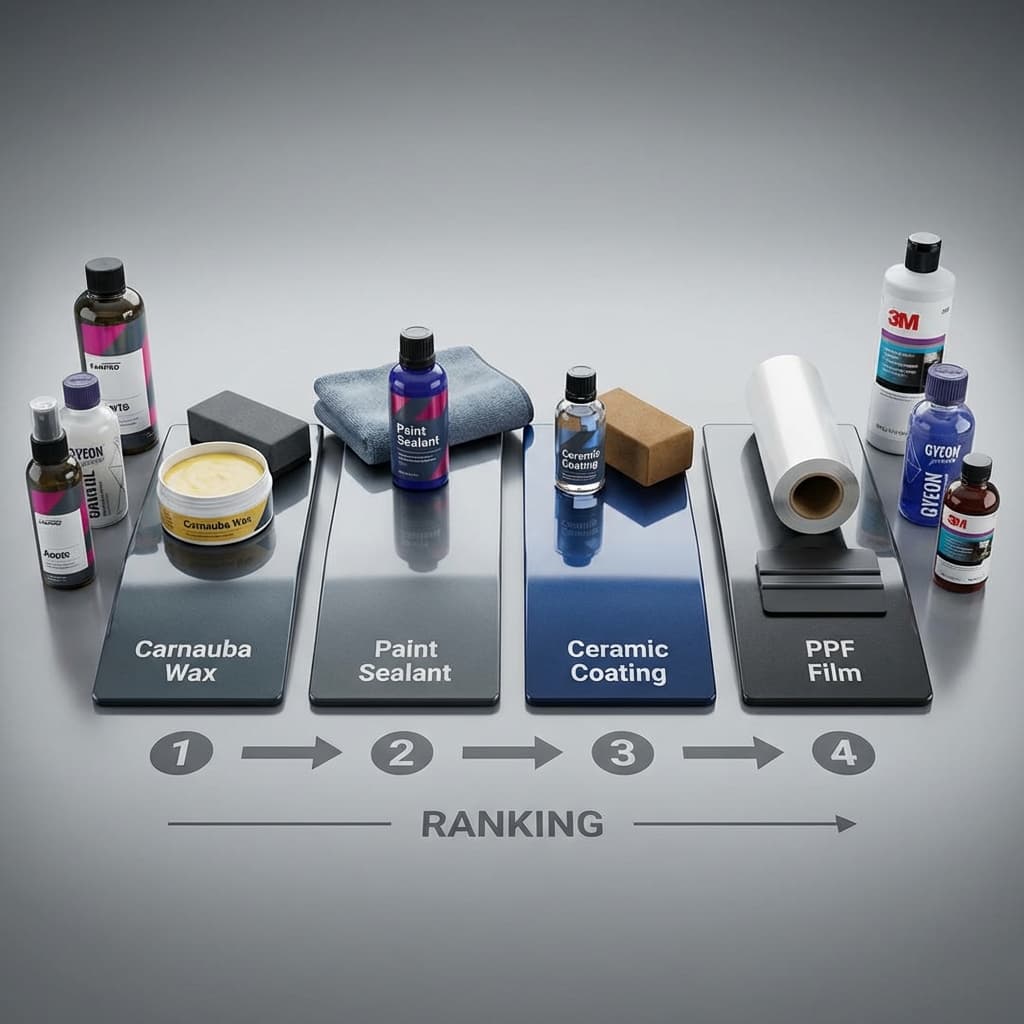
Wax, sealant, ceramic or film, ranked by durability, gloss and rock-chip resistance.
Book Headlight PPF Before Oct 1 Brine
Fall install slots are filling for late September. Stack headlight PPF with a hood full-front, wheel ceramic, or full-front upgrade in one shop visit — cured before the first brine truck, protected through the winter. Ask about the pair-with-hood bundle discount.
Frequently Asked Questions
How much does headlight PPF cost in Calgary in 2026?
A professional headlight PPF install in Calgary runs $150 to $250 for a standard sedan or hatch pair, $200 to $350 for an SUV or half-ton truck pair, and $300 to $450 for a luxury or exotic pair with complex projector-LED lens geometry (Porsche 911 quad-LED, BMW Laser adaptive, Range Rover Pixel LED, Audi Matrix LED). The price spread is driven by two things: the surface area of the lens, and the complexity of the compound curves the installer has to wrap without stretching or gapping the film. A flat 2019 Honda Civic headlight takes 25 minutes per side; a 2026 Range Rover Sport Pixel LED with the amber-turn-signal cutout and heated washer nozzle takes 45–60 minutes per side. Both cost a fraction of a single lens replacement — which is the entire point of the product.
What does a replacement OEM headlight actually cost in Calgary if the lens gets sandblasted or cracked?
This is where the math turns brutal. A halogen or basic HID headlight assembly for a 2018–2022 Civic, Corolla, RAV4, CR-V, or F-150 XL runs $500 to $900 per side at a Calgary dealer parts counter, plus 1–1.5 hours of labour to install (Alberta dealer labour rate is $175–$210/hr in 2026). A projector-LED assembly on a 2021+ RAM 1500 Laramie, Silverado LTZ, F-150 Lariat, 4Runner Limited, or Tacoma TRD Pro runs $900 to $1,700 per side. Matrix-LED or adaptive-LED assemblies (2022+ BMW X5/M-series, Mercedes GLE/GLS, Audi Q7/Q8, Range Rover Sport/Velar, Porsche Cayenne/911, Genesis GV70/GV80, Lucid Air, Rivian R1S) run $1,800 to $3,500 per side, and on some 2024+ vehicles the headlight is integrated with a forward camera or driver-assist sensor that triggers a $300 to $650 ADAS recalibration on top of the swap. The single-headlight-hit math on a 2023 X5 xDrive50e that lost a lens to a Highway 22 gravel strike: $2,850 headlight assembly + $210 install labour + $450 lane-keep recalibration = $3,510 out the door. A $250 pair of PPF-covered lenses installed 3 years earlier would have absorbed the same impact.
How long does headlight PPF actually last in Calgary conditions before it needs replacing?
Premium 8-mil TPU (thermoplastic polyurethane) headlight PPF with a UV-stabilized topcoat — the same base film family we use on hoods — is engineered for 7 to 10 years of exterior exposure and carries a matching 7–10 year manufacturer warranty against yellowing, cracking, and delamination. In practice on a Calgary daily driver that sees Deerfoot, Stoney Trail, or the Highway 1 gravel corridor to Banff, we typically see the outer surface get visibly hazy and micro-pitted at year 4–6 as it does its job absorbing impacts, and we recommend a fresh layer at year 5–7. That is the film aging cosmetically while the lens underneath stays factory-clear — which is the entire ROI. The film to avoid: budget "clear vinyl headlight covers" from Amazon or eBay for $30–$60. Those are typically 4-mil PVC with no UV stabilization; they yellow within 12–18 months of Alberta sun and start peeling at the edges the first winter, and pulling them off often takes the factory hard-coat off the lens with the film. The Calgary Pros install cost delta ($200–$300 more than the eBay kit for a full pair) buys 5–8 additional years of protection — the math is not close.
Why do headlights yellow faster in Calgary than in Toronto or Vancouver?
Three Calgary-specific factors stack: altitude, UV intensity, and winter road grit. Calgary sits at 1,048 m elevation — UV intensity is roughly 10–12% higher per 1,000 m of altitude gained vs sea level, so the polycarbonate hard-coat on your factory lens degrades measurably faster here than it would on the same car in Vancouver (0 m) or Toronto (76 m). Calgary also averages 2,400+ sunshine hours per year (more than Vancouver at 1,938 and Toronto at 2,066), so both intensity AND exposure hours are elevated. Then the winter grit multiplier: City of Calgary Roads applies calcium-chloride anti-icing brine plus a "pickle mix" of salt and 5–7 mm crushed stone from roughly October 1 through spring melt, and Deerfoot, Stoney, 16 Ave, Macleod, Crowchild, and Glenmore see that mix at 100 km/h velocities. Every winter commute is a low-grade sandblasting event on the lower half of your headlight lens. The combined result: unprotected polycarbonate lenses on a Calgary daily driver typically show visible yellowing and lower-half pitting by year 3–4, vs year 5–7 for the same car in a coastal city. How Calgary sun fades paint, and what protects it, is covered in our <Link href="/post/best-ways-to-protect-car-paint" className="text-primary-600 dark:text-primary-400 underline hover:no-underline">guide to protecting car paint</Link>.
Do I need to restore my headlights first, or can PPF go on factory lenses directly?
If your lenses are still factory-clear (no yellowing, no hazing, no visible pitting), PPF applies directly with only a full IPA clean and a hard-water spot check — that is the ideal install, and roughly two-thirds of the vehicles we film are still on the factory hard-coat. If your lenses already show yellowing, cloudiness, or lower-half sandblast texture, the correct sequence is <Link href="/post/headlight-restoration-protection" className="text-primary-600 dark:text-primary-400 underline hover:no-underline">multi-stage headlight restoration</Link> first (wet-sand at 800/1500/3000/5000 grit, then compound to factory clarity, then a hard-coat re-seal) followed immediately by PPF over the restored surface. Skipping the restoration and applying PPF over already-yellowed lenses locks in the discolouration for the film life — you are effectively laminating the yellow tint under a clear film. Skipping the PPF after restoration is the more common Calgary mistake: unprotected restored lenses re-yellow in 6 to 24 months here because you have removed the factory UV hard-coat during sanding and replaced it with nothing. Combined restoration + PPF on a mid-tier daily driver in our shop runs $300–$550 for the pair — still a fraction of a single OEM lens.
Does headlight PPF reduce brightness, mess with matrix-LED beam patterns, or trigger any ADAS issues?
No, no, and no — with a caveat on the third one. Optically clear 8-mil TPU film transmits 99.4–99.7% of visible light at all wavelengths our headlights emit (halogen, HID, LED, laser). The measured brightness loss at the road is not detectable by the human eye and does not affect DOT/Transport Canada lens output ratings. Matrix-LED and adaptive-beam headlights (BMW Adaptive LED / Laserlight, Audi Matrix LED, Mercedes Multibeam) also work through PPF without pattern degradation because the film has zero optical distortion when properly heat-formed to the lens curve — the pixel-level beam shaping happens inside the projector optics behind the lens, not on the lens surface. The ADAS caveat: on 2024+ vehicles where the forward-facing driver-assist sensor mounts near or inside the headlight housing (select 2024+ premium trims such as Audi Q8 e-tron laser-scanner packages and specific Genesis GV70/GV80 driver-assist variants — most vehicles keep the forward camera behind the windshield, and we confirm layout during pre-install inspection), the camera field-of-view passes through a specific portion of the lens. On those vehicles we mask around the camera aperture during install — same as we do around the sensor cluster on windshield film. Our installer confirms the ADAS layout during your pre-install inspection; there has never been a warranty-triggering ADAS event on any PPF headlight install we have done. Contrast this with a full headlight assembly replacement, where the swap itself can misalign the camera and trigger a recalibration — the same problem our <Link href="/post/how-windshield-protection-film-works" className="text-primary-600 dark:text-primary-400 underline hover:no-underline">windshield protection film explainer</Link> covers on the glass side.
When is the best time to book headlight PPF in Calgary — is there a fall install deadline?
The install itself takes 60–120 minutes for a pair and can happen year-round in a heated bay. The reason to book by late September or early October is not the install temperature — it is the winter grit exposure window. City of Calgary anti-icing brine starts on high-priority routes roughly the first week of October each year and runs through spring melt in April, and every commute during that window on an unprotected lens is measurable degradation you cannot undo. Get the film on BEFORE October 1 and it takes the full winter brine hit on the sacrificial layer instead of the polycarbonate. Cure time for headlight PPF is faster than body PPF because the surface area is small and edges are wrapped or tucked into the housing — surface water OK at 24 hours, touchless wash at 7 days, full cure at 14 days. Book in the last two weeks of September to have the film fully cured before the first brine truck rolls. Fall booking usually stacks well with the other pre-winter services covered in the fall checklist of our <Link href="/post/protect-your-car-during-calgary-winters" className="text-primary-600 dark:text-primary-400 underline hover:no-underline">winter car protection guide</Link> — hood PPF, ceramic top-up, wheel ceramic, and the tire swap all happen in the same 6-week window.
Is headlight PPF worth it on a leased vehicle or a used car I plan to sell in 2 years?
Lease: yes, if the lease is 3 years or longer and the vehicle has anything more expensive than a basic halogen lens. Alberta lease-return inspection sheets specifically flag lens yellowing, cloudiness, and pitting as "excess wear" chargebacks — typical lease-end lens deduction is $200–$500 per side on a 3-year daily driver, or up to $1,200 per side on a captive-lender lease (BMW Financial, Mercedes-Benz Financial, Porsche Financial) for a projector-LED or matrix lens. A $250 pair of PPF at lease-signing prevents the entire chargeback and returns to you as a savings-vs-inspection-charge on turn-in. More on leases on our <Link href="/ppf-for-leased-vehicles-calgary" className="text-primary-600 dark:text-primary-400 underline hover:no-underline">PPF for leased vehicles</Link> page. Used car (2-year hold): borderline. If you plan to sell privately on Kijiji or AutoTrader inside 2 years and the car already has clear factory lenses, the film is a $250 spend that recovers roughly $150–$300 in private-sale premium (clear lenses read as "well cared for" to a buyer) — call it break-even with some upside if the lenses would have yellowed inside the hold window. Skip it if the vehicle is going to a dealer trade — most dealer appraisals do not credit lens condition.