Ice Scraper on PPF? The Calgary Cold-Snap De-Icing Playbook for Paint Protection Film & Ceramic-Coated Cars (2026)
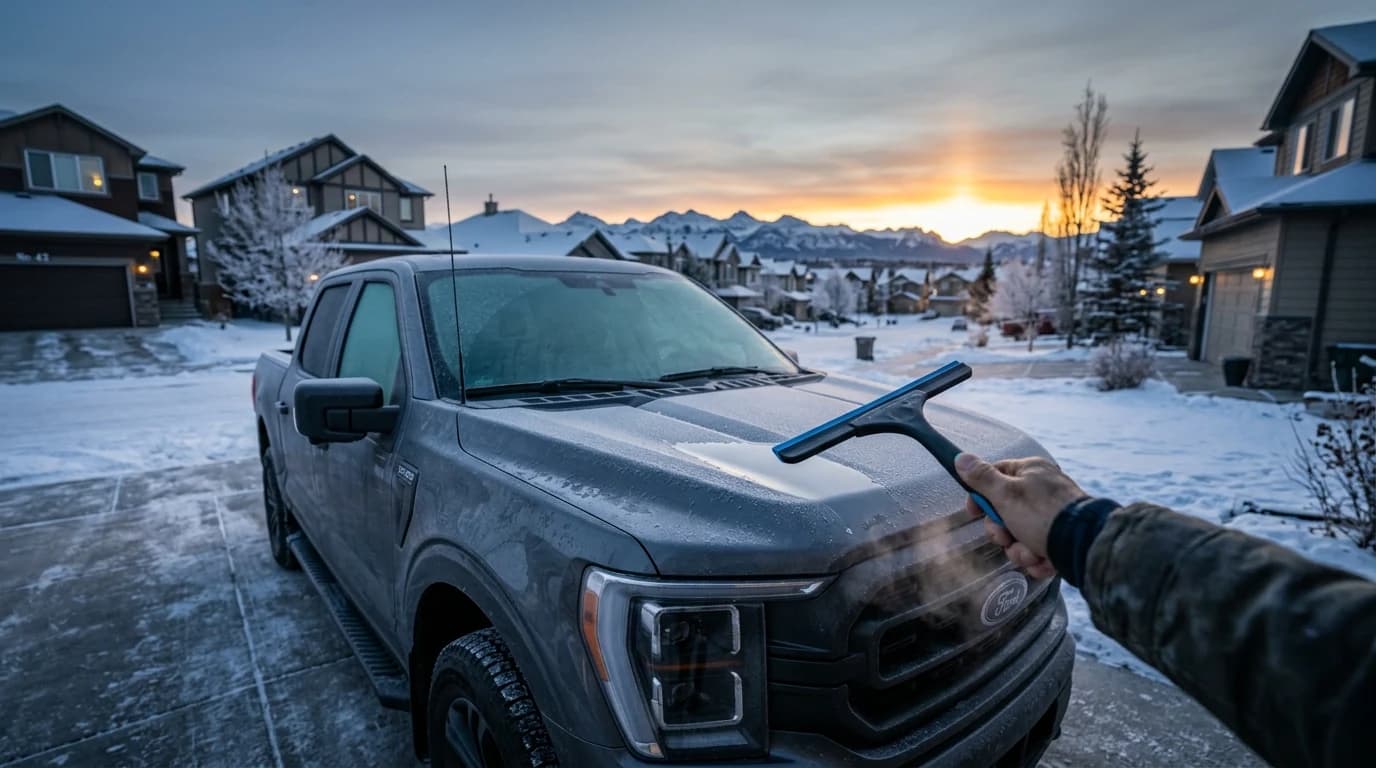
Never use a rigid plastic ice scraper on a PPF-wrapped hood or fender, and never pour warm water on a frozen ceramic-coated panel or windshield in Calgary — both cause damage the coating cannot heal. The safe cold-snap routine: 3–5 minutes of defroster warm-up, a 50/50 isopropyl-alcohol and water pre-thaw spray, then a soft silicone squeegee or foam-bristle brush on the film-covered panels. Scrapers with a soft polycarbonate blade are fine on glass — including ceramic-coated glass — as long as they move in one direction, not a saw-back-and-forth. Skip the hot wax and Rain-X add-ons at Petro-Canada, Co-op, and ESSO touchless bays (they blind the ceramic\'s hydrophobic layer for 4–8 weeks). Refresh the ceramic with a monthly SiO2 spray topper through the Nov–Mar brine season, and keep methanol washer fluid rated for −40°C in the reservoir from October 1 forward. Do this and neither the film warranty nor the paint underneath ever gets tested.
Every October the first hard frost in Calgary lands overnight, the same customer question lands in our inbox at 7:15 a.m., and the answer decides whether that vehicle finishes the winter with intact paint protection film or with a hood-edge cut we spend the spring re-installing. The question is always some version of "can I just use my regular ice scraper on the hood." The answer is no, but the actual playbook — what to use instead, what to keep in the vehicle, what to skip at the touchless bay — is the part every generic winter-car-care post skips. This is that playbook, written for a Calgary driver whose PPF or ceramic coating cost real money and needs to survive its first Alberta winter looking exactly like it did on install day.
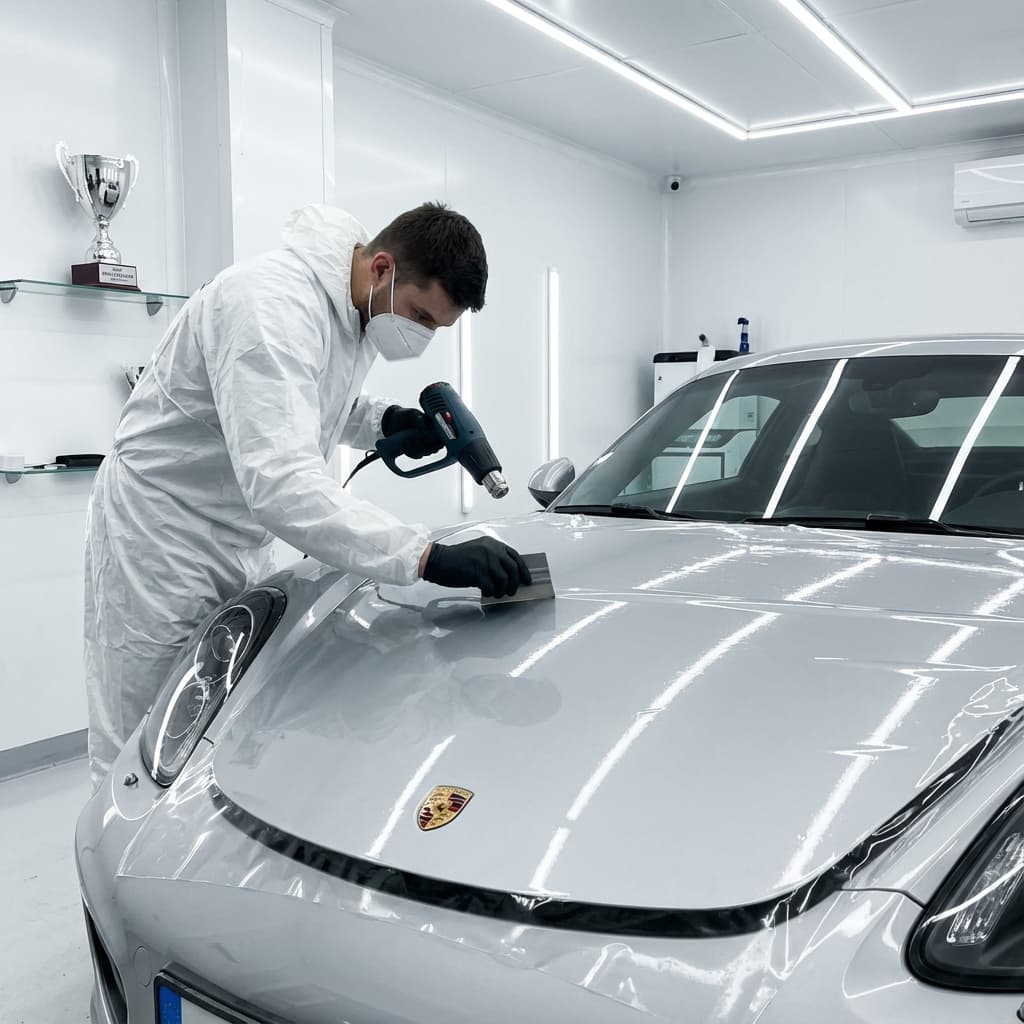
Every spring, roughly one in twenty of the PPF cars that come back through our bay for a first-winter check shows a cluster of shallow linear cuts across the leading edge of the hood or the top of a fender. Nine times out of ten the owner is honest about it — "yeah, I kept a plastic scraper in the car and I was in a rush one morning." The cuts are shallow enough that the film has protected the paint underneath, which is exactly what a full-front install is designed to do, but they will not self-heal because the blade sliced through the topcoat rather than abrading it. Panel replacement is a real out-of-pocket bill (we quote it case-by-case at the follow-up), and the customer's reaction is always the same: they wish someone had walked them through the alternatives before the first frost. This post is that walk-through. It applies whether the vehicle carries our film, our Calgary ceramic coating, both stacked as the Halo package, or a competitor's work you want to keep alive.
Reviewed by Calgary PPF Pros — 4× Consumer Choice Award winner, protecting Calgary vehicles since 2021, 5.0★ rated across 90 verified reviews.
Why a Regular Ice Scraper Ruins PPF (The 40-Micron Story)
A modern 8-mil paint protection film like STEK DYNOshield, 3M Pro Series, or SunTek Ultra Defense is a stack: a self-healing polyurethane topcoat roughly 40 microns thick sits on top of the TPU body of the film. That topcoat is what makes swirl marks and light wash scratches vanish when the panel warms up — the polymer flows back into place with heat from the sun, from a heat gun, or from a hot rinse. It heals abrasion. It does not heal cuts.
A rigid plastic ice scraper — even a "soft" one from Canadian Tire — concentrates the weight of your hand onto a hard corner or edge. Push that edge across a frozen hood and the point pressure at the blade tip is enough to slice through the topcoat rather than skate over it. Once the cut is through the topcoat, no amount of heat brings it back. The film below is still doing its job (the paint underneath is protected), but the visible line stays. Multiply that across a fender, a hood leading edge, and a mirror cap over one bad frost morning, and the fix is a panel-by-panel re-install.
Ceramic coating fails the same way for a different reason. A ceramic layer is about 2 microns thick — far too thin to resist a rigid-blade point load. A scraper corner will not shatter the coating outright, but it will grind a haze into the SiO2 topcoat that reads as a matte streak in the sun and stops beading water on that panel. Once the streak is there, the only fix is a re-polish and a re-coat of that panel — call it CA$400–$700 depending on size.
The Safe Cold-Snap Toolkit — What to Keep in the Vehicle From October 1
Calgary's City Roads department typically starts direct-liquid calcium-chloride brine application on priority arterials in the first week of October, and Environment Canada climate normals for Calgary show the first sub-zero overnight lands in late September on average. That combination is our anchor for stocking the winter toolkit — everything below goes in the vehicle before the first brine truck rolls out of the City yard, not after.
| Tool | PPF Panels | Ceramic-Coated Paint | Glass (Coated or Bare) |
|---|---|---|---|
| Silicone-blade squeegee (soft) | Yes | Yes | Yes |
| Foam-bristle snow brush | Yes | Yes | Yes |
| Polycarbonate soft-blade scraper | No | No | Yes |
| Rigid plastic ice scraper (default hardware-store type) | No | No | Yes |
| Brass or metal scraper | No | No | No |
| Hard-bristle broom or push broom | No | No | Marginal — soft frost only |
| 50/50 isopropyl alcohol + water spray | Yes | Yes | Yes |
| Warm or hot water | No | No | No |
| Boiling water from a kettle | No | No | No |
| Windshield defroster + engine warm-up | Yes | Yes | Yes |
The full-year kit that lives in our own trucks and in every customer's glovebox by mid-October: a 500 ml spray bottle with a 50/50 mix of isopropyl alcohol and water, a silicone-blade squeegee (the 12-inch reach-model works on hoods and windshields both), a foam-bristle snow brush for the roof and windshield after a heavy snow, a stack of two plush waffle-weave microfibres for drying, one polycarbonate soft-blade scraper reserved for glass only, and methanol windshield washer fluid rated to −40°C in the reservoir with a spare 3.78 L jug in the trunk. Total investment is under CA$60 at Canadian Tire, and it replaces the CA$150–$700 per-panel repair math above.
The Calgary Chinook-Morning Routine (Step-by-Step)
This is the exact sequence we walk customers through on pickup day for any install between September and April. It works whether the vehicle sat overnight under −20 °C clear-sky frost or under a chinook-cycle hard ice sheet (yesterday +8 °C, overnight −15 °C, hood now under 5 mm of solid ice). The order matters — skipping steps costs film.
Start the vehicle, engage the defroster on high
0:00Front and rear defroster on, heat set to maximum, direct vents at windshield. Do this before you touch anything on the car. The next 3–5 minutes do more work than any tool.
Spray the 50/50 IPA pre-thaw on frosted panels
0:30Mist the hood, fenders, mirrors, headlights, and the outside of the windshield. Do not soak — a light coat is enough. Let it dwell for 30–60 seconds while the defroster runs.
Wipe frost off filmed panels with a plush microfibre
3:00On PPF-wrapped panels only. The IPA has already lifted the ice layer; the microfibre pulls it away without any tool contact. Two wipes per panel.
Use the silicone squeegee for anything the microfibre missed
3:30One-direction pull — front to back. Never a saw motion. On the hood, pull from the front bumper toward the windshield.
Clear the windshield with the polycarbonate soft-blade scraper
4:00Glass only. One direction. The defroster has already softened the ice from below, so the scraper is finishing, not fighting.
Sweep off remaining snow with the foam-bristle brush
5:00Roof, rear window, deck lid. Never a hard-bristle broom on any panel. Snow above the ice layer comes off with light pressure.
Drive off — skip the touchless car wash for 24 hours
5:30Fresh IPA on the paint plus a cold panel plus a high-pH touchless soap is a bad combination. Rinse at home the next day if road spray is heavy.
Total elapsed time is around six minutes end-to-end — often less than aggressive scraping takes on a hard-frost morning, and shorter still on the second and third mornings when the routine is muscle memory. The one variation: after a heavy overnight snowfall (10 cm+), swap step 2 and step 6 — brush the snow off first so the IPA hits ice, not snow.
The One Wash-Bay Rule That Sits Alongside the De-Icing Routine
One overriding rule for the wash you run after a de-iced drive: touchless is fine, spinning cloth or brush is never fine, and every add-on button at the touchless bay is a step down for a ceramic-coated vehicle — hot wax masks the hydrophobic layer for 4–8 weeks, and the Rain-X or polymer sealant upsell can streak coated glass. If a Calgary winter forces you into the Petro-Canada, Co-op, or ESSO drive-through more often than a hand rinse (fair — it will), the basic wash plus the spot-free rinse is the correct default. The full panel-by-panel touchless-vs-hand-rinse routine, the monthly SiO2 booster cadence, the hard-water-spot prevention, and the dish-soap warning all live in our dedicated companion post on washing a ceramic-coated car through Calgary winter — read that one before the first November brine hits.
Chinook Cycles — The One Calgary Weather Pattern That Complicates Everything
Calgary averages 30-plus days of chinook wind per winter — the fast temperature swings that can move ambient from +8 °C in the afternoon to −15 °C overnight and back to +5 °C the next day. For paint protection film and ceramic coating, chinooks matter in two specific ways beyond the everyday cold.
- Overnight ice sheets, not just frost. A chinook thaw during the day lays a film of meltwater on horizontal panels; an overnight refreeze locks it into 3–5 mm of solid ice. Frost sublimates off with defroster heat alone; ice sheets do not. Skip step 3 above and go straight to the 50/50 IPA spray plus a full 90-second dwell, then squeegee.
- Thermal cycling on new film in the first 30 days of cure. A chinook swing within the first month after a PPF install works the adhesive through a full expansion cycle before it has finished cross-linking. If your install is fresh (day 0–30), keep the vehicle in a heated garage overnight through any chinook forecast, and skip pressure washing for the full 30-day window. The full cure calendar is in our post on Calgary PPF cure time, and the edge-lift risk from long-term chinook cycling is broken down in PPF edge lifting and chinook cycles.
- Windshield thermal shock is real. A cold windshield hit by a hot cabin defroster on high can crack — start the defroster on medium for two minutes before ramping to high, especially on any windshield already carrying a chip or a stone strike. The IPA pre-thaw does not raise this risk; warm water from outside does.
The Traps — Real Calgary De-Icing Mistakes We See Every October
Every one of these is a conversation we have had with an owner in our bay this year. Every one is a preventable film or coating repair.
The "boiling kettle from the kitchen" trap
Owner is late for work, sees ice on the windshield, grabs the kettle. The windshield cracks corner-to-corner because the outer glass expands faster than the interior side can follow. Cracked windshields on ceramic-coated glass still crack — the coating does not add structural strength. Fix: 50/50 IPA plus 3 minutes of defroster.
The "garage-stored plastic scraper" trap
Vehicle got PPF in September, the scraper stayed in the door pocket from last winter, October frost hits and the driver reaches for it out of habit. First run across the hood cuts three parallel lines into the film. Fix: throw the plastic scraper into the recycling on install day, replace with a silicone squeegee for panels + a polycarbonate soft-blade for glass only.
The "hot wax at Petro-Canada" trap
Ceramic-coated car goes through a touchless bay in November, driver upgrades to the "deluxe" package for CA$3 more, gets the hot wax cycle. Water beads on the hood look great for two days, then start sheeting sideways in ugly diagonal streaks. Fix: basic wash and spot-free rinse only; add a SiO2 booster spray monthly at home instead.
The "push broom on the roof" trap
Big overnight snowfall, driver grabs the shop push broom from the garage to clear 20 cm off the SUV roof. Hard bristles cross the ceramic-coated hood on the way past, leaving a haze that shows in every sunrise. Fix: foam-bristle snow brush for the roof (CA$25 at Canadian Tire), silicone squeegee for the hood.
The "washer fluid puddle on the hood scoop" trap
Nozzle sprays high, wind blows it back, puddle forms in the recess of a hood scoop or the base of the windshield wipers. Dwells overnight under freezing temps. Come spring the scoop shows a matte ring where the methanol dwelled on ceramic coating. Fix: check that washer nozzles are aimed correctly at the first oil change of the winter; wipe any visible puddle with a plush microfibre.
The "coin-op wand at 3 feet" trap
Fresh PPF install (day 10), driver hits a coin-op self-serve wash to blast off road spray, holds the wand 3 feet from the hood leading edge. High-pressure water lifts the film edge and forces a bubble under the film that will not settle. Fix: no coin-op wands within 12 inches of any film edge for the first 30 days, and moderate pressure only after that.
The "dish soap because it's what's under the sink" trap
Weekend hand wash, no ceramic-safe soap in the garage, driver uses Dawn or Palmolive. It cleans the paint but strips half the ceramic's SiO2 topcoat. Beading fades within a month. Fix: keep a bottle of Gyeon Bathe+, Gtechniq CarWash+, or CarPro Reset in the garage — CA$25 lasts a full winter.
Bottom Line — The Six-Item Rule for a Calgary Winter With PPF or Ceramic
Compress the whole playbook into a card you can save on your phone:
- Defroster first, always — 3 to 5 minutes before touching anything.
- 50/50 isopropyl alcohol and water in a spray bottle in the door pocket from October 1.
- Silicone squeegee on filmed panels, polycarbonate soft-blade on glass only, foam-bristle brush on the roof.
- Never warm water, never a metal or brass scraper, never a hard-bristle broom across a panel.
- Touchless car wash — basic wash and spot-free rinse only, skip every add-on including hot wax and Rain-X.
- Monthly SiO2 spray topper on ceramic-coated vehicles from November through March.
Follow the six items and the PPF finishes the winter looking exactly like install day, the ceramic still beads a hard sheet of water off the hood in April, and the film warranty never gets tested for a preventable cut. If you just booked a fresh install through our Calgary paint protection film or Calgary ceramic coating team ahead of the Oct 1 brine deadline, this is the pickup-day briefing — save it before the first frost lands.
Related Reading
How to Wash a Ceramic-Coated Car Through Calgary Winter
The panel-by-panel touchless-vs-hand-rinse routine for a ceramic-coated vehicle through the November–March brine season.
Calgary PPF Cure Time (2026)
When can you wash, ceramic-coat, tow, or hit Deerfoot after your install — the full 30-day cure cascade.
How Calgary Road Salt Destroys Paint
Why calcium-chloride brine on Deerfoot and Stoney is chemically aggressive, and how PPF and ceramic protect against it.
Get PPF or Ceramic On Before the First Brine Truck
Fall install slots close by the third week of September. Book a full-front PPF, a Halo stack, or a ceramic top-up before Calgary's Oct 1 calcium-chloride brine hits Deerfoot and Stoney — we'll walk you through the winter de-icing kit at pickup.
Frequently Asked Questions
Experience The Best.
Don't let another commute compromise your vehicle. Get a quote from Calgary's Consumer Choice Award winner today.
Explore Our Services