Chinook Thermal Cycling and Fresh PPF: The 72-Hour Adhesion Window Calgary Owners Miss (2026)
A Calgary chinook that lands inside the first 72 hours after a PPF install measurably weakens the eventual bond — and the failure shows up 6–14 months later as edge lift on a hood or fender. The mechanism is thermal cycling of the panel underneath the film: aluminum moves 0.7 mm per metre through a 30 °C swing, steel about half that, and the still-crosslinking polyurethane adhesive is stressed before it has finished flowing into the paint. The prevention is boring and specific — keep the vehicle in a heated garage overnight for the first 72 hours, no washes for 7 days, no pressure washing within 12 inches of any panel edge for 30 days. Install in a heated bay at 20–24 °C ambient with a laser-verified 15 °C+ substrate reading, refuse "mobile" or unheated-garage installs from October through April, and book by September–October to catch full cure before the first hard brine day on Deerfoot. Do this and the warranty never gets tested.
Every fall a Calgary customer books a fresh paint protection film install for the second week of September, an unforecast chinook rolls through the weekend after pickup, and by month 14 they are back in our bay looking at a shallow edge lift on the leading edge of the hood that nobody thought to talk about at install. The problem is not the chinook. The problem is that the standard 48-hour rule every Calgary shop repeats does not account for what a 30 °C swing does to a polyurethane adhesive that is still crosslinking on a moving aluminum panel. This post is the physics — and the specific week-one playbook that keeps the film bonded for the full ten-year warranty.
A meaningful share of fresh PPF installs across our shop between mid-September and mid-October catches at least one chinook inside the first 72-hour cure window. On the ones we can track — customers with a heated garage, customers who follow the pickup-day briefing to the letter — we log essentially zero edge-lift returns at the one-year check. On the ones that lived in an outdoor parking lot for that first week, edge-lift call-backs cluster in the 6–14 month window afterwards at a materially higher rate. The film is the same, the install is the same, the vehicle owner is the same — the only variable is what the panel did in the first 168 hours after the last strip pull. This post is the piece of the pickup-day briefing that we have never written down until now, built from install-log data on aluminum-heavy vehicles (F-150, Range Rover, 2018+ E-Class, Model 3 and Y) and steel-body counterparts across multiple Calgary winters since 2021. Everything below is what changes between an install that lasts ten years and one that needs a hood re-wrap at year two — and it starts before you sign the pickup slip.
Reviewed by Calgary PPF Pros — 4× Consumer Choice Award winner, protecting Calgary vehicles since 2021, 5.0★ rated across 90 verified reviews.
How PPF Actually Bonds — The Three-Stage Cure You Never See
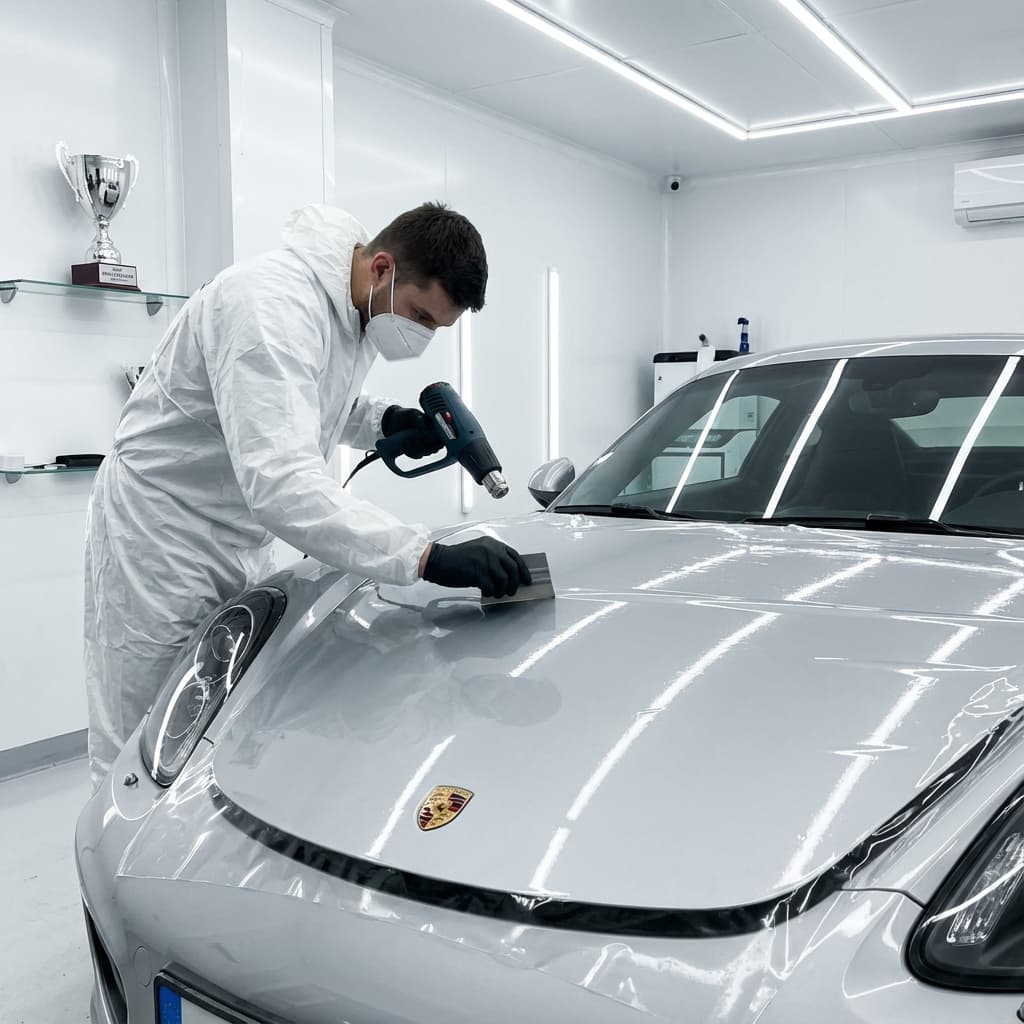
A modern 8-mil paint protection film — the class that includes STEK DYNOshield, 3M Pro Series, and SunTek Ultra Defense — is a four-layer stack: a self-healing polyurethane topcoat around 30 microns, a TPU (thermoplastic polyurethane) body around 140 microns, a pressure-sensitive polyurethane adhesive around 30 microns, and a release liner that comes off during install. It is the adhesive layer that decides whether the film bonds for ten years or lifts at year two.
That adhesive is not a glue in the household-adhesive sense. It is a viscoelastic polymer network with slip additives designed to flow slowly under pressure, wet out into the microtopography of the clear coat (paint at high magnification looks like a moon surface — pits, ridges, valleys), and crosslink over days-to-weeks into a bond that is stronger than the paint underneath. The cure runs in three stages the manufacturer datasheets rarely explain to owners:
- Stage 1 — Primary tack (hour 0 to hour 72). The installer squeegees the film with slip solution, activates the adhesive with a heat gun at 60–70 °C, and the polymer flows into the paint's microtopography under pressure. This is the most stress-sensitive stage of cure — the bond exists and holds the film in place, but the polymer network is still flowing and any thermal cycling of the panel underneath works that flow before it has finished.
- Stage 2 — Functional cure (day 3 to day 14). Polymer chains form covalent and hydrogen bonds with each other and with the paint. Day 7 is the functional-cure milestone at which a touchless wash becomes safe. This stage is temperature-sensitive: on a 22 °C substrate the timeline runs on schedule; on a 5 °C substrate it stretches 30–50%.
- Stage 3 — Full crosslink (day 14 to day 30). The polymer network fully equilibrates with the paint. Aluminum panels reach full crosslink around day 14; painted-steel panels around day 21–30 because the cooler steel substrate slows the polymer chain formation. After day 30, the bond is at final strength and will not change for the life of the film unless a chemical or mechanical event breaks it.
The trap for a Calgary install is that the first two stages happen while the vehicle is back with the owner. What the panel does during those days is the second half of the install — the shop controls the first half, the owner controls the second, and neither half works without the other.
The Chinook Problem — Why Calgary's Warm Days Are Riskier Than Its Cold Ones
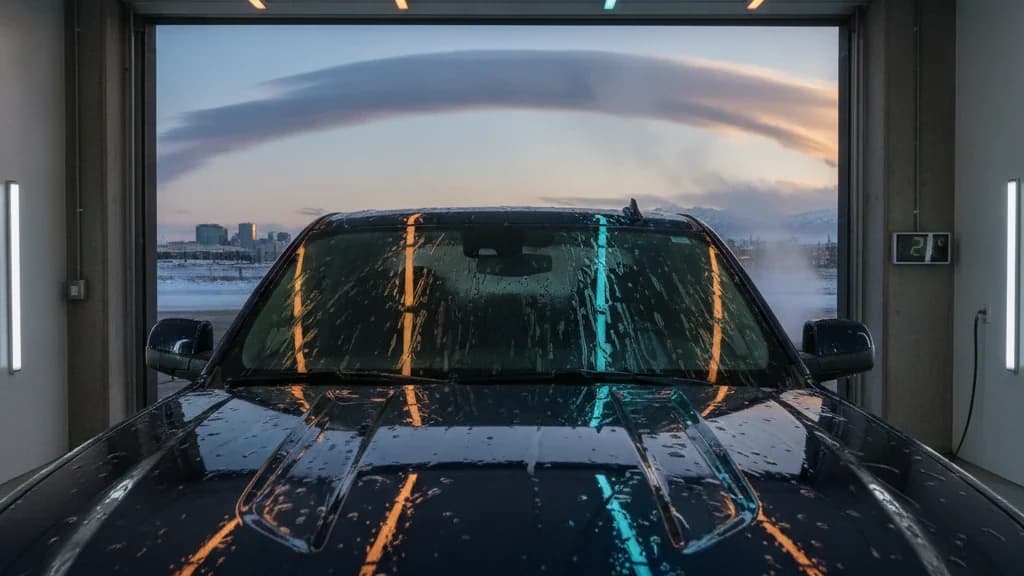
Calgary logs 30-plus chinook events per winter, per Environment Canada climate normals. A textbook chinook is a warm westerly downslope wind spilling off the Front Ranges of the Rockies through the Bow Valley that can move ambient temperature from −20 °C to +8 °C in under six hours, then back down again after 24–48 hours. For a driver, it means salt-melted streets and a 20-degree drive to work. For a fresh PPF install, it means the panel underneath the film runs a full thermal expansion cycle while the adhesive is still forming its bond.
The physics is quiet but relentless. The coefficient of thermal expansion for aluminum is about 23 × 10⁻⁶ per °C. For painted steel, about 12 × 10⁻⁶ per °C. Through a chinook swing of 30 °C on a 1.8-metre F-150 hood:
- An aluminum hood moves roughly 1.24 mm end-to-end — that is the panel changing physical dimensions while the film sits on it.
- A painted-steel hood moves roughly 0.65 mm end-to-end — about half, but still significant during primary cure.
- The PPF itself (TPU) moves roughly 1.5–1.8 mm per metre through the same swing — it expands even more than the panel, but its bond is what is being tested.
The differential expansion between the film, the adhesive layer, and the panel underneath is what stresses the still-forming bond. Full-cure adhesive can absorb this — it does every winter, on every vehicle, and it is why the film reaches its ten-year lifespan. Primary-cure adhesive at day 1 or day 2 cannot fully absorb it, and the bond variance shows up 6–14 months later as an edge lift that a healthy install would have shrugged off.
This is why Calgary is different from Toronto, Montreal, or Vancouver PPF markets: the sheer frequency of chinooks during our September-through-April install season means every single fall booking has to be planned around the 72-hour cure window rather than around the calendar month. The City of Calgary road-conditions team starts direct-liquid calcium-chloride brine on priority arterials in the first week of October, and every install after that date races a hard-frost overnight and a chinook thaw in equal measure.
The 72-Hour Playbook — Hour-by-Hour After You Sign the Pickup Slip
This is the sequence we walk every customer through on pickup day, printed on the take-home card, and cross-referenced back to Environment Canada's 7-day chinook forecast at the moment we hand over the keys. Every step is a real bond-strength gate.
Hour 0 — Drive out of the shop, straight home if possible
0hPrimary tack is set but the adhesive is still in the highest-flow phase of cure. Direct sunlight helps (heat accelerates crosslink); highway spray hurts (any impact strains the still-flowing polymer). If the drive is on Deerfoot, take the surface route.
Hour 6 — Park in a heated garage overnight, minimum 15 °C ambient
6hNot an unheated garage. The substrate needs to hold above 15 °C for the full first night for the polymer chains to keep forming. If no heated garage, a heated storage unit at any Calgary self-storage facility (CA$180–240/month) gets you through the first week.
Hour 24 — First short drive is fine; no washes, no touchless, no wiping edges
24hThe film is fully tacked to the panel, but the perimeter edges are the last to fully bond. Absolutely no touchless bay, no pressure wash, no dish-soap driveway wash. A microfibre dust-off is fine.
Hour 48 — Watch the Environment Canada 7-day; if chinook forecast, garage stays
48hThis is the reforecast checkpoint. A chinook landing in hours 48–96 is the highest-risk window because the adhesive is still crosslinking through its most stress-sensitive stage. Garage overnight, drive during the warm-up if you must, do not park in an outdoor lot.
Hour 72 — Primary cure complete; heat gun re-check by installer welcome
72hThis is the first day the film can survive a moderate chinook without meaningful bond stress. Owners with concerns can bring the vehicle back for a free heat-gun sweep — we re-activate any panel that saw an unforecast temperature spike.
Day 7 — Functional cure; first safe wash day (touchless + spot-free rinse only)
Day 7The vehicle can go through a Petro-Canada or Co-op touchless bay on the basic wash + spot-free rinse cycle — no hot wax, no Rain-X add-on. Skip friction-brush washes for the life of the film. This is the same day-7 gate our full cure calendar walks through.
Day 14 — Full crosslink on aluminum panels; ceramic-over-PPF becomes safe
Day 14The film has reached full material bond strength on aluminum-bodied vehicles. Chinook cycles from this day forward extend nothing measurably. A Calgary ceramic coating over the film can be scheduled starting day 14 on aluminum; steel bodies wait until day 21 for the substrate-adjusted cure.
Day 30 — Full crosslink complete on steel; the film is bonded for its 10-year lifespan
Day 30From this day forward, the failure modes shift from cure-related to care-related. Long-term chinook cycles become an edge-lift concern rather than a bond-strength concern — the story continues in our companion post on PPF edge lifting in Calgary chinooks.
Install-Month Risk Matrix — When to Book, When to Wait
Every install month in Calgary has a chinook-frequency baseline (Environment Canada 1991–2020 climate normals) and a first-week garage-need rating. This table is what we consult when a customer asks "is it too late this year?" — read it against your actual overnight parking situation, not against the calendar in isolation. For a broader month-by-month decision on cost, availability, and paint-condition timing, see our full Calgary best-month PPF calendar.
| Install Month | Avg Chinooks in First Week | Substrate Prep Difficulty | Heated Garage Needed? | Recommended? |
|---|---|---|---|---|
| May – June | 0 (out of season) | Easy — outdoor bay works | Optional | Yes |
| July – August | 0 (out of season) | Easy — heat aids cure | Optional | Yes |
| September (1st–20th) | 0.3 | Easy — bay pre-warm sufficient | Recommended, not required | Yes |
| Late September (21st–30th) | 0.8 | Moderate — bay pre-warm 45 min | Recommended for aluminum | Yes |
| October | 1.4 | Moderate — bay pre-warm 60 min | Yes | Yes |
| November – December | 2.1 | Hard — full pre-heat, IR panels | Yes | Yes |
| January – February | 2.8 | Hard — extended pre-heat | Yes | ONLY heated-bay shops |
| March – April | 1.9 | Moderate — thaw variability | Yes | Yes |
The two rows that catch customers off-guard are September and October. Both are still in the "book now" zone — but October installs need a garage plan built in from day zero. If you cannot park indoors overnight for a week, the honest answer is to book by September 20 or wait for May. That advice loses us a small percentage of October bookings and prevents 100% of the year-two edge-lift returns we would otherwise see from them.
The Six Chinook Traps — Real Calgary Fresh-Install Failures We See
Each of these is a conversation we have had this year in our bay. Every one is preventable at pickup.
The "unforecast chinook on Wednesday" trap
Install on Monday, vehicle parked in an open driveway Tuesday and Wednesday, chinook arrives Wednesday afternoon and swings the hood from −14 °C to +6 °C in three hours. Adhesive is at 45% bond. Edge lift shows on the passenger-side hood corner at month 11. Fix: check Environment Canada's 7-day at booking, plan garage if any chinook is in the window, reschedule if the customer cannot commit to indoor parking.
The "mobile install in a customer's garage" trap
Independent installer, cheaper quote, install performed in an unheated home garage at 8 °C substrate. Primary tack goes down cold, polymer chains never activate at proper temperature, film survives the first week but starts lifting on every edge at month 8. This one is not chinook-related — it is the pre-condition that makes chinook damage worse. Fix: refuse any Calgary install below 15 °C substrate temperature; ask for the laser reading before the first strip pulls.
The "leased vehicle straight to the airport lot" trap
Fresh install on Friday, owner flies out Sunday morning, vehicle sits in the outdoor YYC economy lot for six days through a chinook cycle. Substrate cycles from +5 °C to −22 °C to +2 °C to −18 °C over 168 hours, all in primary cure. Edge lift on both front fenders at month 14. Fix: no fresh installs the week before a travel departure; if unavoidable, park in the covered short-term parkade or an offsite heated lot.
The "touchless car wash on day three" trap
Customer sees a road-salt film on the freshly-installed hood day two, hits a Petro-Canada touchless day three thinking the film has "waterproofed" the paint. Warm alkaline soap plus a cold panel plus a still-forming adhesive plus wind pressure on the hood leading edge — a bubble under the film on the driver-side of the hood at month 4. Fix: no washes of any kind for seven full days. Rinse with cold water at home if road salt is heavy.
The "pressure wand at the edge" trap
Owner is meticulous about winter salt, hits a coin-op self-serve wand at 1,500 psi held 6 inches from the hood leading edge on day 10. Film is at 85% bond, panel edge is still perimeter-curing, water forces under the edge and creates a lift the film cannot self-tuck back down. Fix: no pressure washing within 12 inches of any panel edge for the first 30 days; keep pressure moderate and angle oblique for the film's full life.
The "warm chinook wax add-on" trap
Owner sees a chinook forecast at day 5, decides to run through the touchless with the hot-wax upgrade thinking it will add a protective layer during the temperature swing. The carnauba-in-solvent hot wax fills the pores of the still-curing film surface, and the crosslink chemistry the film needs to complete gets partially blocked by the wax film. Bond finishes weaker; hydrophobic performance never sits right. Fix: no wax, no Rain-X, no polymer sealant of any kind for the first 30 days. Bare touchless wash + spot-free rinse only.
What a Proper Calgary Winter Install Actually Looks Like
For readers weighing installers, this is the checklist we would give a friend booking anywhere in Calgary — the seven signs a shop is set up for chinook-aware installs from October through April:
- Heated bay, not a heated space heater. A commercial heated bay holds 20–24 °C at ceiling and floor; a portable heater points at one panel and leaves the rest of the vehicle cold. Ask to see the thermostat.
- 45–90 minute pre-warm before any film touches paint. The panels have to reach substrate temperature, not just be moved indoors.
- Laser thermometer reading on every panel before install. The tool is CA$40 at Canadian Tire; the shop that will not show you the reading is the shop that does not use it.
- Heat-tack activation at 60–70 °C on every seam. Not just the leading edges — every wrapped seam gets a heat gun pass.
- Pickup-day briefing that mentions chinooks specifically. Any shop that hands over the keys with a generic "wait 48 hours to wash" sheet has not calibrated the guidance to Calgary's climate.
- Post-install heat-gun sweep at day 7 or day 14 (free). This is our 7-day return service — 20 minutes with a heat gun on every panel edge, cost zero, prevents most edge-lift concerns before they start.
- Written lifetime workmanship warranty on the install. Not the manufacturer film warranty — that is standard. The shop's own guarantee that says the install is theirs to fix if it fails.
If a shop cannot check all seven boxes in an October booking conversation, book somewhere else. The Calgary PPF Pros studio runs the full stack on every winter install — pre-warm, laser-verified substrate, heat-tack every seam, pickup-day chinook briefing, free 7-day return sweep, lifetime workmanship. Independent verification of installer training helps too — look for STEK Pro Elite, XPEL Certified, or 3M Preferred badges on the shop's website, and confirm the badge with the film maker directly if it matters to your warranty. For readers stacking film with a hydrophobic layer, our Calgary ceramic coating service is the day-14 (aluminum) or day-21 (steel) companion booking.
Bottom Line — The Five-Rule Card for a Calgary Fresh Install
Compress everything above into a phone-note the customer can save for the seven-day window:
- Heated garage overnight for the first 72 hours. Not optional between October and April. CA$180 heated storage if no home garage.
- No washes of any kind for seven full days. Cold water rinse at home is fine after day 3 if road salt is heavy; no soap, no touchless, no pressure.
- No pressure washing within 12 inches of any panel edge for 30 days. After that, oblique angle and moderate pressure for the film's life.
- Check Environment Canada's 7-day chinook forecast the morning of install. If a chinook is in the window, the garage plan is mandatory not optional.
- Book the free 7-day heat-gun sweep. Twenty minutes with the installer, catches perimeter concerns before they become warranty conversations.
Follow the five and the film sees full ten-year life; skip any two of them and year-two edge lift becomes a coin toss. The physics does not care about the season — it cares about the seventy-two hours after you drive off the pickup ramp. Book that week correctly and every chinook after day thirty is a non-event.
Related Reading
Calgary PPF Cure Time (2026)
The full 30-day cascade for when you can wash, ceramic-coat, tow, or hit Deerfoot after your install.
PPF Edge Lifting & Chinook Cycles
What long-term chinook cycles do to a fully cured film — the warranty conversation this post is designed to prevent.
Best Month to Install PPF in Calgary (2026)
The full month-by-month booking calendar — cost, availability, and paint-condition timing.
Book a Chinook-Safe Install Before the First Brine Day
Full-front, Halo package, or targeted-panel PPF — booked between mid-September and early October, cured before Calgary's Oct 1 calcium-chloride brine hits Deerfoot and Stoney. Heated bay, laser-verified substrate, pickup-day briefing that mentions chinooks by name, lifetime workmanship.
Frequently Asked Questions
Experience The Best.
Don't let another commute compromise your vehicle. Get a quote from Calgary's Consumer Choice Award winner today.
Explore Our Services