Graphene Coating vs Ceramic Coating vs PPF Calgary 2026: Which Actually Survives a Chinook Winter?
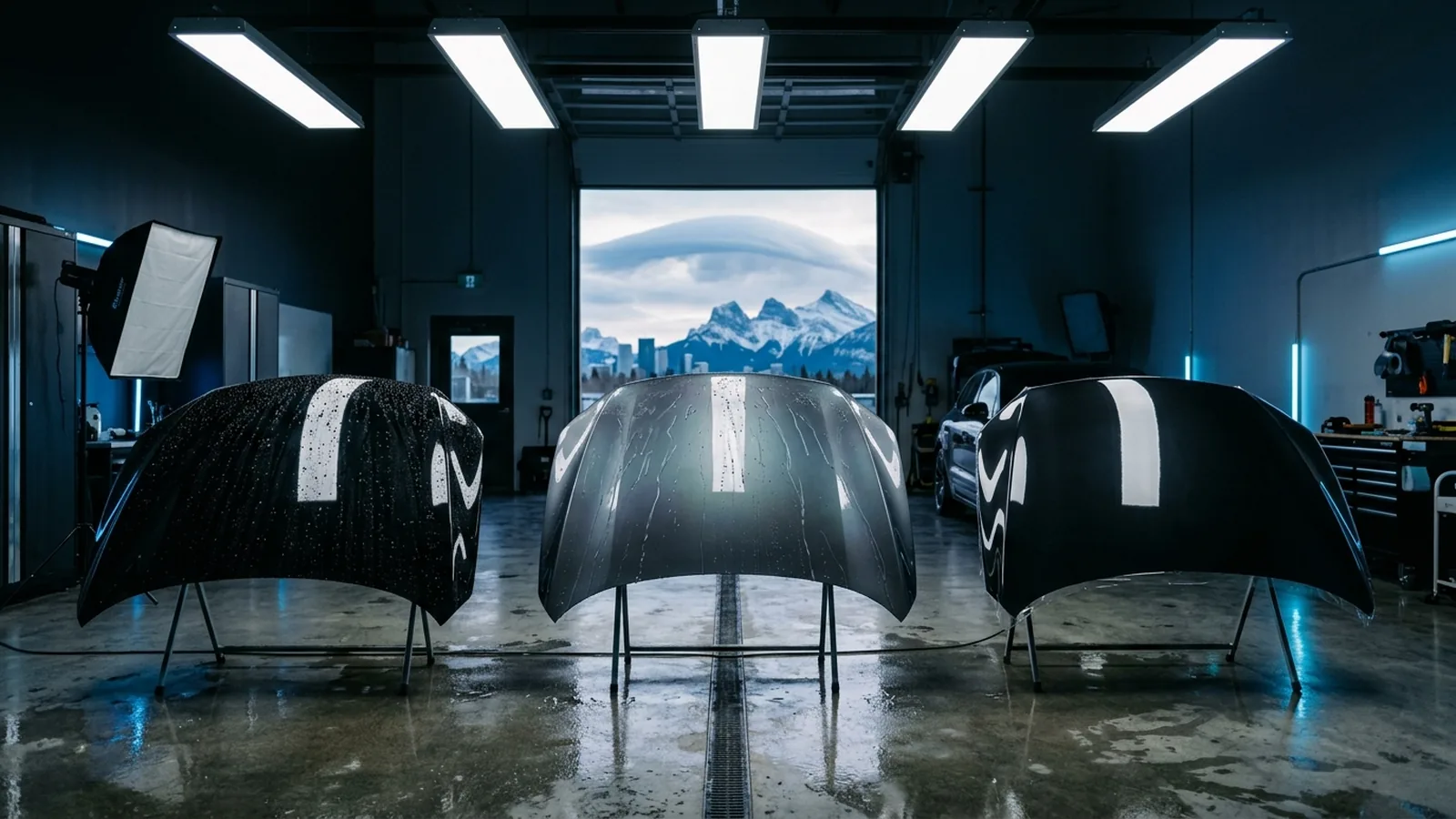
For a Calgary daily driver facing chinook cycles, Oct 1 brine, and Deerfoot gravel, PPF plus a ceramic (or graphene-enhanced) topcoat is the only combination that actually works. Graphene coating is a ceramic coating with a small graphene-oxide additive — it adds anti-static behaviour, roughly 5–8 C cooler surface temperature under direct sun, and slightly better cold-flex than pure silica; expect $1,200–$2,200 for a graphene package versus $899–$1,699 for our ceramic tiers (Gyeon Q² Mohs 1-yr, Gtechniq Crystal Serum 4-yr, Crystal Serum Ultra 8-yr). Neither coating stops rock chips — that is what PPF is for, $399 partial to $4,999 full body. Chinook thermal cycling (30+ events per year, 15–25 C swings in under 24 hours) affects PPF edges — fixable at year 3–5 — not the coating chemistry itself. Book PPF for late September, then stack ceramic or graphene over top after 24–48 hour cure — the full winter defence must be on the vehicle before the first brine truck rolls, typically first week of October.
Every fall we get the same quote request: "What is graphene coating, is it worth the extra $500 over ceramic, and do I still need PPF if I get either?" This is the honest graphene coating vs ceramic coating Calgary head-to-head — plus where PPF fits on the same vehicle — anchored to Alberta's specific winter chemistry, not to which product has the newest marketing sheet. This is the comparison we walk through with every pre-winter Calgary ceramic coating or PPF customer, written out.
Graphene showed up in Calgary detailing shops around 2022, and by 2024 every second Instagram post was some version of "graphene is 10H, ceramic is only 9H, upgrade now." What that marketing skips: the two hardness numbers are measured on different scales, most "graphene coatings" on the market are ceramic products with a 1–5% graphene-oxide additive, and neither product stops a rock chip on Deerfoot at 100 km/h. We install ceramic — Gyeon Q² Mohs, Gtechniq Crystal Serum, Crystal Serum Ultra — and we install TPU paint protection film, and the customers whose cars still look factory after three Alberta winters have both. This post is the un-hyped comparison we walk every customer through before they pick.
Reviewed by Calgary PPF Pros — 4× Consumer Choice Award winner, protecting Calgary vehicles since 2021, 5.0★ rated across 90 verified reviews.
What Graphene Coating Actually Is — Beyond the 10H Marketing
A ceramic coating is a liquid nano-coating built around silicon dioxide (SiO2), the same base chemistry used in industrial glass sealants. When it cures on your clear coat, silica cross-links form a hard, transparent, hydrophobic top layer measured in single-digit microns. That is what makes water bead, dust brush off, and light contamination stop bonding.
A "graphene coating," in the 2026 Calgary market, is almost never pure graphene. It is a ceramic coating with a small percentage of graphene oxide — carbon sheets one atom thick, functionalized with oxygen groups so they can suspend in the SiO2 carrier fluid — mixed into the formula, typically 1–5% by weight. The graphene component brings three measurable behaviours to the finished layer:
- Anti-static behaviour — graphene is electrically conductive, so the cured coating dissipates the static charge that normally attracts fine dust to a painted surface. Owners with dark daily drivers routinely report noticeably fewer maintenance-wash cycles on a black or dark-metallic finish versus the same panel with pure ceramic.
- Lower solar-gain surface temperature — the same conductivity spreads absorbed heat sideways across the panel instead of concentrating it locally, so a black hood coated with a graphene-enhanced product runs roughly 5–8 C cooler under direct July sun than the same panel with pure ceramic. Matters more in Calgary than in most cities: at 1,048 m elevation UV intensity runs 10–12% above sea level and 2,400+ annual sunshine hours pile on the exposure. Lower panel temperature = less thermal stress on the clear coat and the resins beneath.
- Better cold-flex — a pure silica matrix gets brittle below -20 C. Graphene-oxide interleaving keeps the coating flexible through deeper cold snaps, which matters during a Calgary chinook cycle when a panel can swing from -25 C to +5 C in a few hours.
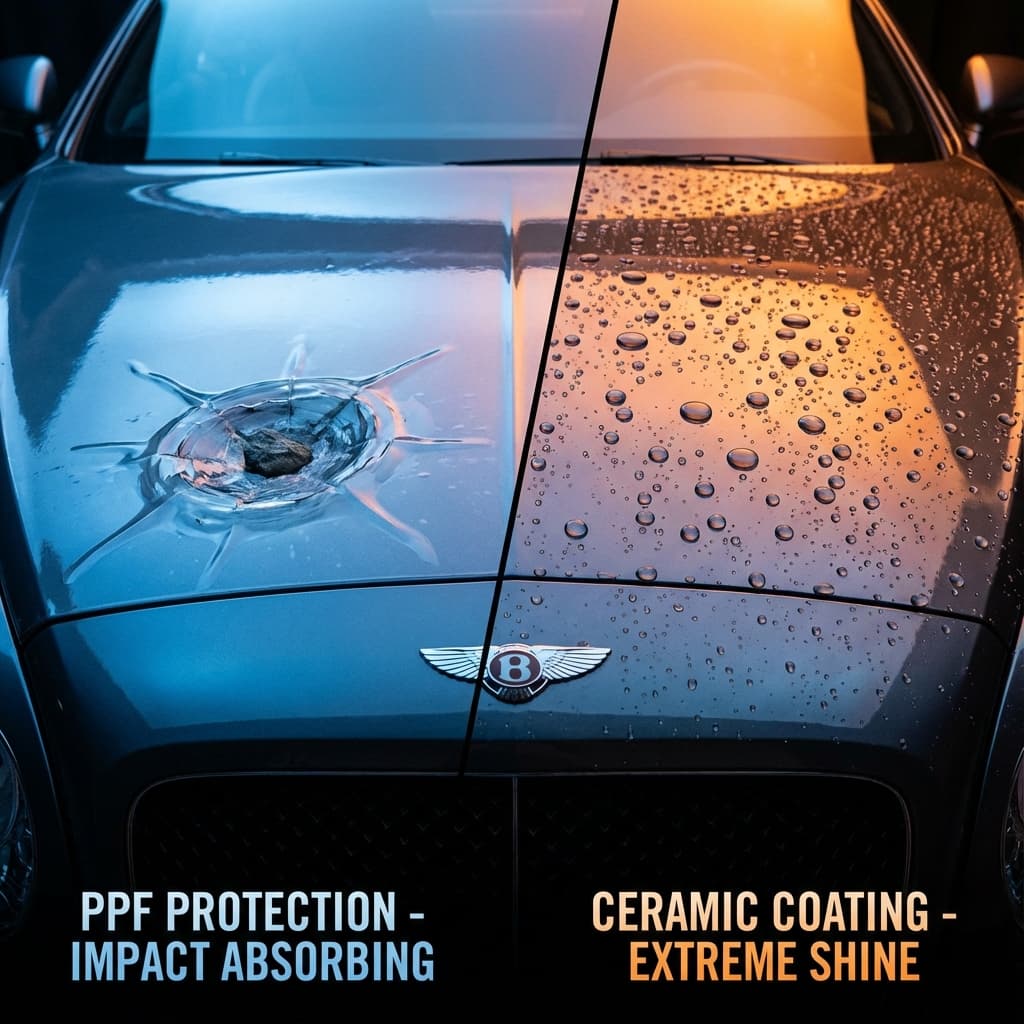
What graphene coating is not: a physical protection layer. It is measured in microns. Rock chips, gravel abrasion, and mechanical scratches from bike racks or ski boxes still reach the clear coat underneath. Both ceramic and graphene are chemistry products, not armor.
The Head-to-Head — Three Products, One Table
This is the honest side-by-side we hand every customer who asks "what should I get?" before they sign anything. All three products serve real, non-overlapping functions — the answer for most Calgary daily drivers is not one of the three, it is the right combination of two.
| Property | Ceramic Coating | Graphene Coating | Paint Protection Film |
|---|---|---|---|
| Type | Chemical (SiO2) | Chemical (SiO2 + graphene oxide) | Physical (8-mil TPU) |
| Thickness | 2–10 microns | 2–10 microns | 200 microns (8 mil) |
| Rock chip protection | No | No | Yes |
| Hydrophobic beading | Yes | Yes | Yes |
| Anti-static / dust rejection | Minimal | Yes | Minimal |
| Chinook cold-flex (-25 C) | Good | Better | Excellent |
| Salt brine chemical resistance | Good | Better | Excellent |
| Self-healing scratches | No | No | Yes |
| Warranty life | 1–8 years | 2–7 years | 7–10 years |
| Calgary daily-driver price | $899–$1,699 | $1,200–$2,200 | $399–$4,999 |
Read across the rows and one pattern is unmistakable: PPF wins physical protection, ceramic and graphene win chemical protection, and the two categories do different jobs. That is why the stack we install most often on winter-first customers — full-front PPF on the hood, fenders, mirrors, and lower rocker panels, with a ceramic or graphene coating over the top — outperforms any single-product spend at twice the price.
The Chinook Test — What Actually Happens at -25 C to +5 C in 6 Hours
Calgary averages 30-plus chinook events per year, defined by Environment Canada as a rapid warm-wind episode that lifts surface temperatures 10 C or more in a short window. In practice we see 15–25 C swings in under 24 hours, and occasional 30 C swings during the deep-winter events (Environment Canada records include documented chinook-driven jumps of 20+ C in under an hour along the Alberta foothills). That thermal cycling is a stress test most protection products are not marketed against, because it barely exists outside Alberta and Montana.
Here is what each product experiences during a hard chinook:
- Ceramic coating — the silica matrix expands and contracts with the underlying clear coat, but at a slightly different rate. Over hundreds of cycles this causes micro-fracturing in the coating layer, visible as reduced beading and cloudier surface at year 4–6 rather than year 6–8 in a stable-temperature climate. Fix: coating maintenance top-up at year 3–4 in Calgary versus year 5 in Vancouver.
- Graphene coating — the graphene-oxide additive keeps the matrix flexible through the deep-cold portion of the cycle, so micro-fracturing runs measurably slower on lab flex tests. Manufacturer bench data and early field reports point to a modest hydrophobic-life gain through chinook cycles versus pure ceramic, but the category is only 4 years old and no published 10-year Calgary-condition dataset exists yet — we treat the durability delta as directional, not guaranteed.
- PPF — TPU film flexes through the full temperature range without failure in the middle of the panel. Edge lifting is a real risk where the film meets a body-panel gap or rocker seam because the adhesive was optimized for a static condition, not for chinook-scale expansion mismatch between the aluminum panel and the TPU film. Full write-up on this in our post about why chinook cycles peel PPF edges — the fix is a $60–$150 edge re-tuck at year 3–5, not a full replacement.
What ALL three products protect against, and what our companion post on chinook paint damage covers in depth: the freeze-thaw cycle drives meltwater into hairline cracks in unprotected clear coat, then refreezes and forces the crack wider. On a bare-paint vehicle that runs for 5–10 winters here, that is what turns a chip into a clear-coat delamination.
The Salt-Brine Test — What Actually Happens Oct 1 to April
City of Calgary Roads starts direct-liquid application (DLA) of a calcium-chloride brine on priority arterials — Deerfoot, Stoney Trail, 16 Ave, Macleod, Crowchild, Glenmore — roughly the first week of October each year, keyed to the forecast rather than a fixed calendar date. Once surface temperatures drop below -5 C the fleet switches to a "pickle" mix of approximately 3% salt and 97% crushed 5–7 mm rock. Every winter commute through that mix is two failure modes stacked: chemical (chloride ions bonding to clear coat and to any exposed aluminum or steel) plus mechanical (rock in the brine sandblasting the lower panels).
Ceramic and graphene coatings handle the chemical side of that attack well. The hydrophobic surface causes brine to sheet off during a rinse rather than sit and etch, and the silica layer slows chloride-ion diffusion into the clear coat. Graphene-enhanced coatings sheet slightly harder than pure ceramic — the anti-static behaviour helps release the residual film that ceramic sometimes leaves behind.
Neither coating touches the mechanical side. Gravel-in-brine at 100 km/h on Deerfoot does not care about surface chemistry — it micro-abrades the coating first, then the clear coat under it. That is why every Calgary winter-first spec we quote leads with full-front PPF and adds coating as the second layer, not the other way around. Full physics on Calgary road-salt failure modes lives in our post on how Calgary road salt destroys paint.
The Real Calgary 2026 Cost Math — What You Get for the Money
These are the actual Calgary 2026 pricing bands across the three categories. Ceramic pricing is our shop-published rate for the Gyeon and Gtechniq products we install; PPF pricing is our full-menu range from partial front to full body; graphene ranges reflect what independent Alberta shops publish (we can top-coat with a graphene-enhanced ceramic on request but do not sell a standalone graphene tier).
| Package | Product | Warranty | Calgary 2026 Price |
|---|---|---|---|
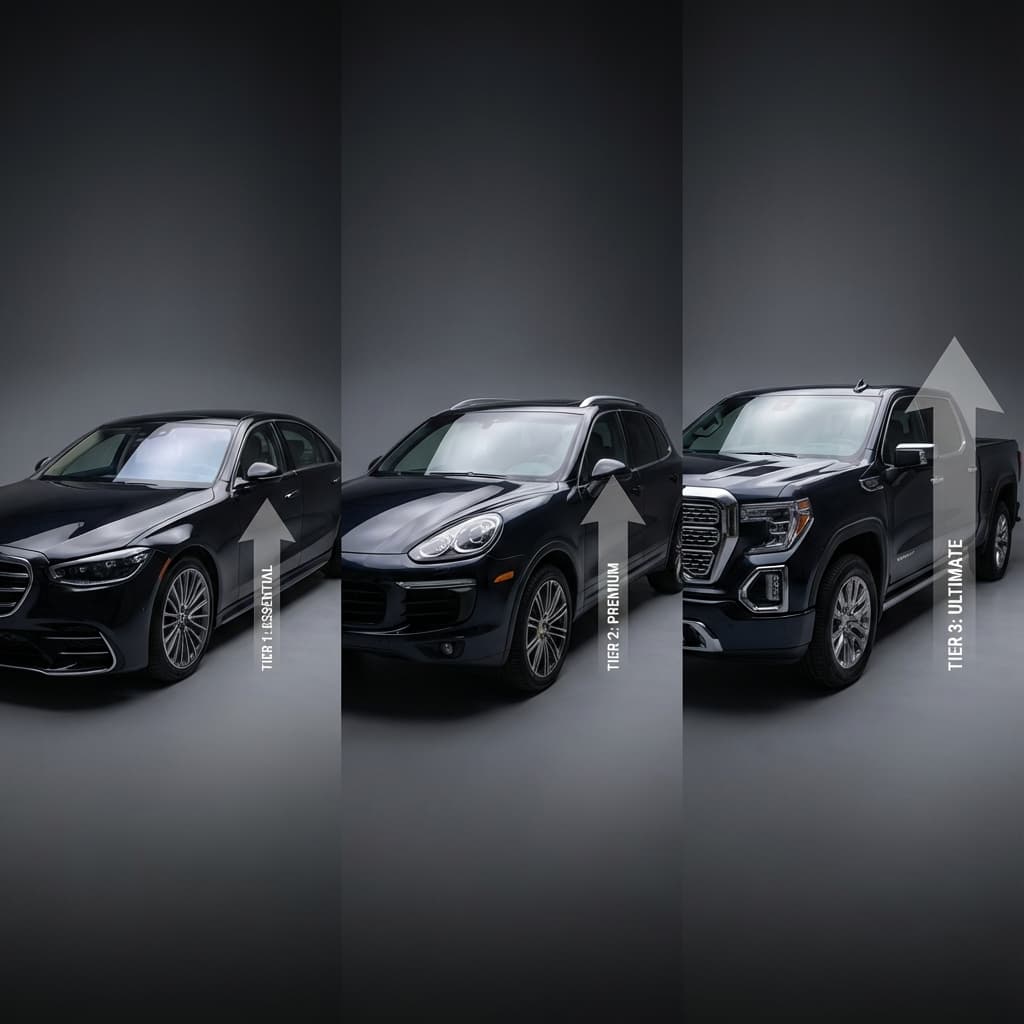
| Essential Defense (ceramic) | Gyeon Q² Mohs (7H) | 1 year | $899 |
| Executive Protection (ceramic) | Gtechniq Crystal Serum (9H) | 4 years | $1,199 |
| Icon Status (ceramic) | Gtechniq Crystal Serum Ultra (10H) | 8 years | $1,699 |
| Graphene-enhanced (Alberta shops) | Various brands (SiO2 + 1–5% graphene oxide) | 2–7 years | $1,200–$2,200 |
| Partial-Front PPF | Premium 8-mil TPU | 7–10 years | From $399 |
| Full-Front PPF | Premium 8-mil TPU | 7–10 years | $1,499–$2,299 |
| Full-Body PPF (Halo Stack) | Premium 8-mil TPU + ceramic topcoat | 7–10 years | $3,999–$4,999 |
Two observations from the price grid that matter for a Calgary buyer. First, the delta between a top-tier ceramic ($1,699) and a graphene-enhanced package ($2,200) is roughly $500 — nearly the exact spend of a partial-front PPF ($399–$500) or a wheel ceramic ($350–$500 on-car). The honest recommendation nine times out of ten is put that graphene delta into physical protection instead of stronger chemistry. Second, the full-body PPF Halo stack at $3,999–$4,999 buys the same total protection surface as buying premium ceramic three times over ten years, at roughly the same total spend — with the added benefit of stone-chip immunity. Full pricing detail in our 2026 PPF cost breakdown.
When To Pick Which — Or Both
The Pros
- Ceramic alone: light-coloured garage-kept car, low-highway commute, budget under $1,000 — Gyeon Q² Mohs at $899 delivers 90% of the visual benefit at 50% of the top-tier price
- Graphene alone: black or dark-metallic outdoor-parked car in summer, owner values the anti-static and cooler-surface behaviour, budget stretches to $1,500–$2,000
- PPF alone: high-highway commute (Deerfoot, Stoney, 16 Ave), new vehicle where preserving factory clear coat is priority #1, budget starts at $399 partial or $1,499 full front
- Ceramic + PPF Halo stack: winter-first daily driver, luxury or performance vehicle, 10-year hold plan — this is the combination we install on 60%+ of pre-winter customers
- Graphene + PPF Halo stack: same as above but on a dark daily driver where the anti-static / cooler-surface behaviour will show its value
The Cons
- Ceramic OR graphene ALONE on a winter-first daily driver — either coating fails the physical-protection test on Deerfoot and does nothing for rock chips
- PPF ALONE without a topcoat — the film itself is protected, but the film surface still collects brine residue that a coating would sheet off
- Chasing "10H" graphene marketing without checking the warranty length — a 2-year graphene at $1,800 is worse value than a 4-year Gtechniq Crystal Serum at $1,199
- DIY graphene spray products layered over a professional coating — silica-to-graphene mismatch causes streaking and adhesion failure
- Installing any coating in an unheated bay in November-January — cure fails at substrate temperatures below 10 C
The Fall 2026 Booking Timeline — Working Backwards From Oct 1 Brine
Every product on this list installs and cures in warm conditions. Every product on this list has to be on the vehicle BEFORE the first calcium-chloride brine truck rolls, because any pre-existing brine contamination locks under whatever you install on top. Work backwards from October 1 and the schedule is tight but doable in the September window.
Book Your Slot
By Sep 1–7Fall PPF slots fill first — book by early September for a late-September install. Coating-only appointments have more availability but the same weather constraint applies.
Pre-Install Decon Wash
Sep 15–25Full iron and tar decontamination, clay-bar the paint. Any existing brine or salt residue lifted off now, before it gets sealed under film or coating for the film life.
PPF Install (Day 1)
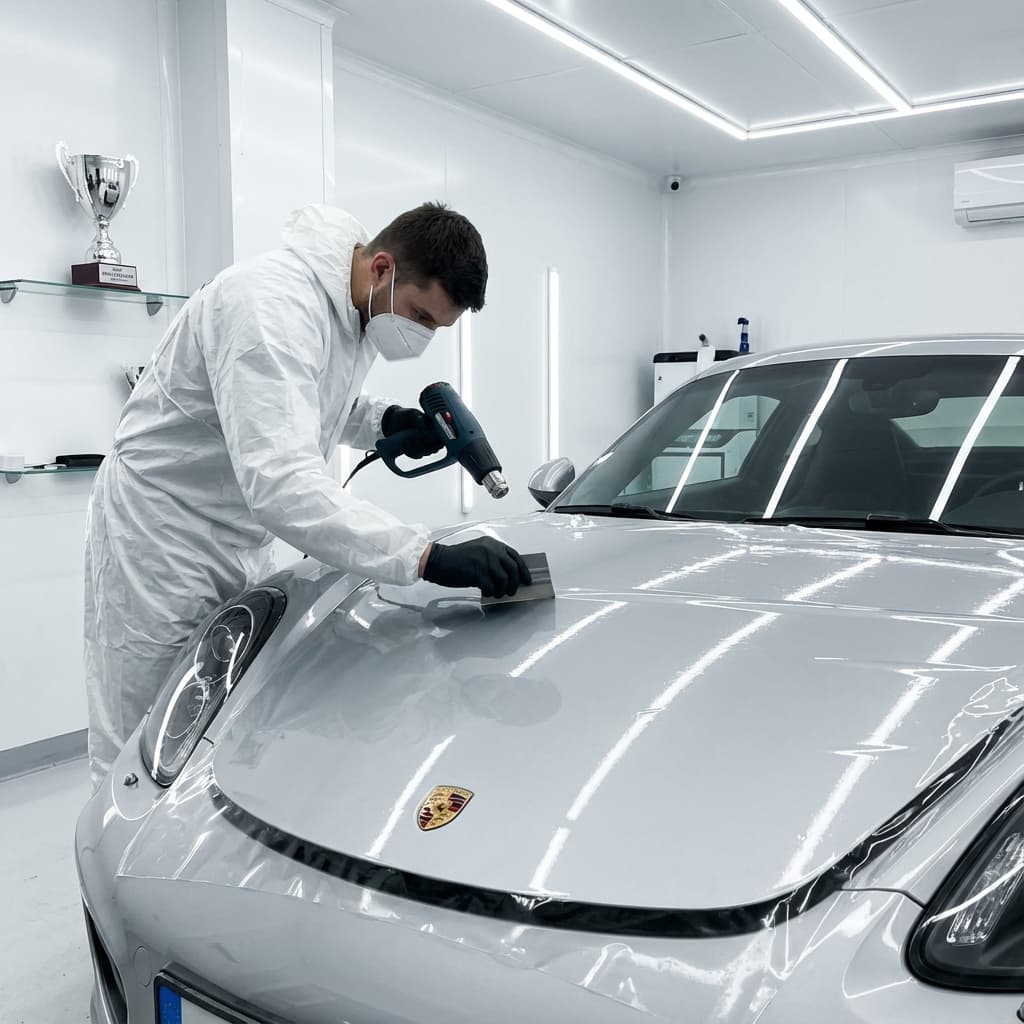
Sep 22–29Full-front PPF on hood, fenders, mirrors, A-pillars, rocker panels. Cured under IR lamps to accelerate initial tack, released to owner at end of day.
PPF Initial Cure (24–48h)
Sep 23 – Oct 1Surface water OK at 24 hours, no wash for 7 days on body PPF. Full cure schedule in our companion cure-time post — the important number is 24–48h before coating can go on top.
Ceramic or Graphene Topcoat
Sep 24 – Oct 2Coating applied over cured PPF and remaining bare panels. Substrate temperature 15–25 C required. 24 hours no water, 7 days no wash, full chemistry cure at 30 days.
First Brine Truck
Oct 1–7Historical first-week-of-October start on Deerfoot, Stoney, 16 Ave. The full stack is now cured and on the vehicle before that first pass — every winter commute after this is protected.
Winter Maintenance Rinse
Oct – AprilPlain-water touchless rinse every 7–14 days through the brine season keeps the coating hydrophobic and the PPF surface free of embedded grit. Never automatic-brush at any age.
If you are reading this in mid-September and have not booked, you have roughly two weeks before the fall PPF calendar closes for pre-brine installs. Our full month-by-month view lives in the Calgary 2026 PPF booking calendar. If you are reading this in October or later, the coating side of the stack can still install in a heated bay — but the pre-install decon step becomes more important because brine has already deposited.
The Traps — Where the Coating Comparison Goes Sideways
Every one of these is a real conversation we have had with a Calgary customer at quote time this year. Every one is preventable.
The "graphene is just better ceramic" trap
Owner sees a 10H marketing badge on Instagram and assumes it renders ceramic obsolete. Reality: pencil-hardness tests top out at 9H, the "10H" number is a modified Mohs scale, and the actual delivered performance difference in Calgary is 5–8 C cooler surface temperature and better anti-static, not "twice as hard." Fix: read the warranty length, not the H rating.
The "coating replaces PPF" trap
Owner picks a $1,800 graphene package over a $1,499 full-front PPF because it "lasts longer." First Deerfoot commute delivers a chip through the coating into the clear coat. Fix: coatings and PPF do different jobs. PPF stops chips; coatings prevent chemical etching and add gloss. Pick one for each job, not both from one category.
The "install any time it's warm inside" trap
Owner books a coating for late November because the shop has a heated bay. Install and cure work fine mechanically. But the vehicle drove through 3–5 weeks of anti-icing brine on the way to the appointment and the coating seals that chloride contamination under itself for the coating life. Fix: book coating for late September, or accept a full multi-stage decontamination wash before install.
The "DIY graphene spray on top of pro ceramic" trap
Owner spends $1,200 on a pro ceramic install, then buys a $60 Amazon "graphene spray" to boost it between washes. Different silica-to-graphene ratios cause the spray to streak, spot-bead, and eventually etch the professional coating from underneath. Fix: use ONLY the shop-recommended pH-neutral quick detailer, never a hybrid spray, on top of a professional coating.
The "cheap graphene, no shop history" trap
A new shop opens offering "10H graphene" at $699 — well below the industry price band. What is missing: warranty registration with an established brand, provable installer certification, and any 5-year customer history to verify longevity. Fix: buy from a shop that has been installing the same coating line for at least 3 years and can show cured customer vehicles from year 3 onward.
The "skipped the decon wash" trap
Coating installed over an unwashed or lightly-washed panel with residual iron fallout from brake dust or road grit. The coating seals the contamination in and it etches from underneath, showing as brown pinpoint spots at year 1. Fix: full iron + tar decon plus a clay-bar pass is non-negotiable — same standard our <Link href="/post/how-to-prepare-car-for-ppf-installation" className="text-primary-600 dark:text-primary-400 underline hover:no-underline">PPF prep guide</Link> covers on the film side.
The "only coating, no maintenance" trap
Owner spends $1,699 on Icon Status ceramic and never books a maintenance top-up or does the 2–3 week pH-neutral wash routine. Coating rated for 8 years fails hydrophobically at year 3. Fix: the coating warranty is conditional on documented maintenance — see the full protocol in our <Link href="/post/ceramic-coating-maintenance" className="text-primary-600 dark:text-primary-400 underline hover:no-underline">ceramic coating maintenance guide</Link>.
Bottom Line — What We Actually Recommend
Graphene coating is a real technical improvement over pure ceramic in three narrow ways: anti-static behaviour, lower solar-gain surface temperature, and slightly better cold-flex through chinook cycles. It is not a replacement for ceramic, and it is emphatically not a replacement for PPF. In Calgary 2026 pricing the graphene delta over top-tier ceramic runs $300–$500, which is almost exactly the price of a partial-front PPF or a wheel ceramic package — and those physical-protection dollars deliver measurably more damage prevention per dollar than the graphene chemistry upgrade would.
For the winter-first Calgary daily driver, the honest playbook is: full-front PPF on the hood, fenders, mirrors, A-pillars, and lower rockers, plus a ceramic or graphene topcoat over the whole vehicle. Book by early September, install by late September, first brine truck rolls Oct 1 with the full stack cured and in place. On a 10-year hold, that combination typically saves $3,000–$8,000 in chip touch-ups, clear-coat blends, and reconditioning versus a bare-paint or single-product approach — and preserves the resale premium we quantified in our PPF resale value breakdown.
Cross-shopping quotes right now? Talk to our Calgary ceramic coating studio or PPF team about the fall-stack bundle discount. If graphene specifically matters to you (black paint, outdoor parking, summer heat), ask about the graphene-enhanced topcoat over PPF — it is the one configuration where the chemistry premium delivers measurable Calgary-condition value.
Related Reading
The Halo Package (PPF + Ceramic)
The two-layer stack we install most often on winter-first Calgary customers — how PPF and ceramic actually complement each other on the same panel.
Ceramic Brand Comparison (Gtechniq vs CarPro vs Ceramic Pro)
Deeper cut on the pure-ceramic side of the decision — brand-by-brand warranty length, hardness ratings, and Calgary installer availability.
Calgary 2026 PPF & Coating Booking Calendar
Month-by-month view of when to book what — plus the fall-stack coordination window with the winter tire swap and the Oct 1 brine deadline.
Get the Full Winter Stack On Before Oct 1 Brine
Fall install slots are filling for late September. Bundle PPF with a ceramic or graphene-enhanced topcoat in one shop visit — cured before the first brine truck, protected through the winter. Ask about the fall-stack bundle discount.
Frequently Asked Questions
Experience The Best.
Don't let another commute compromise your vehicle. Get a quote from Calgary's Consumer Choice Award winner today.
Explore Our Services