Mudflaps vs Rocker Panel & Rear-Fender PPF in Calgary: The Deerfoot Gravel-Storm & Brine-Spray Math That Decides Your $60 vs $650 Winter (2026)
Mudflaps and rocker-panel PPF are not the same product and they do not solve the same problem — a $60 pair of Husky flaps deflects 40–65% of the gravel and brine spray thrown by the front tire, but 100% of what the rear tire kicks up still lands on the rear-fender arch, and none of it stops the calcium-chloride brine that wicks into the pinch-weld seam. The honest Calgary math: mudflaps CA$50–$140 plus rocker + rear-fender PPF at CA$449–$799 (or CA$799–$1,099 with the rear-quarter-arch and door-cup combo) prevents CA$3,000–$8,000 of body-shop repair and resale hit across four Deerfoot winters. Book the install between Sept 22 and Sept 30 so the film hits functional cure before the City of Calgary's Oct 1 first-brine day on Deerfoot, Stoney, Glenmore and 16 Ave N. Applies to every daily-driver truck, SUV, and sedan running Calgary highways.
Every October a Calgary truck owner walks into our bay for a rocker-inspection quote on a three-year-old F-150 or Silverado and, halfway through the walkaround, points at the leading edge of the rocker behind the front tire and says some version of "I bought the mudflaps — why is it still chipped like this?" The honest answer is that mudflaps are a pre-filter, not a solution, and nobody at the dealer walked them through the physics of what a mudflap actually stops versus what a plotter-cut piece of Calgary rocker + lower-body PPF stops. This post is that conversation in full — the tire-throw trajectory that decides where every chip lands, the calcium-chloride brine chemistry the City starts pumping onto Deerfoot on Oct 1, the real Calgary body-shop invoice math for a rocker that goes four winters unprotected, and the September booking window that separates a lower-body panel that lasts to trade-in from one that loses CA$3,000 of resale.
Rocker panel and rear-fender PPF is the most under-quoted line item in the Calgary protection catalogue — every truck, SUV and family crossover that comes through our bay for a full-front quote has a rocker that will eat gravel and brine for the next five winters, and roughly seven out of ten of those quotes leave the shop without the rocker line added. That gap is what this post exists to close. Calgary is not a mild-winter market. The City runs a direct-liquid calcium-chloride brine program on the eight highest-traffic corridors — Deerfoot, Stoney, Glenmore, 16 Ave N, Crowchild, McLeod, Blackfoot, and the ring-road on-ramps — from the first week of October through the first week of April, and Alberta Transportation runs a limestone-and-quartz gravel-aggregate application on the same corridors from April through September. The lower 15 cm of every daily driver on those roads is under mechanical attack for six months a year and chemical attack for the other six. The film is the boring, one-time, high-ROI fix.
Reviewed by Calgary PPF Pros — 4× Consumer Choice Award winner, protecting Calgary vehicles since 2021, 5.0★ rated across 90 verified reviews.
The Tire-Throw Physics: Why Mudflaps and PPF Solve Different Halves of the Same Problem
The single most useful diagram in this decision is the trajectory of a piece of loose gravel or brine droplet as it leaves the tire — because the trajectory decides which zone gets hit, and a shop trying to sell you either a mudflap OR a rocker PPF without walking you through it is selling half a solution. There are four distinct spray vectors on a Calgary daily driver and they land on four different zones of the lower body.
- Front-tire-to-rocker leading-edge throw. The front tire flings loose material at a 40–60° arc back and outward toward the rocker panel behind the wheel. A mudflap intercepts roughly 40–65% of this arc — the exact percentage depends on flap length, flexibility, and how the mudflap is mounted (rigid steel bracket flaps outperform floppy rubber flaps). The residual 35–60% still lands on the rocker leading edge. Both mudflaps AND rocker PPF handle this vector; belt-and-braces is the honest recommendation.
- Front-tire-to-lower-door-cup spray. Fine brine droplets and dust exit the front tire on a nearly horizontal vector and land on the lower door cup handle zone and the leading edge of the rear door. Mudflaps do nothing for this. Only door-cup PPF and lower-door film handles it.
- Rear-tire-to-rear-fender arch throw. The rear tire flings gravel and brine at the same 40–60° arc, and it lands directly on the rear-fender arch above and behind the rear wheel — the exact panel that shows rust bubbling on 5-year-old trucks in Calgary. Rear mudflaps help modestly (they trail the rear tire, not lead it), but the rear-quarter panel above the wheel arch takes the full spray. Only rear-fender PPF handles this vector properly.
- Cross-lane grit and Deerfoot lane-splitter spray. Grit thrown by the vehicle in the adjacent lane at 110 km/h hits the passenger-side rocker at a 15–25° angle, and it hits the mirror cap and A-pillar on the upper body as well. Neither mudflaps nor rocker film alone handles this — it is why full-front-plus-lower-body is the honest Calgary-daily-driver stack.
| Damage Vector | Landing Zone | Mudflap Coverage | Rocker/Rear-Fender PPF Coverage |
|---|---|---|---|
| Front-tire arc throw | Rocker leading edge (30–40 cm behind wheel) | 40–65% deflected | 100% absorbed |
| Front-tire horizontal spray | Lower door-cup + lower-door bottom | 0% | 100% with door-cup add-on |
| Rear-tire arc throw | Rear-fender arch (above rear wheel) | ~10% (rear flap helps trailing) | 100% absorbed |
| Cross-lane / Deerfoot spray | Full rocker length + mirror cap | 10–20% | 100% along filmed panels |
| Pinch-weld brine wicking | Bottom seam + wheel-well lip | 0% | 100% with edge-sealed install |
The Calcium-Chloride Brine Chemistry the City Starts Pumping on Oct 1
Understanding what actually lands on a Calgary rocker in winter changes the mudflap-vs-PPF conversation entirely — because a mudflap deflects a solid piece of gravel just fine, but a mudflap does very little against a fine mist of hygroscopic calcium-chloride brine that wicks laterally along the underbody and then upward into the rocker seam. The City of Calgary Roads maintenance team publishes its snow-ice-salt application schedule starting in the first week of October, and the primary de-icer on Deerfoot, Stoney, Glenmore, 16 Ave N and every ring-road on-ramp is a direct-liquid calcium-chloride solution (a form of pickle brine, cheaper and more effective at lower temperatures than solid rock salt). Two chemistry properties matter for lower-body paint.
- Hygroscopic wetting. Calcium chloride pulls water vapour out of the air and stays wet on painted metal at temperatures well below the freezing point of pure water — as cold as –51 °C in laboratory conditions, and consistently through Calgary's –25 °C to –35 °C cold snaps. That means a brine film deposited on the rocker at 7 a.m. on Deerfoot is still wet at midnight in an unheated driveway, and it wicks into every seam it can find. Bare paint gives it 200+ cm of exposed metal to attack; a filmed rocker gives it a smooth TPU surface that beads and drops.
- Galvanic acceleration. Calcium chloride is a strong electrolyte, and the pinch-weld seam on modern trucks and SUVs is a bonded aluminum + steel dissimilar-metal joint (F-150 has an aluminum body on a steel frame; Silverado and Ram are aluminum tailgate and hood over steel elsewhere; Ram Rebel and TRX have aluminum lower rockers). Brine at that seam accelerates galvanic corrosion by roughly a factor of 4–7× versus dry air. Blog 93 covers the salt chemistry in more depth for readers who want the full mechanism.
For the panel-agnostic version of the same chemistry, our companion post on why calcium-chloride brine attacks Calgary rocker seams walks through the freeze-thaw wicking cycle and the timeline from first-year matte-look to year-four rust bleed. Every truck-specific vehicle guide on our site — F-150 rocker + door-cup coverage, Silverado & Sierra 1500 rocker-package guide, and the Ram and Toyota half-ton posts — folds the rocker package into a Calgary-daily-driver recommendation for that specific vehicle.
The 4-Winter Damage Cost Table — Real Calgary Body-Shop Invoices
This is the table we walk every Calgary rocker-quote customer through at the counter. Numbers are from Calgary body-shop invoices we see cross the desk through warranty consults, post-purchase inspections, and trade-in pre-sale reconditioning quotes — and they compound because each year's damage becomes the substrate for next year's brine wicking.
| Winter # | Damage Signature | Repair Route | CA$ Cost (both sides) |
|---|---|---|---|
| Year 1 | Chip cluster on rocker leading edge, matte look in raking light | Cosmetic only, no action | $0 |
| Year 2 | 20–40 chips through clear coat exposing base coat | Professional touch-up, no blend | $360–$520 |
| Year 3 | Micro-fractures at pinch weld, first iron bleed visible | Partial rocker respray + door blend | $1,600–$2,800 |
| Year 4 | Rear-quarter arch bubbling, rust wicking past seam | Full rocker + partial-quarter respray + rust remediation | $3,600–$7,000 |
| Year 4 resale hit at trade-in | Documented rocker damage flagged at appraisal | Deducted from trade value | +$1,500–$4,000 loss |
| Rocker + rear-fender PPF, year 1 | Zero damage across all 4 winters | One-time install, transferable warranty | $799–$1,099 (one-time) |
Aggregate: CA$3,000–$8,000 in 4-year body-shop exposure plus resale hit, versus CA$799–$1,099 one-time rocker + rear-fender PPF installed in year one. That is a 3× to 7× return — and unlike a paint touch-up warranty, the PPF warranty is transferable at resale (10-year manufacturer coverage on XPEL Ultimate Plus, STEK DYNOshield, and 3M Pro Series films), which is why appraisers add CA$1,000–$2,500 back to the trade value on a documented full-lower-body PPF vehicle. Blog 197 walks the resale math in full for readers already inside the trade-in decision.
Rocker PPF Coverage Options — Puck, Skin, or Full Lower-Body Stack
Not every Calgary vehicle needs the same coverage. The decision is driven by the vehicle's highway exposure, whether the owner ever leaves pavement, whether it will be kept past 5 years, and — for trucks — whether the tailgate ledge and bed-rail see any load abrasion. Three coverage tiers cover roughly 95% of Calgary rocker quotes.
| Coverage Tier | What It Includes | Best For | Installed (CA$) |
|---|---|---|---|
| Rocker-only strip | Rocker panel, both sides, 4–6" tall, pinch-weld to door bottom | City-only sedans and crossovers, garage-kept | $449–$649 |
| Rocker + rear-fender arch | Rocker + vertical rear-quarter above rear wheel, both sides | Daily-driver SUVs and crossovers on Deerfoot / Stoney | $649–$899 |
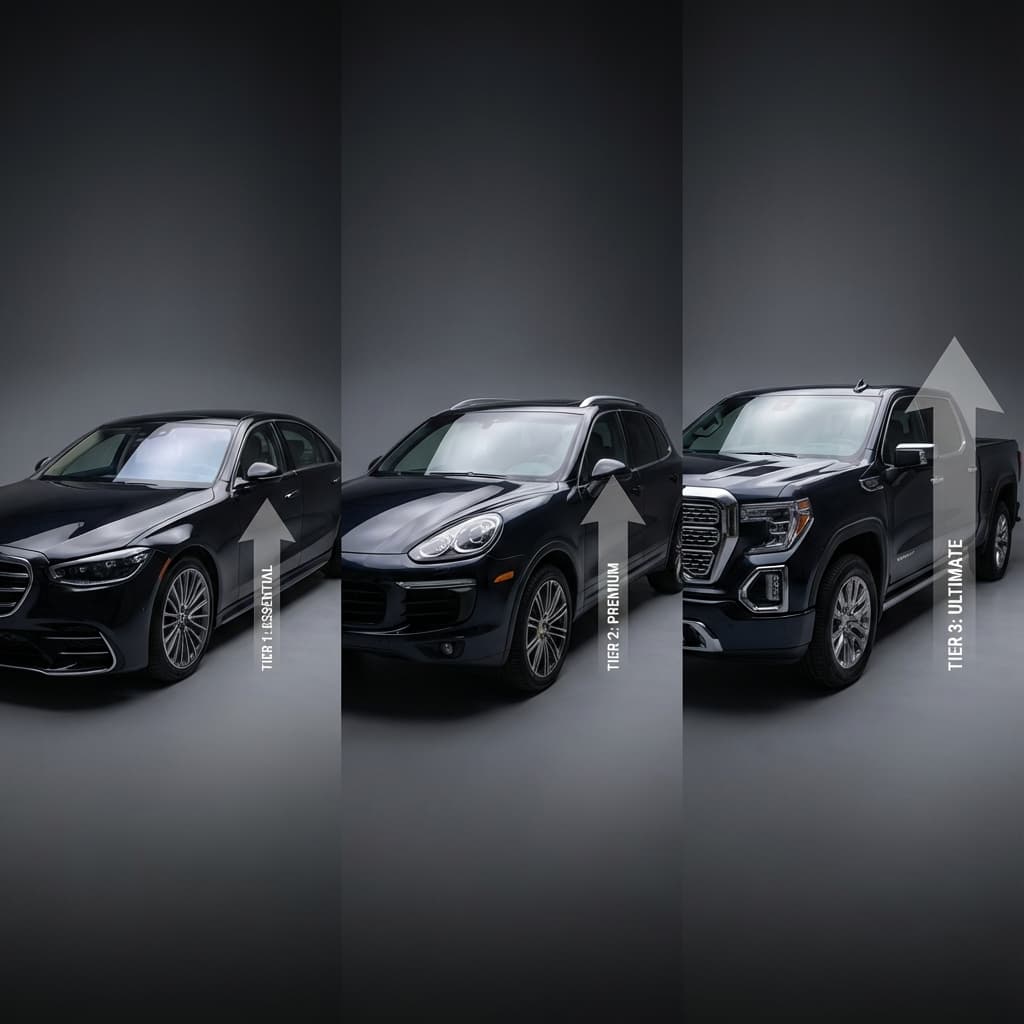
| Full lower-body stack | Rocker + rear-fender + lower door + door-cup + tailgate ledge (truck) | Half-ton trucks (F-150, Silverado, Ram, Tacoma, Tundra), off-road SUVs | $799–$1,099 |
| Full-front + full lower-body combo | Above + full-front hood/bumper/fender PPF at same install | Highest-ROI stack for keep-to-trade-in owners | $2,299–$2,899 |
The September Booking Sequence — Beat Oct 1 Brine Day by 14 Days
The scheduling sequence matters as much as the coverage decision. Book too late and the film is installing over a brine-contaminated substrate (adds decon time and reduces bond life); book before the tire changeover and the wheels-off event becomes a natural first-inspection opportunity. Here is the exact cadence we book every Calgary rocker-package customer against between Sept 15 and Oct 15.
Sep 15–20 — Phone or in-bay quote
Week 1Send phone photos of both rockers (front tire arc angle) and both rear fenders (rear tire arc angle) for a paint-condition read. Confirm coverage tier, vehicle model, film brand (XPEL / STEK / 3M) and firm installed price.
Sep 22–27 — Pre-install decon
Week 2Wash the vehicle thoroughly the day before drop-off (touchless preferred, or a two-bucket hand wash). Do NOT wax, sealant, or coat the lower body in the 30 days before install — PPF acrylic adhesive needs bare clear coat.
Sep 24–30 — Install day (3–5 hours)
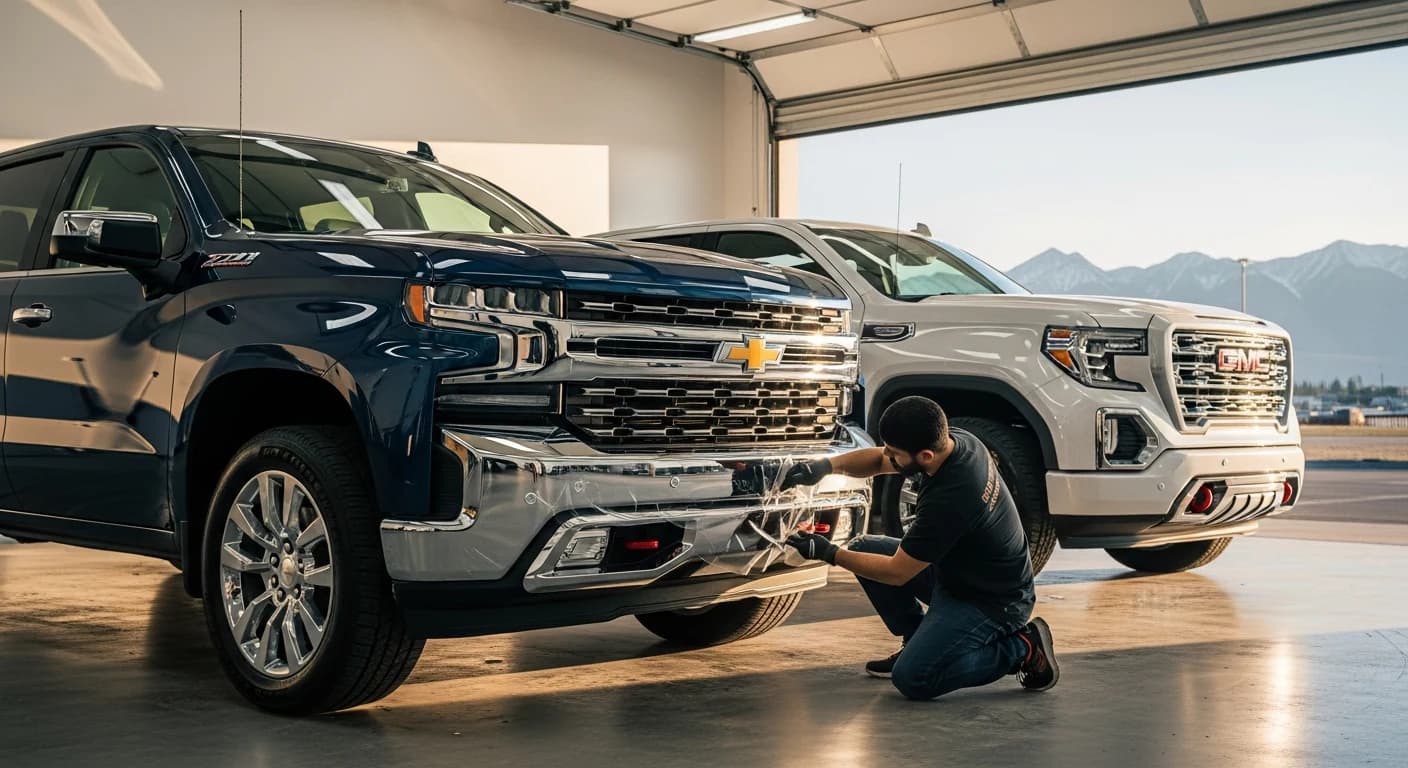
InstallPlotter-cut TPU film applied with IPA prep, edge tension set on wheel-arch curves, heat-set on the pinch-weld seam, plastic-moulding removal and refit where needed. Drive away same day; no car wash for 48 hours.
Sep 25–Oct 14 — Functional cure
CureFilm reaches functional cure at day 7 on aluminum panels, day 14 on painted steel. Drive normally throughout; the film survives gravel and grit from day one. Blog 206 covers first-72-hour chinook adhesion risk.
Oct 1–7 — First-brine day
DeadlineCity of Calgary begins direct-liquid calcium-chloride on Deerfoot, Stoney, Glenmore and 16 Ave N. Filmed rocker is now protected; the film beads brine and the pinch-weld seam stays dry underneath.
Oct 10–25 — Winter tire changeover
BonusAny tire-shop technician stepping on the rocker to lever a bead is doing it on filmed paint, not bare paint. Photograph both rockers before drop-off; see our companion post on winter tire changeover damage for the wheels-off protocol.
If the September window has already slipped, we install indoors year-round in a heated bay — but the September slot is measurably lower risk (no brine-decon add-on) and gives the film a full clean-substrate cure envelope. For a deeper look at the freeze-thaw thermodynamics that make first-72-hour adhesion so sensitive on aluminum rocker panels, see the physics in chinook thermal cycling and fresh PPF adhesion. And if the tire changeover is on the horizon, the wheels-off October tire changeover pre-inspection playbook is the natural companion.
The Calgary Gravel-Storm Exposure Map — Who Actually Needs This
Not every Calgary driver is exposed equally. The rocker + rear-fender PPF break-even math depends on which roads the vehicle sees and how many kilometres per day of that exposure. Rough thresholds we quote at the counter, based on which highways see the heaviest gravel-aggregate and brine passes:
| Driving Pattern | Weekly Exposure | Rocker PPF Priority | Recommended Tier |
|---|---|---|---|
| Deerfoot / Stoney daily commute >25 km/day | High (5–7 days/week brine + gravel) | Highest | Full lower-body stack |
| Glenmore / Crowchild / 16 Ave commute | High (frequent brine) | Highest | Rocker + rear-fender |
| Ring-road on-ramp usage 3–4×/week | Moderate-high | High | Rocker + rear-fender |
| City-only side streets, occasional Deerfoot | Moderate | Medium | Rocker-only strip |
| Off-pavement forestry / Kananaskis / Ghost / McLean Creek | High mechanical (gravel), low brine | Highest | Full lower-body + rock rails |
| Garage-kept weekend car, summer-only pavement | Low | Optional | Ceramic + mudflaps acceptable |
Half-ton trucks in the off-pavement bucket — Ram Rebel, Silverado Trail Boss, F-150 Tremor, Toyota Tundra TRD Pro, Tacoma Trailhunter — are the highest-priority quotes on our board every September. See the Ram, Silverado, and Tacoma/Tundra vehicle-specific posts for the exact tailgate-ledge and door-cup add-on pricing per model, or the F-150 rocker + door-cup coverage money page for the Ford half-ton specifically.
Five Mudflap-and-Rocker Mistakes We See Every Calgary October
Each of these is a conversation we have had at the counter this year. Every one is preventable in ten minutes at the phone-quote stage.
The "mudflaps solve the whole problem" mistake
Buying a CA$140 Husky flap set for a new F-150, feeling protected, then finding a chipped rear-fender arch two winters later that the flaps physically could not reach. Fix: mudflaps are a pre-filter, not a solution. Add rocker + rear-fender PPF or expect the rear-quarter respray.
The "I'll do it in the spring" mistake
Booking rocker PPF for March or April because "the damage happens in winter anyway." Correct — which is why the film has to be on before the winter, not after. A rocker filmed in April is protecting already-chipped paint through the next spring gravel-aggregate season. Fix: book September, install September, done.
The "cheap DIY kit from Amazon" mistake
A pre-cut PVC kit installed over the plastic rocker moulding in an unheated driveway in October. The moulding was never removed, the edge tension was never set, the film lifts in the first chinook, and the residue has to be commercial-solvent stripped before a proper install can go on. Fix: skip the kit.
The "undercoat is enough" mistake
Booking a full underbody oil-spray undercoating and assuming the rockers are covered. Undercoating protects the underside of the pinch weld and the wheel-well liner — it does nothing for the exterior rocker face where the gravel and brine actually land. Fix: undercoating AND rocker PPF are complementary, not substitutes. See our PPF vs undercoating budget priority post for the correct stacking order.
The "wait for the second owner to worry about it" mistake
Skipping rocker PPF on a leased or short-term-hold vehicle assuming the next owner deals with it. Except the appraiser sees the chipped rocker at trade-in and deducts CA$1,500–$4,000 from the trade value, and the lease-end wear-and-tear inspection flags rocker damage as chargeable. Fix: rocker PPF pays back at exit even on a 3-year lease.
What Separates a Clean Rocker PPF Install From a Bad One
The install itself is 3–5 hours; the difference between a shop that does it every week and a shop that does it occasionally shows up at year two, not day one. Six install signals to inspect at pickup.
The Pros
- Plotter-cut precut TPU film (XPEL Ultimate Plus, STEK DYNOshield, or 3M Pro Series) — vehicle-specific pattern, edges land exactly on the door seam without lifting
- Plastic rocker moulding removed and re-tucked over the film — proves the installer worked the pinch-weld properly
- Edge tension set with heat gun on the wheel-arch curve — no ripples, no bubbles, no visible seam at 3-metre viewing distance
- Pinch-weld seam has 6–10 mm of film overlap, heat-set to seal — brine cannot wick under
- Written 10-year manufacturer + minimum 2-year workmanship warranty — transferable at resale
- Post-install care sheet with 48-hour no-wash + 30-day cure timeline (see Blog 196 for full waiting-period cascade)
The Cons
- Hand-trimmed film with visible knife marks along the wheel arch
- Film installed on top of the plastic rocker moulding, not underneath — will peel in first chinook
- PVC or entry-level film that will not self-heal and will yellow inside 3 winters
- Silicone edge sealer applied over the film edge (masks bad edge tension; peels in 90 days)
- Visible ripples or lifting at the wheel-arch curve on day-one inspection
- Verbal warranty only — no written coverage on either film or install labour
How Rocker PPF Fits Into a Full Calgary Protection Plan
Rocker + rear-fender PPF is a targeted fix — the highest-ROI single line item in the lower-body catalogue for any Calgary daily driver — but it is not a substitute for a broader front-end package on a vehicle that also sees Deerfoot gravel storms on the hood and bumper. The math we walk every Calgary customer through: rocker + rear-fender PPF first (CA$449–$799 — the highest per-panel damage-per-year vector), full-front PPF second (CA$1,499–$1,999 — the fix for gravel and rock chips on hood, bumper, fenders, mirror caps, A-pillars), ceramic coating third on top of it all (CA$799–$1,299 — the fix for salt-film adhesion on the un-filmed panels), and an optional oil-spray underbody undercoating fourth (CA$149–$299/yr — the fix for the underside of the pinch weld the film cannot reach). Blog 22 walks the budget-priority decision if the full stack is out of reach. And every Calgary owner already inside the ceramic + coating conversation should cross-reference the Calgary rocker + lower-body PPF packages for how the individual line items combine into a Halo stack.
Book Your Rocker + Rear-Fender PPF Before Oct 1 Brine Day
Send phone photos of both rockers and both rear fenders — we'll come back with a paint-condition read, a spec tier (rocker-only, rocker + rear-fender, or full lower-body) matched to your vehicle and highway exposure, and a firm installed price. Same-day and next-day appointments available through the last week of September. Calgary AB. Consumer Choice Award winner. 5.0★ from 90+ verified reviews. Independent specialist studio.
Frequently Asked Questions
Experience The Best.
Don't let another commute compromise your vehicle. Get a quote from Calgary's Consumer Choice Award winner today.
Explore Our Services